
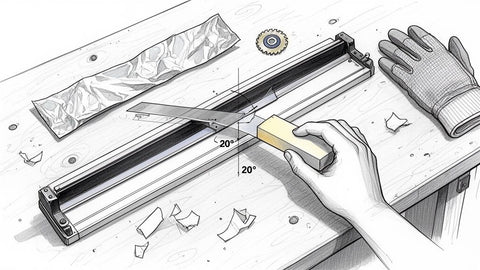
Let's be honest, sharpening a paper cutter blade isn't the most glamorous part of crafting. But whether you're using a quick aluminum foil trick for a touch-up or a sharpening stone for a serious refresh, it's a skill that pays off. The secret is all about keeping the right angle and using smooth, even strokes. Do that, and you'll bring that clean, sharp cutting surface back to life for those perfect, crisp edges we all love.
Why a Sharp Paper Cutter Is a Crafter's Best Friend

Every amazing project, whether it's a precisely pieced quilt or a flawless garment from a custom sewing machine design, starts with one thing: a clean cut. But how many times have you been completely frustrated by frayed fabric, chewed-up stabilizer, or patterns with jagged, messy edges? I see it all the time, and it almost always points back to one sneaky culprit—a dull blade.
In the crafting world, a sharp paper cutter isn't just a nice-to-have; it's your partner in crime for getting professional results. It’s what separates a project that looks truly polished from one that just looks… homemade. Here at bsewinn.com, we believe that empowering crafters means providing not just inspiration for incredible sewing machine designs, but also the fundamental skills to execute them flawlessly. A sharp blade is the foundation of any creative work.
The True Cost of a Dull Blade
A dull blade costs you more than just your patience. It actively fights against you, creating tiny flaws right at the very first step. Think about the last time you wrestled with a cut. Does any of this sound familiar?
- Wasted Materials: Instead of slicing cleanly, a dull edge crushes and chews through materials. This means you’re often forced to recut, wasting your beautiful (and expensive!) fabric and stabilizer.
- Inaccurate Patterns: When the edges of your paper patterns get crushed or torn, it can throw off your fabric pieces. Even a tiny inaccuracy there can mess up the dimensions of your whole project.
- Frayed Edges: For quilters and appliqué lovers, this is a big one. A dull blade pulls and separates threads, leaving you with a frayed mess that’s a nightmare to sew neatly.
This isn't a new problem, by the way. Paper cutters have been around since the 19th-century guillotine designs, and even back then, dull blades were a huge source of waste. It’s a frustration that’s echoed by creators today. In fact, a recent quilting guild survey found that 67% of home quilters said blade dulling was their number one frustration. You can see more on how these tools have changed in this fascinating video history.
At bsewinn.com, our goal is to empower crafters to do their best work. That means giving you the right tools and the knowledge to keep them in top shape, which is why we offer extensive resources, online classes, and training. Learning how to sharpen your paper cutter blade is a core skill that will seriously elevate your craft.
When you take the time for blade care, you're not just doing a chore. You're making a real investment in the quality of all your future projects. Clean cuts are a mark of expertise, and they start long before you even thread your machine. The same principle applies to other tools, too. You can learn more about why sharp tools are so important in our guide on the benefits of rotary cutting.
Should I Sharpen or Replace My Blade?
Before you pull out your sharpening stone, let's figure out if your blade is even a good candidate for saving. Trust me, there's nothing more frustrating than spending time trying to sharpen a blade that's already past its prime. A quick check will tell you everything you need to know and save your future projects from a mangled fate.
The biggest giveaway is always the quality of your cut. A dull blade doesn't slice; it tears and chews its way through. If you’re seeing soft, bruised edges on your paper instead of a crisp, clean line, your blade is crying out for help. This is especially true if you find yourself pushing down harder and harder just to get through the material. A sharp blade should feel almost effortless.
A Closer Look at Your Blade
Sometimes, the cut quality alone doesn't tell the whole story. You’ve got to get up close and personal with the blade itself. A careful visual inspection can spot problems that no amount of sharpening will ever fix.
Here’s what I always check for:
- Nicks and Chips: Carefully run your finger along the back (the non-sharp side!) of the blade. Feel any dents? See any visible chips along the cutting edge? You might be able to hone out a tiny nick, but a bigger one means the blade’s integrity is shot. Time for a new one.
- Rust and Pitting: A few spots of surface rust can often be cleaned off before you sharpen. But if you see significant corrosion or pitting, that metal is weakened. It'll just drag and snag, so it's best to replace it.
- A Rounded, Shiny Edge: A truly sharp edge is so fine it's almost invisible. If you can hold your blade up to the light and see the edge as a rounded, reflective line, it's become far too dull for a simple touch-up. It'll need a serious sharpening session, if it's salvageable at all.
To help you make the call, I’ve put together this quick diagnostic table. It’s a handy reference for whenever your cutter starts acting up.
A Quick Diagnostic Guide to Your Blade's Health
| Symptom | Likely Cause | Recommended Action |
|---|---|---|
| Tearing or fuzzy paper edges | General dullness | Sharpen the blade. |
| Having to apply extra pressure to cut | General dullness | Sharpen the blade. |
| Inconsistent or skipped cuts | A small nick or dent in the blade | Inspect the blade. If the nick is tiny, try sharpening. If it's large, replace it. |
| Noticeable chips or large dents | Impact or cutting inappropriate materials | Replace the blade immediately. Sharpening can't fix this. |
| Rust spots on the blade or cuts | Moisture exposure or humidity | For light surface rust, clean it off and then sharpen. For deep corrosion, replace it. |
| Blade feels "sticky" or drags | Buildup of adhesive or grime | Clean the blade thoroughly. If it still cuts poorly, sharpen it. |
Running through this checklist should give you a clear answer. If your blade just has some general dullness or a bit of gunk on it, a good sharpening will bring it right back to life. But if you're seeing major damage like chips or deep rust, you'll save yourself a world of frustration by just getting a replacement.
A good rule of thumb is if you have to question whether the blade is sharp, it probably isn't. A truly sharp blade leaves no doubt—it cuts effortlessly and perfectly every single time.
Making the right call here is a skill every crafter develops over time. It’s just like knowing which tool to grab for a specific job to get the best results. Speaking of which, if you want to dial in your accuracy even further, you might like our guide on how to use quilting rulers for perfectly straight cuts.
If your blade passed this little health check, fantastic! It's ready for a sharpening session. If not, don't sweat it—a new blade is a small price to pay for perfect cuts.
The Aluminum Foil Trick for a Quick Rescue
We’ve all been there. You’re in the zone, slicing up pieces for a project, maybe getting ready for an upcoming B-Creative class, when you notice your cuts are getting… fuzzy. Your paper cutter isn't slicing anymore; it's just kind of tearing the paper. It’s the worst.
This is exactly when a simple roll of household aluminum foil becomes your secret weapon. Seriously. It’s an old-school trick that can save a project in a pinch.
Now, this isn't a full-blown sharpening job. What you’re actually doing is honing the blade. Think of it less like grinding a whole new edge and more like straightening out the existing one, smoothing out the microscopic dings and burrs that come from regular use.
How to Give Your Blade a Foil Tune-Up
The best part about this is how ridiculously simple it is. You don't have to take anything apart, and it works for both the big guillotine-style cutters and the smaller rotary trimmers. All you need is a sheet of aluminum foil. I’ve found that heavy-duty foil gives slightly better results since it's a bit thicker, but honestly, any kind will do the trick.
Here’s my go-to process:
- Grab a sheet of foil and fold it over on itself several times. You’re aiming for a thick strip with at least six or eight layers. This gives it just enough substance to gently work on the blade’s edge.
- Now, just start cutting. Carefully and deliberately, slice right through the folded foil strip with your paper cutter. If you have a guillotine cutter, I’d make about 10 to 15 full, smooth slices. For a rotary trimmer, just run the blade back and forth across the foil strip about the same number of times.
- Time for the moment of truth. Grab a piece of scrap paper—the same kind you were just having trouble with—and give it a test cut. You should see a noticeable difference right away. The edge will be cleaner and crisper, with much less of that frustrating fuzz.
If it's still not quite perfect, go ahead and repeat the process with a fresh strip of foil. But if a second round doesn’t get you a clean cut, your blade is probably past the point of a quick fix. It’s likely time for a more serious date with a honing stone.
I love the foil method because it’s something anyone can do, right now, with stuff they already have in the kitchen. You're not just sharpening; you're realigning the blade’s fine edge. It’s the perfect emergency fix to get you through a project without losing your momentum.
When to Pull Out This Quick Fix
This is my move for those in-between moments. The blade isn't completely useless, but it’s definitely starting to complain. It’s a great habit to get into before starting any project that needs absolute precision, like quilting or detailed paper crafting.
I find myself reaching for the foil in these situations:
- Mid-Project Meltdown: The cuts are getting sloppy, and I just don't have time to stop everything for a full sharpening session.
- Pre-Class Prep: I'm gathering materials for one of bsewinn.com's online classes and want to make sure my tools are performing at their best. No one wants to fight with their cutter on camera!
- The Finishing Line: I’m trimming the final, critical edges on a quilt or garment and need that perfectly clean, professional-looking cut.
Just remember, this is a maintenance trick, not a replacement for proper sharpening. It's meant to buy you more time between those deeper sharpening sessions and keep your cuts looking sharp. For anyone serious about their craft, knowing a few different ways to sharpen a paper cutter blade means you're always ready for whatever a project throws at you.
Using Honing Stones for a Professional Edge
So, the aluminum foil trick helped in a pinch, but what happens when your blade is seriously dull? When foil just won’t cut it anymore (pun intended!), it’s time to bring out the big guns: honing stones. This is how the pros restore a factory-sharp edge, and trust me, it’s a skill that will save you a ton of money on replacement blades and guarantee flawless cuts every time.
The basic idea is simple: you use an abrasive material to refine the blade's edge and then test your work.

We're just swapping out the foil for sharpening stones to do a much deeper, more restorative job.
This isn’t just about getting a cleaner cut on paper, either. A sharp blade is about efficiency and saving materials. Think it’s a new idea? Not a chance. A 1950s study from the Graphic Arts Technical Foundation found that routine blade maintenance cut printing downtime by a staggering 52%.
Even today, in our own crafting world, a dull blade is a real problem. A 2026 poll from the Quilting Guild International revealed that 73% of its members wasted up to 30% more fabric from ragged cuts. I see it all the time with appliqué pieces and stabilizers—a dull blade just chews them up. Taking a few minutes to hone your blade properly solves all that.
Getting Started with Whetstones
First things first, you have to get that blade off your cutter safely. Every machine is different, so please, grab your user manual and follow its specific instructions. Once the blade is free, you need to clamp it down securely in a vice with the cutting edge facing up. You can’t have it wiggling around while you work.
You’ll want at least two kinds of honing stones (also called whetstones):
- A coarse-grit stone, something around 400-grit, is for the heavy lifting. This will grind out any nicks and reshape the cutting bevel.
- A fine-grit stone—1000-grit or even higher—is for polishing that edge to a razor-sharp finish.
Before you start, add a bit of honing oil or water to your stone, depending on what kind it is. Don't skip this! It floats away the tiny metal particles you're removing, so they don’t clog up the stone and scratch your blade.
Maintaining the Perfect Angle
Here’s the part that really matters: holding a consistent angle. If you get this right, you'll get a beautiful, sharp edge. For most paper cutter blades, that magic number is somewhere between a 20- to 25-degree angle.
The key to a truly sharp edge is consistency. Use long, smooth, even strokes, moving from the heel of the blade to the tip. Imagine you are trying to shave a thin layer off the stone itself.
Grab your coarse stone first. Holding it at that 20- to 25-degree angle, apply steady, moderate pressure and make several passes along the entire bevel. After a handful of strokes, you should feel a tiny ridge of metal—called a "burr"—forming on the opposite side of the edge. That burr is your sign of success! It means you've removed old material and created a fresh edge.
Once you can feel that burr along the entire blade, flip the blade over. Make just a few light passes on the flat side to knock the burr off.
Now, it's time to switch to your fine-grit stone. Do the exact same process all over again, but this time use much lighter pressure. You're no longer grinding; you're polishing the edge to a perfect, almost mirror-like finish.
Finding the right stone can feel like an art in itself. If you really want to dive deep and master this, it's worth learning what makes the perfect knife sharpening stone for your needs.
After one final, super-light pass to remove any remaining micro-burr, carefully wipe the blade clean. Now for the fun part: test it on some scrap paper. The clean, silent slice you get will be all the reward you need.
Keeping Your Blade (and Fingers) Safe
 Getting that perfectly sharpened blade feels incredible, but let's be real—a fresh edge needs to be treated with respect. A dull blade is frustrating, sure, but a razor-sharp one can be downright dangerous if you get careless.
Honestly, knowing how to sharpen your blade is only half the battle. Building a few good safety habits and a simple maintenance routine is what really makes the difference.
These are the little things that keep your tools working like a dream and, more importantly, keep you safe. Here at bsewinn.com, we're all about empowering you with the skills to craft confidently and safely for years to come.
Your Safety-First Checklist
Before you even touch a blade for cleaning or sharpening, you need to run through a quick mental checklist. I treat these steps as absolute must-dos. They've saved me from more than a few close calls over the years.
- Always Wear Protective Gloves. This one's non-negotiable. Get a good pair of cut-resistant gloves. It’s a small investment that provides serious protection. A slip can happen to even the most experienced crafter, and gloves are your best line of defense.
- Good Lighting is Key. I can't stress this enough. Trying to work in a dim corner is just asking for trouble. Make sure your workspace is bright so you can clearly see what you’re doing and where that blade edge is at all times.
- Secure the Blade. Never, ever try to sharpen or clean a blade that's flopping around. Whether it's in a vise or a clamp, make sure it’s locked down tight before you start.
- Push Away, Not Toward. Every single sharpening stroke should move away from your body. It feels a little awkward at first, but it's a simple habit that can prevent a very serious injury if your hand or the tool slips.
The most important tool in your craft room is you. Taking a minute for safety prep isn't a hassle; it’s the mark of a pro. It means you get to enjoy your craft without an unexpected trip to the ER.
A Simple Maintenance Routine for a Happy Blade
A little proactive care will stop most problems before they even start. Instead of waiting for a blade to snag and ruin a project, you can keep it in prime condition with just a few minutes of routine upkeep.
After Every Big Project:
- Wipe it Down. Grab a soft cloth and some isopropyl alcohol and give the blade a quick wipe. This gets rid of any sticky residue, paper dust, and fingerprints. Buildup causes drag and can eventually lead to rust.
- Quick Inspection. Just take a second to look at the edge. See any new nicks or dull spots? Catching them early makes the next sharpening session a whole lot easier.
Monthly or Quarterly (Depending on How Much You Use It):
- Lubricate Moving Parts. For guillotine cutters, a tiny drop of machine oil on the pivot points and lever makes a world of difference. It keeps the action smooth and effortless.
- Check for Rust. Give any stored blades a once-over for any signs of corrosion. If you spot any, clean it off right away before it gets worse.
- Store It Right. Spare blades should live in a blade guard or their own dry box. Never just toss them in a drawer—that’s how they get damaged and how accidents happen. This goes for other tools, too! Proper storage for a rotary cutter is just as important, which you can learn more about in our guide on how to use a rotary cutter.
If you want to dive deeper into blade care across all your tools, the principles are often the same. This guide on mastering saw blade sharpening has some great insights that apply to keeping a sharp edge on almost anything in your workshop.
Common Blade Sharpening Questions Answered
Even after you've walked through the sharpening process, it's totally normal to have a few questions pop up. In my years helping fellow crafters at bsewinn.com, I feel like I’ve heard them all!
Think of this as our little chat about the common "what ifs" and "how often's" of blade care. My goal is to get you feeling confident enough to keep your tools in perfect shape, so every cut you make is crisp and clean.
How Often Should I Sharpen My Blade?
This is the number one question I get, and the honest-to-goodness answer is: it really depends on how much you use your cutter. It's not a one-size-fits-all schedule.
A scrapbooker cutting heavy cardstock every day is going to need to sharpen their blade way more often than someone who just trims printer paper once a month.
The best rule of thumb is to pay attention to your cuts. The moment you start seeing fuzzy edges or find yourself pressing down harder than you used to, it’s time for a touch-up.
Don’t wait until your blade is completely mangling your paper. A quick pass with some aluminum foil every few weeks can make a huge difference and really stretch the time between those deeper sharpenings with a stone.
Can These Methods Damage My Blade?
Oh, absolutely. Improper sharpening can definitely do more harm than good. The biggest mistake I see people make is using the wrong angle or just pressing way too hard.
This can create a wonky, uneven edge or even put a chip in the metal. It’s exactly why I always say to start with a light touch and let the sharpening stone do the work.
If your cutter has a built-in sharpener (some of the big slicers do), make sure you read the manufacturer's instructions carefully. Some of those systems are a little particular and require you to sharpen the front and back of the blade separately to prevent damage.
A few key things to remember:
- Stick to the Angle: Really focus on maintaining that consistent 20-25 degree angle.
- Let the Stone Work: Use light pressure. You're honing, not grinding.
- Check Your Manual: If you have a built-in system, get to know how it’s supposed to work before you use it.
Will Sharpening Work on Specialty Blades?
The techniques we've gone over are fantastic for your standard, straight-edge guillotine and rotary blades. But they aren't meant for every blade out there.
If you have blades with special coatings (like that pretty gold titanium nitride) or decorative edges like scallops or pinking shears, you'll need specialized tools.
Trying to sharpen these with a regular whetstone is a surefire way to ruin that unique edge. Always check what the manufacturer recommends first. When in doubt, it’s almost always safer—and more effective—to just buy a replacement. Those blades are engineered differently, and home sharpening is a quick way to damage them for good.
Here at bsewinn.com, we believe that having the right skills is just as important as having the right tools. From top-tier sewing and cutting equipment to the hands-on training you need to use it like a pro, we're here to support your creative journey every step of the way. Explore our resources and see how we can help you get those professional-level results you're looking for.

