
If you’ve ever tried to quilt anything bigger than a lap quilt on your home sewing machine, you know the struggle. It’s like trying to stuff a sleeping bag into a pillowcase—a battle of pushing, pulling, and wrestling that heavy, bulky fabric through that tiny space.
A long arm quilting machine completely changes the game. It’s a genuine upgrade for any quilter ready to finish their own projects with way less hassle and way more fun. At B-Sew Inn, we're dedicated to empowering crafters like you, not just by providing the best tools, but by teaching you how to bring your creative visions to life with them.
What Is a Long Arm Quilting Machine?
Think about the difference between drawing in a small sketchbook versus painting a mural on a wall. That's the leap you make when you move to a long arm. Instead of you moving the quilt around, the machine’s head moves freely over your fabric, which is stretched perfectly taut on a large frame.
This one simple change makes finishing a quilt feel less like a workout and more like an art form. It’s a fluid, creative, and honestly, a much more enjoyable process.
This is where the magic happens for beginners and experienced quilters alike. You can finally create those gorgeous, sweeping curves and intricate patterns you see online. You’re no longer fighting the fabric, so all your energy can go into bringing your design to life. The machine does all the heavy lifting for you.
The Core Concept of Long Arm Quilting
At its heart, a long arm breaks down the quilting process into two simple parts:
- The Stationary Quilt: Your quilt top, batting, and backing get loaded onto rollers on a big frame. This creates a perfectly flat, tensioned canvas to work on.
- The Movable Machine: The machine's head is mounted on a carriage that glides effortlessly over the quilt. You guide it with handles, essentially drawing your quilting designs with the needle and thread.
One of the best parts? This whole setup means you can say goodbye to basting your quilt layers together. No more crawling around on the floor with pins or dealing with sticky spray adhesive. For anyone who has spent hours pinning a king-sized quilt, this feature alone is a total game-changer.
Unlocking Your Creative Potential
The biggest benefit for someone just getting into long arming is the immediate boost in both confidence and capability. All that frustration of wrangling fabric just vanishes. It’s replaced by a smooth, intuitive motion that feels more like sketching than sewing. You’re no longer limited by the small workspace of your domestic machine.
A long arm quilting machine gives you the space and control to finally stitch out the designs you’ve been dreaming of. It lets you finish your own projects with a truly professional touch, turning those quilt tops into treasured family heirlooms.
With a long arm, you can finally pull that queen or king-sized quilt top out of the closet and get it finished. Here at B-Sew Inn, we're all about helping you start this exciting journey. We don't just sell machines; we offer the custom support, online classes, and training you need to feel successful from your very first stitch. To dig a little deeper, you can learn more about what longarm quilting is and see how it can completely elevate your craft.
Choosing the Right Type of Long Arm Machine
Once you start exploring the world of long arm quilting, you’ll quickly realize they come in a few different flavors. Making the right choice isn't just about bells and whistles; it’s about finding the perfect partner for your creative space, your budget, and how you dream of quilting. The main options you'll run into are stand-up models on a frame, sit-down models, and mid-arm machines.
Each one offers a totally different quilting experience. A stand-up machine on a big frame is the classic setup that gives you the most freedom. Imagine standing at a huge canvas, brush in hand—that’s the feeling of gliding the machine head over your quilt. On the flip side, a sit-down model feels a lot more like traditional sewing, where you move the fabric instead of the machine.
This is often the first big fork in the road for a new long arm quilter. This decision tree can help you visualize which path might be the best fit for your specific goals and home setup.
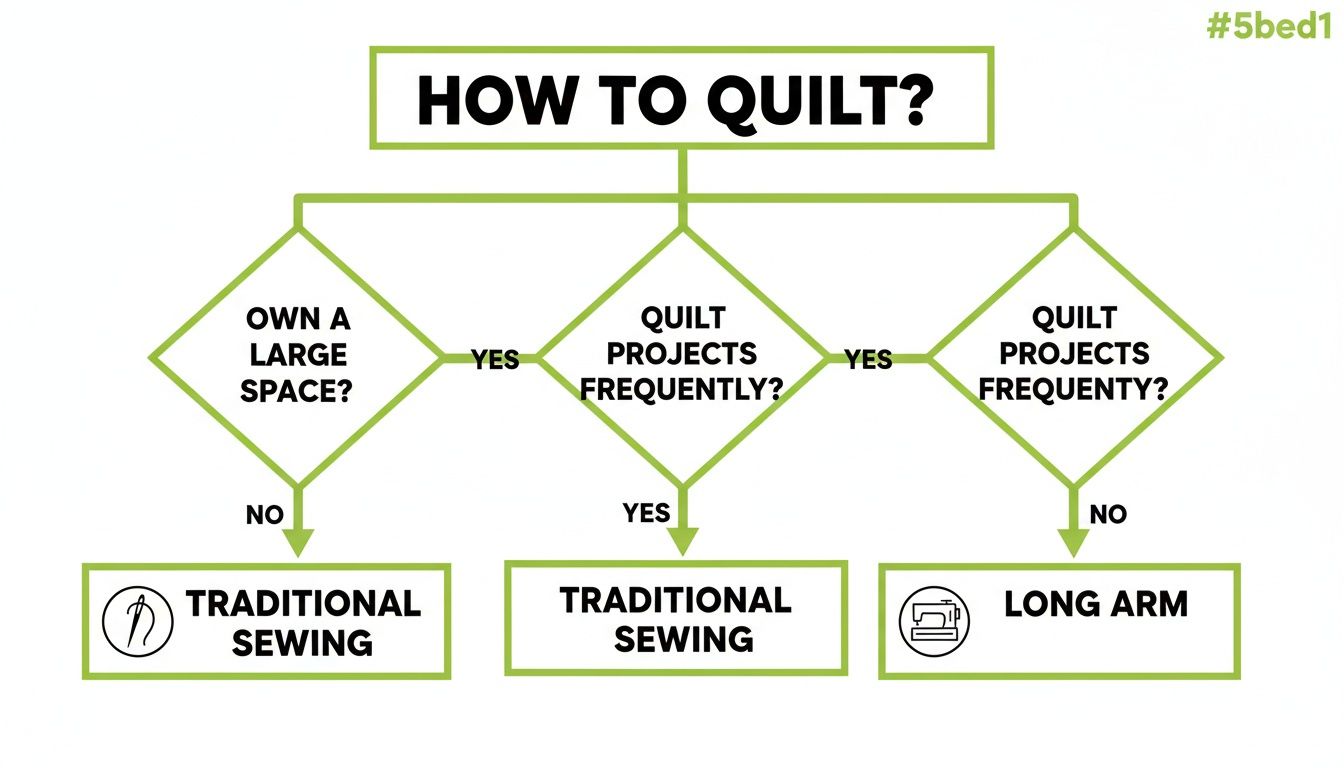
As the chart shows, while you can create beautiful quilts either way, the long arm approach is perfect for anyone tackling bigger projects who wants to move the machine, not wrestle the quilt.
Stand-Up Long Arm Machines
The stand-up model is what most people picture when they think of a long arm. The machine head sits on a carriage that glides along a huge frame, which holds your quilt layers perfectly taut.
- How It Works: You stand and guide the machine from the front or back using handlebars, basically "drawing" your quilting designs across the stationary fabric.
- Best For: Quilters with a dedicated studio space who want to finish large quilts (queen or king size) with ease and create those intricate, free-flowing patterns.
- Space Requirement: This is the big one. A typical 10-foot frame needs a room that's at least 12-14 feet long to give you enough space to walk around it comfortably.
This setup is the go-to for achieving professional-level results and is the top choice for quilters who might want to quilt for others someday. Being able to see your entire work area at a glance is a huge advantage for complex designs.
Sit-Down Long Arm Machines
A sit-down long arm gives you the power and generous throat space of a long arm but in a stationary format, much like your everyday sewing machine. It sits in a specialized table, and you move the quilt sandwich under the needle.
- How It Works: You sit at the machine and manually guide the fabric. The massive workspace makes it way less of a struggle than bunching up a quilt on a standard sewing machine.
- Best For: Crafters with limited space or those who just prefer the familiar feeling of sitting and moving the fabric. It’s a fantastic step up from a domestic machine without having to commit to a full frame system.
- Space Requirement: The footprint is much smaller, usually needing a space similar to a large desk or craft table.
These models are great for building confidence and quilting larger projects without dedicating an entire room to a frame. If you're curious about computerized options, which are available for both stand-up and sit-down models, check out our guide on the longarm computerized quilting machine.
Mid-Arm Machines
Mid-arm machines are a hybrid, offering a sweet spot between the two main types. They have a throat space that's bigger than a home sewing machine but smaller than a full-sized long arm, typically falling between 15 to 18 inches. They can often be set up for either sit-down use or placed on a smaller, more compact frame.
Comparing Long Arm Machine Types for Beginners
Deciding between these options really comes down to your personal quilting style, budget, and the room you have to work with. Here's a quick breakdown to help you compare.
| Machine Type | Space Requirement | Budget Range | Best For | Quilting Motion |
|---|---|---|---|---|
| Stand-Up Long Arm | Large (dedicated room) | $$$ | Large quilts, professional results | Move the machine over the fabric |
| Sit-Down Long Arm | Medium (large table) | $$ | Quilters who prefer traditional sewing motion | Move the fabric under the needle |
| Mid-Arm Machine | Small to Medium | $-$$ | Versatility and transitioning from a domestic machine | Can be either (sit-down or small frame) |
Ultimately, the best machine is the one that gets you excited to finish your quilts. Whether you’re standing and gliding or sitting and guiding, you're taking a huge step toward bringing your creative visions to life.
Essential Features for a Beginner Machine
When you first start looking at long-arm quilting machines, the list of technical specs can feel like reading a foreign language. It's easy to get overwhelmed! Let's cut through the noise and focus on what really matters for a smooth, joyful quilting experience. Knowing what these core features actually do will help you find a machine that builds your confidence, not your confusion.
The journey into long-arm quilting is an exciting one, and you're in great company. The quilting world is booming, with a solid base of 9-11 million quilters in the U.S. alone. We're seeing a huge wave of new faces, too—a recent survey showed that 18% of quilters were new to the craft, a big jump from just 11% the year before. This growing community means manufacturers are focused on making user-friendly machines, and at B-Sew Inn, we specialize in matching new quilters with their perfect starter model. You can learn more about the quilting market's recent growth and see why it’s such a great time to jump in.
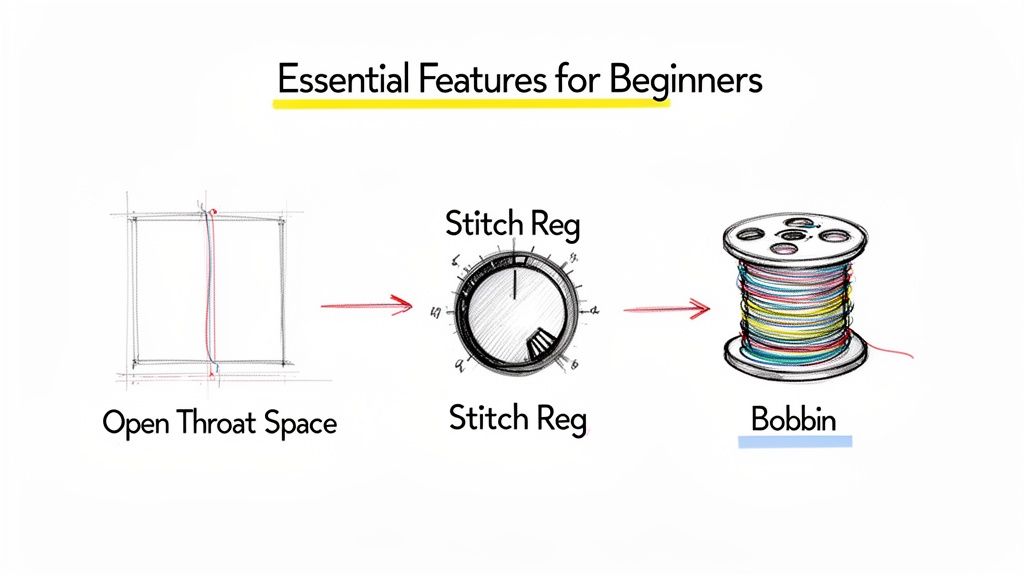
Understanding Throat Space
One of the first specs you'll see listed for any long arm is throat space. This is simply the distance between the needle and the back of the machine's "throat," or arm. Think of it as your creative workspace—the bigger the throat, the more quilt you can roll up and still have plenty of room to stitch your designs.
A regular sewing machine might only have 6-9 inches of throat space, which is why you're constantly bunching and wrestling your quilt. Long-arm machines give you so much more breathing room:
- Mid-Arm Machines: These usually offer 15-18 inches of throat space. It's a massive upgrade that's great for lap quilts and even smaller bed-sized quilts without much struggle.
- Full-Size Long Arm Machines: These often boast 20 inches or more. This massive area lets you stitch wide, sweeping patterns with ease and handle huge sections of a king-sized quilt before needing to advance it on the frame.
For a beginner, a machine with at least 18-20 inches of throat space hits a sweet spot. It gives you more than enough room to grow your skills without ever feeling boxed in.
The Magic of Stitch Regulation
If there's one feature that's a total game-changer for beginners, it’s stitch regulation. Think of it as cruise control for your quilting. A stitch regulator is a sensor that knows how fast you're moving the machine head and automatically tells the motor to speed up or slow down to match.
The result? Perfectly even, consistent stitches every single time. It doesn’t matter if you're zipping along a straight line or slowing down for a tricky curve, your stitches stay the same length. This is a huge confidence booster because it eliminates the steep learning curve of trying to sync your hand speed with a foot pedal. You get to focus purely on your design.
A stitch regulator takes the guesswork out of quilting. It ensures your work looks professional from the very first pass, allowing you to focus on creativity instead of worrying about tiny, choppy stitches or long, uneven ones.
The Importance of a Good Bobbin System
The bobbin is basically the fuel tank for your quilting machine, and trust me, you’ll go through a lot of thread! Having to constantly change the bobbin can really break your creative flow, so the bobbin system is a bigger deal than you might think.
Most long arms use either an "L" size bobbin or the much larger "M" size bobbin.
- L Size: This is the standard size you'd find in most home sewing machines.
- M Size: This is a much bigger bobbin, holding about twice as much thread as an L size.
For a beginner, a machine with an M-size bobbin is a huge plus. It means you can quilt for much longer stretches without stopping to wind and swap out the bobbin. This helps you stay in the zone and makes the whole process more efficient and fun. When you’re in the middle of a big quilt, fewer interruptions make all the difference.
Budgeting for Your First Long Arm Quilter
Let's talk money. I know, it's the elephant in the room. A long arm quilting machine is a serious purchase, and that price tag can feel pretty intimidating at first glance. But it’s helpful to think of it as more than just a machine—it’s a true investment in your craft, your creativity, and maybe most importantly, your time.
If you’re anything like me, you probably have a growing stack of beautifully pieced quilt tops just waiting to be finished. A long arm is what finally turns them from "projects in waiting" into finished, huggable, usable quilts. You're not just buying a machine; you're buying back all those hours you'd spend wrestling a big quilt through a small domestic machine. You're buying the ability to get professional results right in your own home.
Making the Dream a Reality
That initial cost doesn't have to be a roadblock. Seriously. Here at B-Sew Inn, we've seen so many quilters hesitate, and we believe everyone who is passionate about this craft should be able to get the tools they need to bring their visions to life. That's exactly why we have straightforward financing options.
These plans break down the total cost into smaller, more manageable monthly payments. Suddenly, that big number doesn't seem so scary. It makes owning a brand-new, top-quality machine a practical and achievable goal, letting you get started on your long arm journey way sooner than you might have thought possible.
A Smart Start with Certified Pre-Owned Machines
Another fantastic option, especially if you're just starting out, is a certified pre-owned long arm. This is one of the best ways to get your hands on a high-performance machine for a fraction of what a new model would cost, and you don't have to sacrifice quality or support to do it.
When you get a certified pre-owned machine from a trusted shop like B-Sew Inn, you know it's been thoroughly inspected, serviced, and is ready to quilt. You get a reliable, proven machine with the peace of mind that comes from having experts you can call for help.
Every single pre-owned machine we sell has been put through its paces to make sure it meets our standards. This means you can invest with confidence. Whether you decide to finance a shiny new machine or go with a pre-loved one, we're here to help you find the perfect fit for your budget and your quilting goals.
Setting Up Your Space and Essential Tools
Your new long arm quilting machine has arrived—congratulations! That moment of unboxing can feel both exciting and a little daunting, but setting up your space is the first real step toward transforming your craft. Let's get it right from the start.
Creating a comfortable, efficient studio is honestly key to a joyful experience. Whether you chose a space-saving sit-down model or a full-frame system, a well-planned setup prevents physical strain and keeps your creative energy flowing. It just means less time hunting for tools and more time actually quilting.
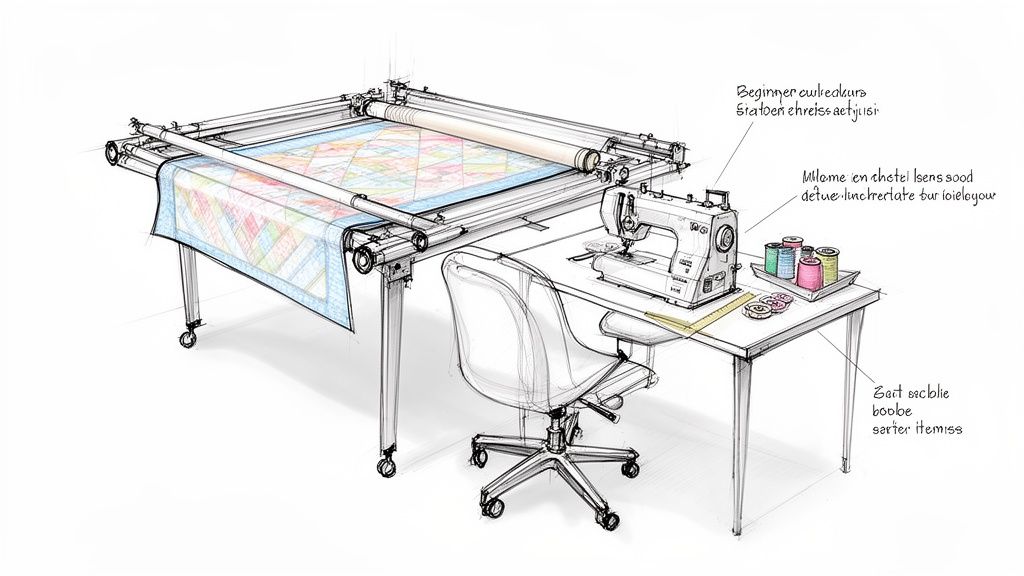
Preparing Your Quilting Area
Before you even crack open the box, the first job is to make sure the machine has a perfect home. Precise measurements are everything, especially with those big frames. You'll find great guidance on measuring your space accurately for a perfect fit to avoid any "uh-oh" moments later.
Once you know it fits, think about these practical things for an ideal setup:
- Lighting: Good lighting is completely non-negotiable. Try to position your machine to take advantage of natural light, and then add bright, focused task lighting directly over the quilting area to kill any shadows.
- Flooring: A hard, flat surface is best. If you have carpet, a heavy-duty chair mat is a great idea to let your stool or chair glide smoothly around the machine.
- Power Supply: Your machine needs reliable power. I always recommend plugging it into a quality surge protector to safeguard its sensitive electronics. It's a small price to pay for peace of mind.
Your Essential Starter Toolkit
Having the right tools on hand from day one makes that first quilting session smooth and fun, not frustrating. Think of this as your beginner's starter kit—everything you need to get quilting right away. At B-Sew Inn, we've put together a selection of high-quality essentials designed to work perfectly with long arm quilting machines for beginners.
Here’s a little checklist of must-have accessories to get you started:
- High-Quality Thread: Grab a few large cones of neutral-colored, 40-weight quilting thread. This weight is a fantastic all-rounder for most projects and a great starting point for learning how to manage your thread tension.
- Extra Bobbins: You can never, ever have too many bobbins. Having several pre-wound and ready to go means you won't have to break your creative flow just to wind a new one. Most long arms use a large "M" size bobbin.
- Long Arm Rulers: A basic set of long arm rulers is a game-changer for stitching straight lines, gentle curves, and echo quilting. Look for a starter set that has a good straight edge and a few simple curved templates.
- Snips and Scissors: Keep a pair of small, sharp thread snips right at your machine. A little magnetic holder on the machine head is perfect for this.
- Practice Fabric and Batting: Before you load that quilt top you've poured your heart into, have some inexpensive fabric (like old bed sheets or muslin) and batting scraps ready. This is your playground for getting a feel for the machine's movement and dialing in your stitch tension.
As you build your collection, remember that investing in quality tools really pays off. They not only produce better results but also make the entire quilting process more enjoyable and efficient from the start.
This foundational toolkit ensures you have everything you need for a successful first run. For a more detailed list and our expert recommendations, you can check out our complete guide to quilting supplies for beginners and find everything you need to stock your new creative space. With the right setup and tools, you're ready to master that machine and bring your beautiful quilt tops to life.
Mastering Your Machine with B-Sew Inn
Getting your new long arm quilting machine home is an incredible feeling, but that’s really just the beginning of the adventure. At B-Sew Inn, we know the real magic happens after the unboxing. We are deeply committed to empowering crafters by showcasing tangible quilting designs you can replicate. Our support system is built to ensure you feel confident and capable, from your very first stitch to your most ambitious quilt.
Your success is our passion, and we're here for the long haul.
When you get a machine from B-Sew Inn, you’re not just making a purchase—you're joining a community that’s genuinely dedicated to helping you grow. You’ll never have to feel stuck or overwhelmed, because our expert instructors are right here to give you personalized guidance and custom sewing machine design ideas whenever you need them.
Your Gateway to Creative Growth
To help new owners like you really take off, we created the B-Creative membership. Think of it as your all-access pass to a world of quilting knowledge and inspiration. It’s built from the ground up to help beginners build skills and confidence at their own pace, with how-to guides for creating a wide variety of designs.
Through this membership, you get an incredible library of resources, all tailored for owners of long arm quilting machines for beginners. Our goal is simple: to empower you to move beyond the basics and start creating those intricate, beautiful designs you've been dreaming about, with tangible examples you can follow.
Your journey with a new long arm shouldn't be a solo mission. It’s about having a supportive partner who provides the right tools, education, and encouragement to help you unlock your full creative potential.
Education That Fits Your Life
We get it—everyone learns differently. That’s why we offer all kinds of educational opportunities, so you can find the perfect learning style for you. Our support system includes:
- Online Classes: Learn right from the comfort of your own home with a huge library of on-demand courses. They cover everything from basic machine setup to advanced free-motion techniques with step-by-step design tutorials.
- Hands-On Training Events: Come join us for in-person workshops and events! You'll get direct, hands-on experience and learn from some of the best experts in the industry.
- Extensive Video Tutorials: Our video library is packed with easy-to-follow guides that break down even the trickiest skills into simple, manageable steps, showing you exactly how to create beautiful quilting patterns.
From figuring out thread tension to finally mastering ruler work, our resources are here to answer your questions and spark your next great idea. We’re passionate about providing the kind of ongoing training that turns a new machine owner into a skilled, confident quilter. With B-Sew Inn, you have a true partner ready to help you bring every beautiful quilting idea to life.
Answering Your Top Questions
Stepping into the world of long arm quilting is a huge, exciting move! It's also a big investment, so it’s completely normal to have a few questions swirling around. Let's tackle some of the most common things quilters ask when they start thinking about bringing one of these amazing machines home.
How Much Space Do I Really Need for a Long Arm Machine?
This is always the first—and most important—question on everyone's mind. And the honest answer is: it really depends on the machine you fall in love with.
If you’re looking at a sit-down long arm, the space commitment is pretty manageable. Think of a large desk or a serious crafting table. If you've already carved out a dedicated sewing corner, you can probably make a sit-down model work.
The game changes with a stand-up machine on a frame. The frame itself is the real space-hog. For a popular 10-foot frame, you'll want a room that's at least 12 to 14 feet long. That extra couple of feet isn't just for show—it gives you the breathing room to walk all the way around the machine, get to the back for cleaning, and just move freely without feeling boxed in. Trust me, you'll want to measure your space carefully before you make a decision!
Can I Do Regular Sewing on a Long Arm Quilting Machine?
I get this one a lot! While it seems like a machine that sews could, well, sew anything, long arm machines are highly specialized artists. They are built from the ground up to do one thing exceptionally well: quilt the layers of your project together.
Their whole design is fine-tuned for gliding over a large, flat surface. They just aren't equipped for things like piecing quilt blocks, constructing a garment, or other tasks that need specific feed dogs and presser feet. It's best to think of your long arm as the ultimate finishing tool, while your trusty domestic sewing machine handles all the other creative steps.
What Is the Biggest Mistake Beginners Make?
Hands down, the biggest mistake I see is letting the machine intimidate you. It’s a big piece of equipment, and it's easy to feel a little overwhelmed and not practice enough to build that muscle memory and confidence.
The secret to getting over that initial hurdle is simply giving yourself permission to play. Load up some scrap fabric—a "practice quilt sandwich"—and just doodle! Try out some simple, all-over patterns and get a feel for how the machine moves and responds to you.
Don't worry about making it perfect. Just have fun! This is a huge reason why we offer so much support at B-Sew Inn. Joining a beginner's class or our B-Creative community can make all the difference, connecting you with other quilters and turning that early apprehension into pure creative joy.
At B-Sew Inn, we're here to help you at every stage of your quilting adventure. From finding the perfect machine to learning how to use it, our classes and resources are designed to bring your creative vision to life. https://www.bsewinn.com

