

A king-size quilt can turn a pleasant sewing afternoon into a wrestling match. The bulk bunches beneath a domestic machine, the throat space disappears under layers of fabric and batting, and the quilter ends up pushing, pulling, and readjusting instead of concentrating on the design. A quilt long arm machine solves that physical problem by changing which part moves.
Longarm ownership, however, isn't just about buying the machine with the biggest throat or fastest motor. The frame must fit the room, the controls must suit the operator's posture, and maintenance has to become part of the quilting routine. The right purchase is the one that supports the way a quilter works, not the one with the longest feature list.
Table of Contents
- Understanding the Quilt Long Arm Machine
- Comparing Long-Arm and Domestic Sewing Machines
- Choosing Between Sit-Down and Frame-Mounted Styles
- Essential Features and Quilting Terminology
- Sizing Your Space and Choosing a Frame
- Maintenance and Real Ownership Costs
- Next Steps for Testing and Buying
Understanding the Quilt Long Arm Machine
The defining idea behind a longarm is simple. The quilt stays supported on a frame while the machine head travels across the fabric. Instead of forcing a thick, bed-size quilt through the narrow throat of a domestic sewing machine, the quilter guides the head over the area being stitched.
That arrangement has deep roots. The first quilting machine appeared in 1871, soon after the sewing machine changed fabric production, and by about 1877 the design had developed into a form where the machine moved over the quilt. Historical accounts also describe a 24-inch throat machine built by Fred Nolting in the early 1960s and a machine he built from scratch in 1972 that he considered the first long arm similar to modern versions. These milestones established the mechanical advantage still central to longarm quilting today, a large working area and more efficient stitching than hand quilting or domestic-machine handling. The history of longarm quilting provides further background.
The parts that change the workflow
A traditional setup has three working elements:
- Frame: The supporting structure holds the quilt layers and keeps them aligned as quilting progresses.
- Rails: These guide movement along the length of the quilt.
- Carriage: The carriage lets the machine head travel across the frame, usually with smooth front-to-back and side-to-side motion.
- Machine head: This contains the needle, motor, controls, bobbin system, and throat opening.
The frame doesn't merely hold the quilt. It creates a stable surface that removes much of the lifting and bunching associated with domestic quilting. The carriage then turns the machine into a guided tool, allowing the operator to draw curves, feathers, meanders, and ruler work across the quilt surface.
Why the change feels substantial
A quilter moving from a domestic machine often notices the difference first in the shoulders and hands. The longarm head carries the stitching mechanism over the quilt, so the operator spends less effort compressing a heavy quilt into a small opening. The work still requires control and practice, but the movement becomes more deliberate and less physically cramped.
The longarm quilting guide helps clarify the distinction between longarm quilting and other machine-quilting approaches. The important buying question is whether the new workflow matches the projects being made. A quilter finishing occasional small pieces may not need a frame system, while someone routinely handling large quilts may find the larger working area decisive.
Comparing Long-Arm and Domestic Sewing Machines
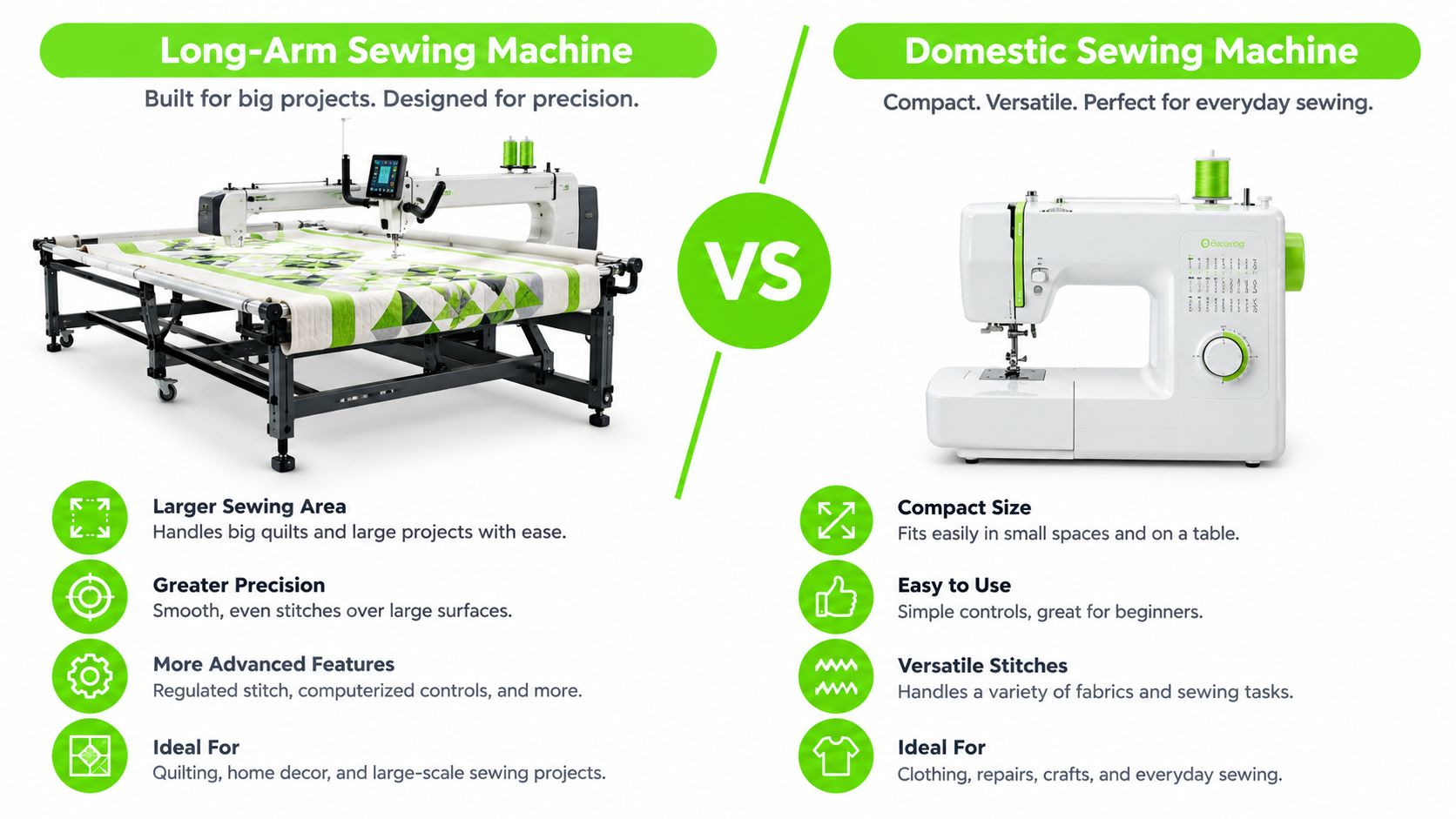
A domestic sewing machine remains the more flexible choice for piecing, garment work, mending, and general sewing. Its compact form fits a table, the operator moves the fabric beneath the needle, and setup is relatively straightforward. For quilting large layered projects, though, that same design creates the central limitation: the fabric must pass through the machine's throat space.
A long-arm reverses the relationship. The quilt is supported on the frame, and the machine head moves over it. The operator guides the head rather than dragging the quilt through the opening. That distinction affects comfort, visibility, stitch control, and the amount of uninterrupted quilting space available during each pass.
Where each machine earns its place
| Consideration | Domestic sewing machine | Long-arm system |
|---|---|---|
| Fabric movement | The operator moves the quilt under the needle | The machine head moves across supported fabric |
| Throat space | Compact and suited to general sewing | Designed for a substantially larger quilting area |
| Large quilt handling | Can require frequent bunching and repositioning | Frame and rails support the quilt during stitching |
| Stitch regulation | May be available on selected models, but depends on the machine | Commonly built around carriage movement and regulated quilting |
| Room commitment | Fits a sewing table or cabinet | Requires clearance for the frame and operator |
| Versatility | Strong choice for piecing and mixed sewing tasks | Purpose-built for quilting workflow |
Motor power and bobbin capacity matter, but they shouldn't distract from the movement question. A powerful domestic machine still requires the quilter to manage the bulk of the quilt. A longarm can make that handling easier, yet it occupies more space and usually represents a much larger investment.
Stitch regulation is another meaningful difference. A regulator senses carriage or fabric movement and coordinates needle speed to maintain a consistent stitch length during variable hand movement. Modern systems commonly operate around 1,300 to 2,600 stitches per minute, and many target approximately 10 to 11 stitches per inch for balanced quilting. This explanation of stitch regulation describes why the feature matters during free-motion work.
This quilting machine overview is useful for readers deciding whether a dedicated quilting platform fits their projects. A quilter who mainly pieces tops and occasionally quilts a small project should keep the domestic machine. A quilter who wants smoother large-quilt handling, more open design space, and a dedicated quilting workflow should test a longarm before making the jump.
Choosing Between Sit-Down and Frame-Mounted Styles
The most important configuration decision comes before comparing screens, handles, or automation. A sit-down longarm gives the operator a large throat and dedicated quilting mechanism while the fabric moves beneath the needle. A frame-mounted system places the quilt on rails and lets the machine head travel over the supported layers.
Neither format is automatically superior. They solve different space and workflow problems.
Sit-down systems suit compact rooms
A sit-down machine can work on a table or dedicated quilting surface rather than requiring a full-length frame. That makes it attractive for a quilter who lives in a multipurpose room, shares a studio, or can't leave a large frame permanently assembled. The operator also remains seated, which feels familiar to anyone who has spent years free-motion quilting on a domestic machine.
The trade-off is fabric management. The quilter still moves the quilt beneath the needle, so large or dense projects can require more hand movement and repositioning. Sit-down systems work particularly well for free-motion practice, smaller quilts, art quilting, and users who value a compact footprint over a rail-based production flow.
Frame-mounted systems suit continuous quilting
A frame-mounted longarm creates a more open, guided workflow. The machine head glides across the quilt, and the frame keeps the layers organized as the project advances. This arrangement is especially helpful for bed-size quilts, repeated edge-to-edge patterns, and quilters who want to avoid compressing a heavy project through a domestic throat.
The frame also changes posture. The operator may stand or move around the frame, depending on the design and quilting task. That can reduce seated strain for some people, but it introduces its own demands on the back, shoulders, hands, and feet. Handle placement, carriage resistance, screen position, and the ability to reach controls without leaning forward deserve a hands-on test.
Practical rule: Choose the configuration that fits the operator's real posture and room, not the setup that looks most impressive in a showroom.
Frame options deserve separate attention. The guide to longarm quilting frames can help a buyer compare frame-based arrangements before measuring the room. A sit-down choice is sensible when storage and flexibility dominate. A frame-mounted system is the stronger recommendation when large quilts, repeatable movement, and dedicated quilting throughput matter most.
Essential Features and Quilting Terminology
Longarm specifications become useful only when they connect to a real quilting task. A deep throat can reduce the number of advances needed across a design. A responsive carriage can make curves feel controlled rather than jerky. A well-placed handle can determine whether a long session feels manageable or exhausting.
Stitch regulation comes first
A stitch regulator senses movement and adjusts needle speed so stitches remain consistent as the operator changes hand speed. Without regulation, a quilter must coordinate movement and needle speed manually. Skilled free-motion quilters can do that, but buyers seeking a more forgiving learning curve should treat regulation as a core feature rather than a luxury.
Look for controls that make regulated modes easy to select and adjust. Precision-style operation can stop the needle when movement stops, while cruise-style operation maintains a controlled minimum speed as the carriage moves. The right choice depends on the quilter's preferred rhythm, but both should respond predictably during a test.
The stitch regulator explanation gives buyers a clearer foundation for comparing regulated and manual operation.
Translate the rest of the vocabulary
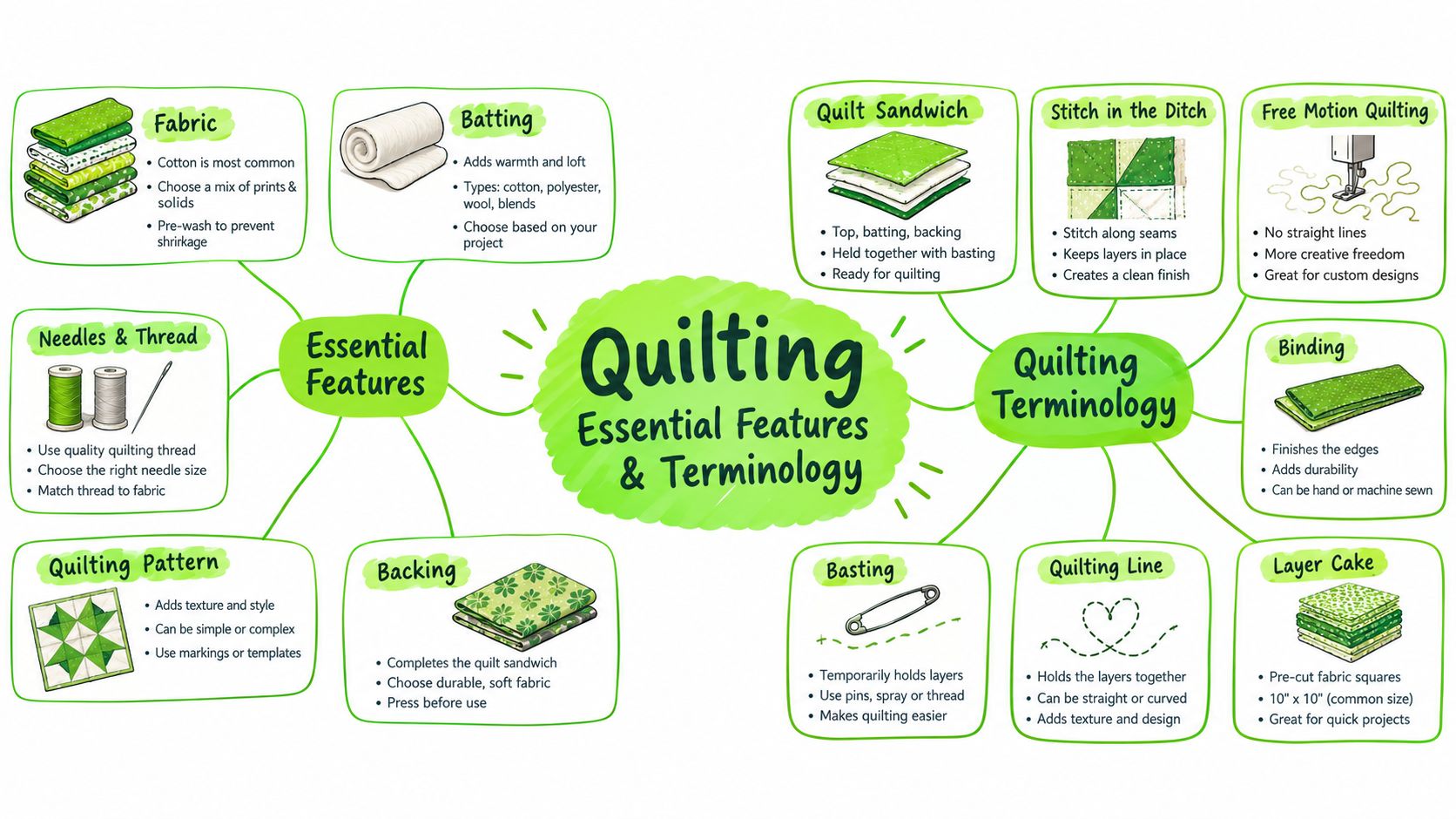
- Throat space: This is the open area between the needle and the machine body. An 18-inch throat provides a substantial quilting area, while 24 inches creates more room for larger motifs and uninterrupted movement. Manufacturer guidance on throat space explains why this measurement affects daily workflow.
- Carriage handles: Handles should let the operator guide the machine without pinching the wrists or lifting the shoulders. Test curves, straight lines, and stops, not just a quick forward glide.
- Channel lock: This feature restricts movement along one axis, helping the operator stitch straight horizontal or vertical lines. It can be useful for borders, sashing, and structured quilting.
- Ruler foot: A ruler foot creates a safe edge for guided templates. Buyers should confirm which feet are included and which accessories suit the machine's needle and foot system.
- Bobbin and tension controls: A large bobbin can reduce interruptions, but easy access matters just as much. Tension should be straightforward to inspect and adjust when thread, batting, or fabric changes.
Quilting also involves moving and protecting bulky layers around the workspace. For transporting or temporarily covering padded materials, quilted moving blankets offer a practical reference for the kind of protective, cushioned covering useful around a craft room or during equipment moves. They aren't a substitute for proper frame loading or machine care, but they can help keep fabric and equipment protected during rearrangement.
Sizing Your Space and Choosing a Frame
A frame should be measured as furniture, not as an accessory. Buyers need room for the frame itself, the operator's standing or walking position, the quilt roll, electrical access, and maintenance access. A frame that technically fits between two walls can still make a room unusable if it blocks a door, closet, cabinet, or cutting surface.
Start with painter's tape on the floor. Mark the proposed frame footprint, then stand at the front and rear edges while pretending to advance a quilt. Open nearby doors, pull out drawers, and walk the route used to load fabric. If the operator has to twist around furniture or press against a wall, the space isn't ready.
Frame length changes the project range
Retail listings commonly pair longarm machines with 10-foot and 12-foot frames. Industry guidance generally associates a 10-foot frame with most king-size quilts, while a 12-foot frame suits oversized quilts and production work. This frame listing and guidance illustrates the practical distinction.
Throat depth also affects how much quilting fits within each pass. A larger throat can reduce the frequency of advancing the quilt, but it doesn't eliminate the need to measure the frame and room around the machine. Buyers should evaluate both measurements together.
Long-Arm Frame and Space Planning Guide
| Frame Length | Max Quilt Width | Minimum Room Size | Best For |
|---|---|---|---|
| 10 feet | Most king-size quilt projects | The full frame footprint plus comfortable operator clearance | Home quilters handling standard bed-size quilts |
| 12 feet | Oversized quilts and wider production work | A dedicated room with clearance at the working sides and ends | Serious hobbyists and business-oriented workflows |
The table provides a planning framework, not a substitute for the exact manufacturer's footprint. Frame designs vary, and the machine head may require additional clearance beyond the rail length. Buyers should request the complete assembled dimensions before placing an order.
A usable quilting room needs circulation space. If the frame fits but the operator can't comfortably reach the controls, bobbin area, and quilt edges, the room is too small.
Maintenance and Real Ownership Costs
The purchase price tells only part of the story. A longarm adds recurring supplies, cleaning tasks, setup time, and eventual professional service. Buyers who budget only for the machine and frame often underestimate the commitment, especially when quilting becomes a frequent activity.
Routine care is procedural rather than mysterious. The machine needs the correct oiling points, clean areas around the bobbin and needle, suitable needles, compatible thread, and regular checks for lint or tension changes. A neglected machine can develop avoidable stitching problems, while a maintained machine gives the operator a more stable starting point for troubleshooting.
The maintenance calendar matters
Independent maintenance guidance recommends oiling at every bobbin change, replacing the needle about every 8 hours, and arranging professional service every 24 months or 10 million stitches, as described in this longarm maintenance resource. Those intervals should be checked against the specific machine's manual and service requirements.
The schedule is easier to follow when it becomes part of the workflow:
- At each bobbin change: Clean the accessible bobbin area, inspect lint, and apply oil only where the manual permits.
- About every 8 hours: Replace the needle rather than waiting for skipped stitches, thread damage, or visible wear.
- During every session: Watch for unusual noise, drag, thread shredding, tension changes, or a carriage that no longer glides smoothly.
- At the service interval: Have a qualified technician inspect timing, tension-related components, lubrication, electrical systems, and mechanical wear.

Consumables are part of the ownership calculation
Needles, bobbins, thread, batting, leaders, rulers, and cleaning supplies all affect operating cost. The exact total depends on project size, thread choice, quilting density, and how often the machine runs, so a responsible buyer should track actual usage rather than rely on a generic annual estimate.
Maintenance also has a time cost. Oiling takes attention, needle changes interrupt momentum, and frame cleaning can require moving around the setup. Professional service adds a scheduled expense, but it can be less disruptive than waiting for a timing or tension problem to stop a project.
The practical recommendation is straightforward. Before buying, ask for the service process, available parts, maintenance instruction, and turnaround expectations. A dealer that offers service, repair, trade-ins, and machine mastery support gives the owner a clearer path when routine care isn't enough.
Next Steps for Testing and Buying
A longarm should be test-driven before purchase. Online specifications can't reveal whether the handles fit the operator's hands, whether the carriage feels too light or too resistant, or whether the screen can be read without leaning. A hands-on test also exposes the physical scale of the frame, which photographs routinely understate.
A showroom visit should include more than a few decorative stitches. The buyer should guide the head through a slow curve, a fast curve, a straight line, and a controlled stop. The test should include regulated and unregulated movement when available, along with an inspection of bobbin access, needle visibility, thread path, lighting, and control placement.
A practical showroom checklist
- Test posture: Stand or sit in the actual quilting position and notice shoulder height, wrist angle, foot placement, and screen visibility.
- Move the carriage: Push in every direction, then stop abruptly. The machine should feel controllable rather than loose or difficult to start.
- Try the regulator: Vary hand speed and watch whether stitch formation remains consistent.
- Inspect access: Open the bobbin area, thread the machine, change the needle, and ask how oiling points are reached.
- Discuss the frame: Confirm assembled dimensions, delivery, setup, clearance needs, and whether the frame can be adjusted or expanded.
- Ask about support: Find out how service appointments, repairs, parts, trade-ins, and in-person machine mastery sessions are handled.
Automation may also influence the decision. The Baby Lock Pro-Stitcher quilting robotics software is designed to support computerized quilting and free-motion work on compatible Baby Lock longarm systems, including automated edge-to-edge designs. Buyers interested in robotics should ask about compatibility, installation, pattern preparation, and how much manual control remains available.
The guide to longarm quilting machines for home use can help narrow the field before a showroom visit. B-Sew Inn is an authorized sewing, quilting, and embroidery machine dealer with retail stores in Tulsa, Oklahoma City, Springfield, Humble, and Fayetteville, plus an online store. The retailer sells and services machines from Baby Lock, Bernina, Bernette, Brother, and Janome, along with longarm systems, thread, notions, cabinets, cutting tables, embroidery designs, and related supplies.
The strongest next move is a scheduled test and a class plan. An in-person machine mastery session can turn the first project from an intimidating investment into a manageable workflow, while service support protects the machine after the purchase. Serious hobbyists should bring measurements, typical quilt sizes, preferred posture, and examples of the quilting styles they want to practice.
Visit B-Sew Inn to browse available longarm quilting machines and accessories, then visit a store in Oklahoma, Missouri, Texas, or Arkansas to test the carriage, throat space, and controls in person. The team can also help arrange service, trade-in guidance, or an in-person machine mastery class before the first full-size quilt.

