

A good thread weights chart is one of the most useful tools you can have in your sewing room. It's basically a map that helps you understand thread thickness by translating all the different systems out there—like Weight (wt), Tex, and Denier. With one of these handy, you'll have all the info you need to pick the absolute perfect thread for any sewing, quilting, or embroidery project you're creating.
Your Essential Guide to Thread Weights
Stepping into the world of sewing thread can feel like learning a new language. You've got all these different numbers and systems slapped on spools from different brands, and it's easy to get confused. But figuring out what those numbers mean is the first step to avoiding frustrating problems like puckered seams, broken thread, and tension headaches, allowing you to focus on creating beautiful designs.
At its core, thread weight is just a simple way of talking about the thickness of a thread. That one little detail affects everything—your stitch quality, how durable your seams are, and the final look of your project.
Here at B-Sew Inn, we're committed to empowering you through our extensive resources and support. This guide will break down those numbers so you can walk into a store and pick your next thread with total confidence. Once you get these concepts down, you’ll be able to take your custom sewing machine designs from good to absolutely amazing.
Why Thread Weight Matters
The weight of your thread really does impact every single part of your sewing. It dictates which needle you should use and even how you should set your machine's tension. If you try to use a thread that’s too thick for a lightweight fabric, you’ll end up with ugly, bunched-up seams. On the other hand, a thread that's too thin might just snap under the strain of holding a heavy-duty project together.
Did you know that just understanding thread weights can completely change your sewing game? A thread's weight, shown by numbers like Tex 30 or Denier 120, is all about its thickness and strength. This is critical for everything from the finest embroidery to the toughest quilting projects.
Believe it or not, this all started back in the 18th-century cotton mills in England. They came up with a "ticket number" system where the higher numbers meant finer, thinner threads. As the Industrial Revolution took off, these charts became essential. You can learn more about how the sewing thread market has evolved over time.
To make things a little easier, let's talk about the three main systems you'll see today.
Quick Reference for Thread Weight Systems
Sorting out the different thread measurement systems can be a bit of a headache at first. You'll see numbers like "50wt" or "Tex 40," and they mean very different things. The table below breaks down the three big ones you’ll run into so you can quickly see how they work.
| System | How It Is Measured | What the Number Means |
|---|---|---|
| Weight (wt) | An indirect system based on how many kilometers of thread it takes to equal 1 gram. | The higher the number, the finer the thread. A 50wt thread is thinner than a 40wt thread. |
| Tex | A direct system based on the weight in grams of 1,000 meters of thread. | The higher the number, the thicker the thread. A Tex 40 thread is heavier than a Tex 30. |
| Denier | A direct system based on the weight in grams of 9,000 meters of thread. | The higher the number, the thicker the thread. A Denier 150 is thicker than a Denier 120. |
The key takeaway here is knowing whether you're looking at a direct or indirect system. For Weight (wt), bigger means thinner. For Tex and Denier, bigger means thicker. It’s a simple distinction, but it makes all the difference when you're choosing your supplies.
Your Go-To Thread Weight Conversion Chart
Alright, this is the part you'll want to print out and hang in your sewing room. Think of this chart as the ultimate decoder ring for your thread stash. It’s designed to be your go-to reference, mapping out all the common thread weights and making those confusing conversions between systems totally painless.
This master chart lays out everything from a super-fine 100wt thread to a chunky 12wt, and it lines them up with their approximate Tex and Denier equivalents. At B-Sew Inn, we are dedicated to empowering crafters like you with the tools and support needed to succeed. This chart is a perfect example of our commitment. You can look up any thread you have and immediately know what you're working with and what tools you need.
The image below gives you a quick visual breakdown of the three main systems—Weight, Tex, and Denier—that our chart will help you navigate.
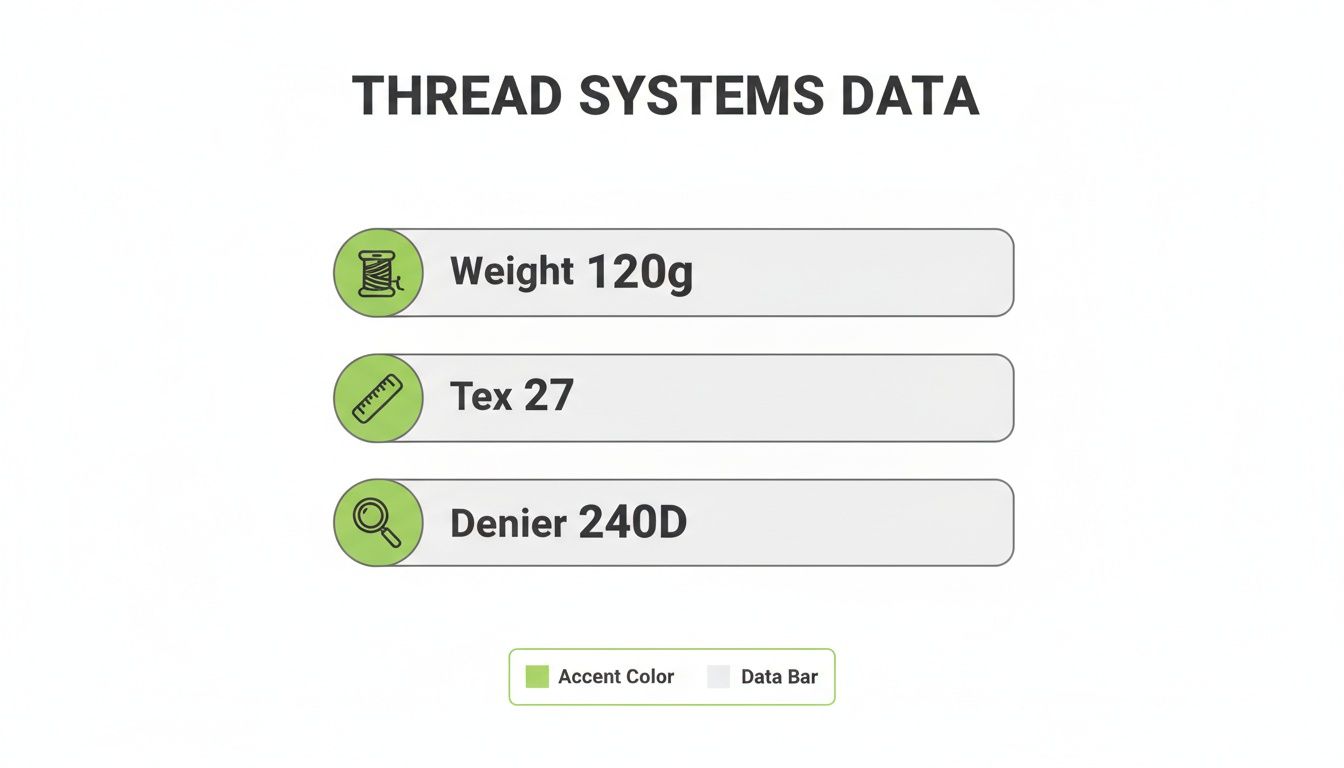
It really shows the core difference between the indirect Weight (wt) system and the direct Tex and Denier systems, which is the key to getting your head around how they all relate.
Master Thread Weight Conversion and Usage Chart
Here’s the full breakdown. We’ve gone beyond simple conversions to give you practical, real-world advice for each thread type. This chart will help you match the right thread and needle to your project every single time, saving you a ton of frustration.
| Weight (wt) | Tex Equivalent | Denier Equivalent | Recommended Needle Size | Common Uses and Projects |
|---|---|---|---|---|
| 100wt | Tex 12 | 108d | 60/8 Microtex | Invisible appliqué, delicate lace, fine heirloom sewing, tiny quilt stitches |
| 80wt | Tex 15 | 135d | 60/8 or 70/10 Microtex | English paper piecing, bobbin thread for most projects, delicate embroidery |
| 60wt | Tex 25 | 225d | 70/10 Microtex/Embroidery | Detailed machine embroidery, quilting where you want the texture, not the thread, to show |
| 50wt | Tex 30 | 270d | 80/12 Universal/Quilting | The workhorse! Piecing, quilting, garment construction, general sewing |
| 40wt | Tex 40 | 360d | 80/12 or 90/14 Quilting | Machine quilting, decorative stitching, all-purpose sewing that needs a bit more strength |
| 30wt | Tex 60 | 540d | 90/14 Topstitching/Denim | Topstitching, buttonholes, bag making, quilting for bold, visible stitches |
| 12wt | Tex 105 | 945d | 100/16 Topstitching | Hand quilting, decorative serging, bold topstitching on denim and canvas, sashiko |
This chart is designed to be a living document in your sewing space. Whether you're working with delicate silk, sturdy quilting cotton, or heavy-duty denim, you'll find the clarity you need for a beautiful, professional finish.
How to Get the Most Out of the Chart
To make this chart as useful as possible, we packed it with more than just numbers. For every single thread weight, we've included:
- Recommended Needle Size: You'll see exactly what needle to grab, like a 70/10 for 50wt thread or a beefy 100/16 Topstitching needle for that heavy 12wt.
- Typical Uses: Not sure what a thread is for? We've got you covered. Find out which weights are perfect for heirloom stitches, quilting, decorative work, or serging.
- Project Examples: We connect the dots between the numbers and actual projects. Think 80wt for fine lacework or 30wt for building a durable tote bag.
Here at B-Sew Inn, we're passionate about supporting your entire creative journey. This thread weights chart is just one example of that—it’s the kind of practical, detailed resource we share in our online classes and training sessions to help you get flawless results, every single time.
So go ahead, let this chart be your guide. It's built to take the guesswork out of thread selection, so you can spend less time worrying and more time enjoying the process of making something amazing.
How to Decode Thread Weight Systems
It’s one thing to have a conversion chart, but really understanding the logic behind thread weight systems is a game-changer. Once you know what those numbers on the spool actually mean, you can confidently pick the right thread from any brand, no matter what system they use on the label. This is the kind of practical skill B-Sew Inn is committed to building through our supportive community and extensive resources.
Each system—Weight (wt), Tex, and Denier—tells you something different about the thread. Let's break down what those numbers are really saying.
The Weight (wt) System
The Weight (wt) system is probably the one you see most often, especially on cotton and spun polyester threads. It's what's called an indirect measurement, which sounds a little confusing at first, but it's simple once you get the hang of it.
The number, like 40wt or 50wt, tells you how many kilometers of that thread it takes to weigh one kilogram. Because of this, the relationship is inverse: the higher the number, the finer the thread. A spool of 80wt thread is going to be much finer and thinner than a beefy 30wt thread.
The Tex System
The Tex system is way more straightforward because it's a direct measurement. The Tex number literally tells you the weight in grams of 1,000 meters of that thread. Simple as that.
With Tex, the logic is exactly what you'd expect: the higher the number, the thicker and heavier the thread. A Tex 60 thread is double the thickness of a Tex 30. This system is super common for industrial threads because it’s so consistent and easy to understand.
The Denier System
Denier is another direct measurement system, much like Tex. You'll see it used most often for filament threads made from synthetic fibers like rayon and polyester, especially in the embroidery world.
The Denier number is the weight in grams of 9,000 meters of thread. And just like Tex, a higher Denier number means a thicker, stronger thread. For example, a 300d thread is much heavier than a 120d thread.
Think of these systems as the language of sewing. Once you learn the grammar, you can "read" any spool and know exactly how it will perform in your machine. That's a skill we work hard to build in our online classes, because it’s key to getting professional-looking results.
To see how these numbers stack up against each other in the real world, check out our complete sewing thread size guide. It’s a great resource for seeing exactly how a 40wt cotton compares to its Tex or Denier equivalent.
Choosing the Right Thread for Your Project
Okay, let's get into the good stuff. Taking what you see on a thread weights chart and actually applying it to a project—that's where the real magic happens. It’s one thing to know the numbers, but it’s another to confidently grab the right spool for a specific task. That's what turns a homemade piece into something truly professional-looking.
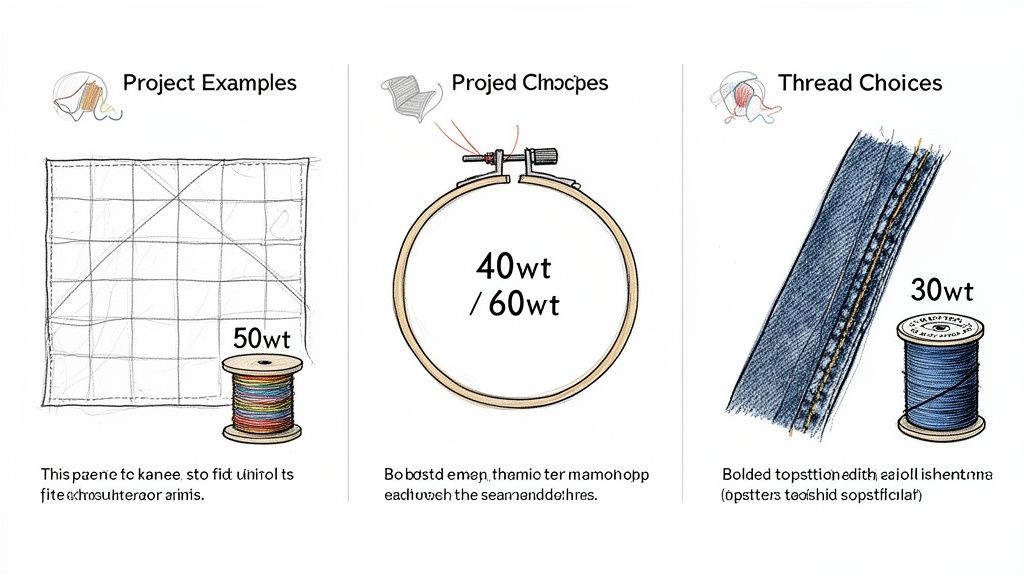
This is a core skill we're passionate about at B-Sew Inn, because once you have this down, you can make creative choices with total confidence. Let’s look at how different projects call for their own special thread weights.
Threads for Quilting Projects
If you're a quilter, you already know that thread choice is a huge deal. It affects both the structure and the final look of your quilt. Not all quilting steps are the same, so why would your thread be?
- For Piecing: Your go-to here is a 50wt thread. This is pretty much the industry standard for piecing quilt blocks. It’s fine enough that your seams lie incredibly flat (hello, accurate points!), but it’s still tough enough to hold your masterpiece together for decades.
- For Decorative Quilting: This is where you get to play! When you want your stitches to be part of the design, a heavier thread is your best friend. A 28wt or even a chunky, beautiful 12wt thread will create a visible texture that really pops. With this knowledge, you can replicate decorative quilt designs you've seen or invent your own.
Threads for Embroidery and Garment Sewing
Embroidery and clothing construction are all about the details. The right thread can handle intricate work and create durable seams, preventing annoying puckering and giving you that clean, store-bought finish.
Here are the workhorse threads for these crafts:
- Standard Embroidery: The most common embroidery thread you'll find is 40wt. It gives fantastic coverage and is strong enough for almost any design you can throw at it.
- Fine-Detail Embroidery: For tiny, intricate lettering or super delicate designs, a finer 60wt thread is perfect. It produces sharp, crisp stitches that won't look bulky or muddy the details.
- Garment Construction: Just like with quilt piecing, 50wt is the all-star for putting clothes together. It creates seams that are strong but not bulky or obvious.
- Topstitching: Want to make your seams stand out on a pair of jeans or a sturdy tote bag? Switch to a thicker 30wt thread. It gives you that classic, professional topstitch that looks so good.
It’s worth noting that the global sewing thread market is projected to hit USD 5.86 billion by 2032, which just shows how many of us are sewing! That's why we make it easy to stock up on different weights.
Getting these pairings right is a game-changer. It’s the kind of practical, hands-on knowledge we love sharing in our online classes. Seeing that lightbulb moment when a student realizes how the perfect thread takes a project from just "done" to beautifully crafted is the best part of our job.
Matching Needles and Machine Settings to Thread Weight
Getting that perfect, beautiful stitch isn’t just about the thread you choose from the chart. It's really a three-part harmony between your thread, your needle, and your machine settings. Picking the right thread is step one, but pairing it with the correct tools and tweaks is what truly creates a flawless finish. This is the kind of practical expertise we are committed to sharing at B-Sew Inn—it’s what takes a project from good to absolutely great.
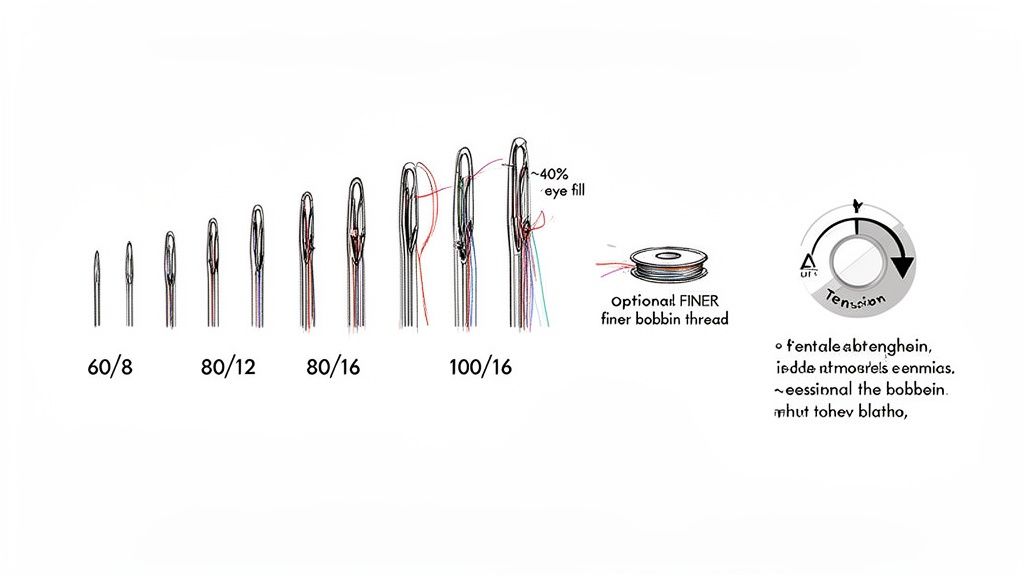
The most critical relationship here is between the thread's thickness and the needle's eye. If the thread is too thick for the needle, you'll end up with shredding and constant breaking. On the flip side, a thread that's too thin won't have enough control, which often leads to annoying skipped stitches.
A great rule of thumb is that the thread should fill about 40% of the needle's eye. This gives the thread enough room to glide through smoothly without friction, but just enough tension to form a clean, consistent stitch every time.
Pairing Needles with Common Thread Weights
You absolutely cannot get a quality stitch without matching your needle size to your thread weight. Heavier threads need a needle with a larger eye to pass through, while those delicate, fine threads require a smaller needle to make a clean puncture in the fabric. Getting this pairing right prevents damage to your project, your thread, and your machine.
Here’s a quick-glance guide to get you started:
- Fine 80wt Thread: For this delicate thread, you'll want a small 60/8 or 70/10 Microtex needle. It’s perfect for heirloom sewing or really fine embroidery details.
- Medium 50wt Thread: This is your all-purpose workhorse. It pairs perfectly with an 80/12 Universal needle for most general sewing.
- Heavy 12wt Thread: When you want bold, decorative topstitching, you'll need a large 100/16 Topstitching needle. These have an extra-large eye and a deep groove to protect that thick thread.
If you want to go deeper into all the different needle types and what they do best, be sure to explore B-Sew Inn's extensive resources.
Adjusting Machine Tension and Bobbin Thread
Beyond the needle, your machine settings are just as crucial. Heavier threads create more friction as they pass through the tension discs, which usually means you'll need to lower the top tension. Finer threads might need the opposite—a little increase in tension to help form a balanced stitch. Always, always test on a scrap of your project fabric first!
Finally, don't forget the bobbin. For most everyday sewing, you’ll just use the same thread in the bobbin as you do on top. Simple. But, when you're doing machine embroidery or quilting with a thick, decorative thread on top, it's much better to use a finer bobbin thread, like a 60wt or 80wt. This little trick reduces bulk on the back of your project and helps you get much smoother tension, making sure your beautiful top stitches are the star of the show.
How to Troubleshoot Common Thread Issues
Even with the perfect thread weight chart in hand, things can still go sideways. It happens to all of us! A beautiful stitch is all about the harmony between your thread, needle, and machine. When one of those is out of sync, you’ll get those frustrating problems like thread shredding, seams puckering, or stitches just plain disappearing.
Think of this guide as your first line of defense. Before you get too frustrated, let's walk through some common culprits. At B-Sew Inn, we're big believers in turning a potential project-ender into a learning moment. Our online classes and resources are built to help you solve these exact kinds of problems.
Solving Thread Shredding and Breaking
Is your thread fraying or snapping mid-seam? This is probably the most common headache for sewers, and nine times out of ten, it’s a simple friction problem. Before you throw your hands up, let’s check a few things.
- Wrong Needle Size: This is the big one. The needle's eye is likely just too small for the thread you're using. Trying to force a beefy 30wt thread through a tiny 70/10 needle eye is a recipe for shredded thread every single time.
- Old or Damaged Needle: A dull, bent, or burred needle will snag your thread on its way through the fabric. Needles are cheap—swap it out for a fresh one first. It’s amazing how often this simple fix works.
- Poor Thread Quality: Let's be honest, not all thread is created equal. Low-quality thread can have slubs and weak spots that are just waiting to break under normal sewing tension.
Fixing Puckered Seams and Skipped Stitches
There's nothing worse than seeing your fabric bunch up or finding a trail of incomplete stitches. It can throw off the whole look of your project. Both of these issues usually point to an imbalance in your machine's setup.
If your seams are puckering, chances are your thread is too heavy for your lightweight fabric, or your top tension is cranked too high. Try going down a thread size or lowering your tension setting by one full number. Always test on a scrap piece first!
Skipped stitches often scream of a mismatch between the needle and thread type. For example, if you’re using a fancy metallic thread with a standard universal needle, you’re going to get skipped stitches because the needle's eye isn't shaped to handle that specific kind of thread.
For our long-arm quilters out there, using a heavy-duty thread like a Decitex 840 (which is similar to a 10wt) can seriously boost stitch integrity by up to 50%. But get the weight wrong, and you're in trouble—improper weights are a known cause for a whopping 22% of long-arm machine jams. Our B-Sew Inn charts are designed to prevent exactly this, making those conversions seamless and helping 80% of beginners avoid these common pitfalls. This kind of support helps hobbyists thrive, especially in North America, which is projected to be the fastest-growing market for sewing. You can dig deeper by reading the full research about sewing thread market trends.
Frequently Asked Questions About Thread Weights
Diving into the world of sewing brings up a ton of questions, especially when you get into the nitty-gritty of supplies. A good thread weights chart is an amazing starting point, but sometimes you just need a quick answer without digging through tables. This section covers the most common questions we hear from fellow sewists.
Getting these details right is what takes your projects from good to great, a goal we're passionate about at B-Sew Inn through all our resources and classes. Let's clear up some of the usual head-scratchers.
What Is the Best All-Purpose Thread Weight for a Beginner?
If you're just starting out, a 50wt (Tex 30) thread is your new best friend. I'd go so far as to call it the undisputed champion of all-purpose threads. It hits that perfect sweet spot—strong enough for solid seams on light to medium fabrics like cotton, but fine enough that it won't add any annoying bulk. It’s the go-to for just about everything, from piecing quilts to sewing garments.
Can I Use the Same Weight Thread in My Bobbin?
For most everyday sewing, absolutely. Using the same thread weight on your spool and in your bobbin is the standard way to get a perfectly balanced, beautiful stitch.
But, when you get into more decorative work like machine embroidery or quilting with a thick top thread (like a chunky 28wt or 12wt), you'll want to switch things up. Using a finer bobbin thread (60wt or even 80wt) is a game-changing trick. It cuts down on bulk on the back of your project and helps your machine keep a smooth, even tension without a fight.
How Do I Know if My Thread Is Too Thick?
Your project will give you some pretty clear signals if your thread is too heavy for the fabric. The stitches will look clunky and almost sit on top of the material instead of sinking in nicely. You might also see the fabric pucker or bunch up along the seam line—that's a dead giveaway of a thread-fabric mismatch.
Does Thread Ply Affect the Weight Number?
It sure does. Ply is just the term for how many individual strands are twisted together to make the final thread. So, the weight number you see on the spool, like 40wt, is the final thickness of all those plies combined. A thread labeled 40wt/2-ply, for example, is made of two strands twisted together to reach that final 40 weight thickness.
Ready to see how the right thread can make all the difference? Check out the amazing sewing machines and supplies we have at B-Sew Inn. A little knowledge goes a long way in making your next project your best one yet. Visit https://www.bsewinn.com to see what's new.

