
If you ask a dozen seasoned sewists what the best thread is, you'll probably get a dozen different answers. But if you're looking for a tried-and-true workhorse for most garment projects, you can't go wrong with a high-quality, all-purpose polyester thread in a 50 weight. For my fellow quilters working with cottons, a 50 weight cotton thread is usually the go-to for seams that will wear just like the fabric itself.
How to Choose the Right Thread for Flawless Stitches
Walking up to that giant wall of thread spools at the craft store can feel a little daunting. The secret to strong seams and beautiful stitches for your sewing machine designs, though, really comes down to picking the right thread. Think of it like the foundation of a house—if the foundation is weak, the whole structure suffers. Getting this one skill down is what takes your work from looking "homemade" to truly "handcrafted."
This how-to guide is here to help you make sense of that wall of spools and move beyond just matching colors. Understanding thread is a core part of the creative process, and here at bsewinn.com, we are committed to empowering crafters with the know-how to replicate tangible examples and bring their ideas to life.
The Basics of Choosing Thread
Let's break down what you actually need to know. It's way simpler than it looks and really just boils down to a few key things working together.
These are the elements that decide how a thread will behave in your machine and play with your fabric:
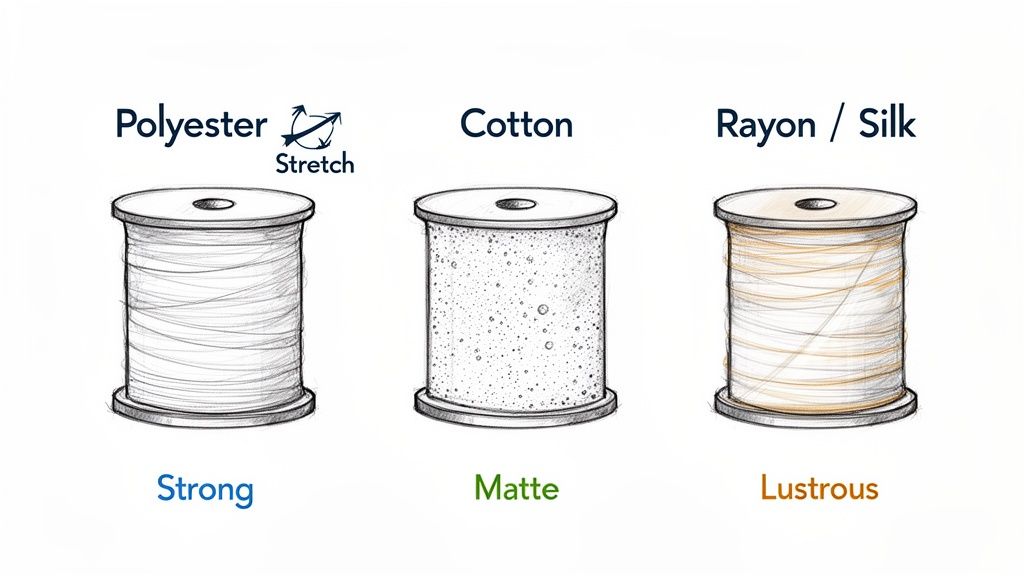
- Thread Fiber: This is what the thread is made of—like durable polyester, natural cotton, or shiny rayon.
- Thread Weight: This tells you how thick the thread is, which affects both the look of your stitches and the strength of your seams.
- Intended Purpose: Some threads are specialists, designed for things like high-speed embroidery or heavy-duty serging.
It's amazing to think that the global sewing thread market was valued at around USD 3.66 billion and is expected to grow to USD 4.28 billion by 2030. That just shows how many of us are out there sewing! It also reinforces why knowing your materials is so important in a market with so many options. You can explore more about these market trends and their impact on crafters.
Putting It All Together for Your Projects
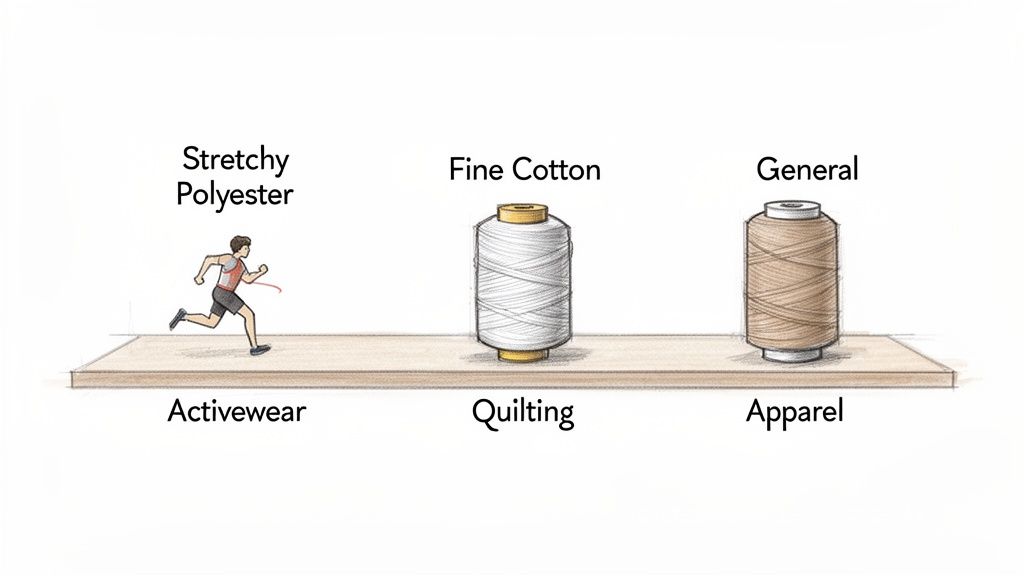
Once you get these concepts, you can start making smart choices for your sewing projects. For instance, you’d grab a stretchy polyester thread for sewing an activewear design because it gives with the fabric and stops seams from popping when you move. On the other hand, a fine cotton thread is a quilter’s best friend because it has very little stretch and ages just like the cotton fabrics in the quilt, a tangible example of matching materials for longevity.
Here at bsewinn.com, we believe knowledge unlocks creativity. Our custom sewing machine designs are supported by our commitment to empowering crafters through online classes, training, and extensive resources, starting with foundational skills like picking the perfect thread.
Think of this first section as your quick-start map. The sections that follow will build on these basics, turning you into a confident expert who can walk up to that wall of thread and know exactly what you need.
Quick Thread Selection Guide
To make things even easier, here’s a quick reference table I put together. It matches common projects with the thread I'd typically reach for.
| Project Type | Recommended Thread Fiber | Common Thread Weight |
|---|---|---|
| General Garment Sewing | All-Purpose Polyester | 50 wt |
| Quilting Cotton Fabrics | Cotton or Cotton/Poly Blend | 50 wt |
| Topstitching/Heavy Duty | Upholstery or Topstitching Polyester | 30 wt or 40 wt |
| Sheer/Delicate Fabrics | Fine Polyester or Silk | 60 wt to 100 wt |
| Embroidery (Machine) | Rayon or Polyester | 40 wt |
| Serging/Overlocking | Serger/Polyester Thread | General Purpose Cone |
| Activewear/Knits | Polyester | 50 wt |
This little chart is a great starting point, but don't be afraid to experiment! The best way to learn is to sew, see what works, and find what you love using for your unique projects.
Decoding the DNA of Thread Fibers
Every spool of thread has its own personality, and that personality comes from the fiber it’s made of. Getting this right is the secret to creating sewing machine designs that are strong, beautiful, and built to last. It’s about more than just matching colors; it’s about matching your thread’s traits to your fabric’s needs.
I like to think of it like this: polyester is the tough, all-weather tire for your car, while cotton is like a soft, handcrafted leather seat. Both are perfect for their intended job, and knowing when to use each one is what takes your sewing from pretty good to truly impressive. Let's break down the most common fibers you’ll run into.
The Synthetic Workhorses: Polyester and Nylon
When it comes to pure, reliable performance, you can't beat polyester and nylon. These synthetic threads are the undisputed workhorses of the sewing room. They’re engineered for strength and durability, and they have just a little bit of stretch, which makes them incredibly versatile.
If you’re sewing clothes—especially designs with knits or activewear—polyester is your best friend. That subtle give lets seams stretch right along with the fabric, which means no more hearing that dreaded pop when you pull on a garment. This toughness also makes it my go-to for kids' clothes, bags, or outdoor gear that's going to take a beating.
It's really no surprise that synthetic threads dominate the industry, accounting for over 65% of the global sewing thread market. Their strength and affordability make them a staple for everyone from home sewists to big manufacturers.
Here at bsewinn.com, our custom sewing machine designs are built to handle these modern, high-performance threads. Our commitment to empowering crafters includes offering support through online classes and training to help you master sewing with them.
The Natural Classic: Cotton
There's a reason cotton thread is a timeless classic, especially in the quilting world. As a natural fiber, it has a lovely matte finish that just melts into cotton fabrics. The real magic, though, is its lack of stretch. For quilters piecing blocks, this is a game-changer.
Because it doesn't give, your seams stay perfectly flat and precise, preventing any warping in your quilt top. Another huge plus is its heat resistance. You can press your seams with a hot iron without worrying about the thread melting or weakening, which can be a real issue with some synthetics.
Pro Tip: Using 100% cotton thread on 100% cotton fabric is a quilter's secret for longevity. It means the thread and fabric will wear and shrink at the same rate over time, keeping your quilt looking beautiful for years to come. This is a tangible example of how smart choices lead to lasting results.
While cotton isn’t the best choice for stretchy knits, its stability is absolutely unbeatable for quilting and woven fabrics.
Specialty Fibers for That Extra Touch of Elegance
Once you move past the everyday workhorses, you’ll find a whole world of specialty threads designed to add a unique, polished look to your projects. These are the threads you pull out when you want to create a sewing machine design that makes a statement.
Two of the most popular choices are:
- Rayon: Known for its incredible, high-sheen luster. Rayon is the top choice for decorative stitching and machine embroidery because of the way it catches the light and makes designs pop.
- Silk: Don’t let its delicate appearance fool you—silk is the strongest natural fiber. It's incredibly fine and smooth, allowing it to glide through delicate fabrics like silk chiffon and charmeuse, creating seams that are practically invisible. Perfect for heirloom sewing.
Choosing a specialty fiber can elevate a simple project into something truly special. For a closer look at these and other options, check out our guide on the different types of sewing thread.
Understanding Thread Weight and Size
The numbers printed on a spool of thread can look like a secret code, but they’re really just a straightforward guide to its thickness. Once you learn to crack this code, you’ll gain a whole new level of control over your sewing, creating balanced, professional-looking stitches that make your sewing projects shine.
The best way to think about thread weight is that it’s a bit backward, like sandpaper grit. A higher number actually means a finer, thinner thread, while a lower number points to a thicker, heavier one. It’s all based on how much thread it takes to reach a certain weight—it takes a whole lot more of a fine thread, so its number is higher.
Common Thread Weights and What They’re For
Most of the threads you'll come across use this "weight" system, often shortened to wt. A 50 wt thread is the jack-of-all-trades, your go-to for most garment construction and quilt piecing. When you need stitches to disappear, you'll reach for something finer, like an 80 wt or even a delicate 100 wt. These are perfect for invisible appliqué, English paper piecing, and lacework.
On the flip side, sometimes you want your thread to make a statement. A 30 wt or 40 wt thread is fantastic for decorative topstitching on jeans or bags, giving them that crisp, ready-to-wear finish. If you really want to go bold, a chunky 12 wt can create beautiful, textured quilting stitches that look just like hand quilting, but done right on your machine. For a deeper dive into how different sizes look and feel, you can learn more in our comprehensive sewing thread size guide.
Picking the right thread weight isn’t just for looks—it’s absolutely critical for the structural integrity of your seams. A thread that's too heavy for a light fabric will cause puckering and distortion. A thread that's too fine for a heavy fabric simply won't be strong enough, and you'll end up with busted seams.
Pairing Thread Weight with Your Fabric
The golden rule here is simple: match the thread weight to the fabric weight. Fine fabrics get fine threads; heavy fabrics get heavy threads. Following this one piece of advice will save you from a world of common sewing headaches.
Here’s a quick reference to get you started:
- Lightweight Fabrics (Chiffon, Voile, Organza): Stick with a fine thread like an 80 wt or 100 wt. This keeps the thread from overpowering the delicate material, so your seams are nearly invisible and lay perfectly flat.
- Medium-Weight Fabrics (Cotton, Linen, Poplin): A 50 wt all-purpose thread is your best friend. It has the perfect balance of strength and subtlety for almost any everyday project, from dresses to quilt tops.
- Heavyweight Fabrics (Denim, Canvas, Upholstery): You'll need a stronger, thicker thread like a 40 wt or 30 wt. This ensures your seams are durable enough to handle all the stress these tough fabrics will go through.
Here at bsewinn.com, we know that mastering these small details is what truly builds confidence. Our custom sewing machine designs are perfectly calibrated to handle a wide range of thread weights, and our online classes provide the hands-on training to help you make these choices instinctively, project after project.
Matching Your Thread to the Project
You wouldn't use a paring knife to chop a butternut squash, right? The same logic applies to sewing. The perfect thread for a delicate quilt top is almost never the right choice for a stretchy swimsuit. This is where the real craft begins—picking the best sewing threads for your specific sewing machine design. It’s a choice that makes all the difference in the look, feel, and durability of your finished piece.
Think of this as your go-to how-to guide for matching thread to whatever you're making, whether it’s a tailored dress, a cozy quilt, a detailed embroidery design, or the neat, finished seams from your serger.
At bsewinn.com, we are committed to helping you feel totally confident making these choices. Our custom sewing machine designs are built to handle all sorts of threads, and our extensive resources, including online classes and training, are here to support you on any creative path you take.
Threads for Garment Making
When you’re sewing clothes, you need a thread that can do it all—it’s got to be strong but also flexible. For the vast majority of your garment designs, a high-quality all-purpose polyester thread is your undisputed champion. It has just a little bit of give, which is crucial for seams on both woven and knit fabrics. That little bit of stretch is what stops your stitches from popping when you move.
Of course, some fabrics are a little more demanding:
- Heavy-Duty Fabrics: For tough stuff like denim, canvas, or upholstery, you'll need to level up to a stronger, thicker thread. Look for spools labeled "heavy duty" or "topstitching thread" to make sure your seams can handle the stress.
- Swimwear and Activewear: These fabrics need a thread that can stretch and bounce back. Textured polyester or nylon threads are engineered specifically for this.
The demand for great thread isn't going away. The apparel and footwear industries are huge, and the U.S. sewing thread market is expected to rocket past USD 700 million by 2030. This means we get a steady stream of new and improved threads for every possible project. If you're curious, you can learn more about the growth of the sewing thread market.
This little decision tree is a great visual for picking a thread weight based on how heavy your fabric is.
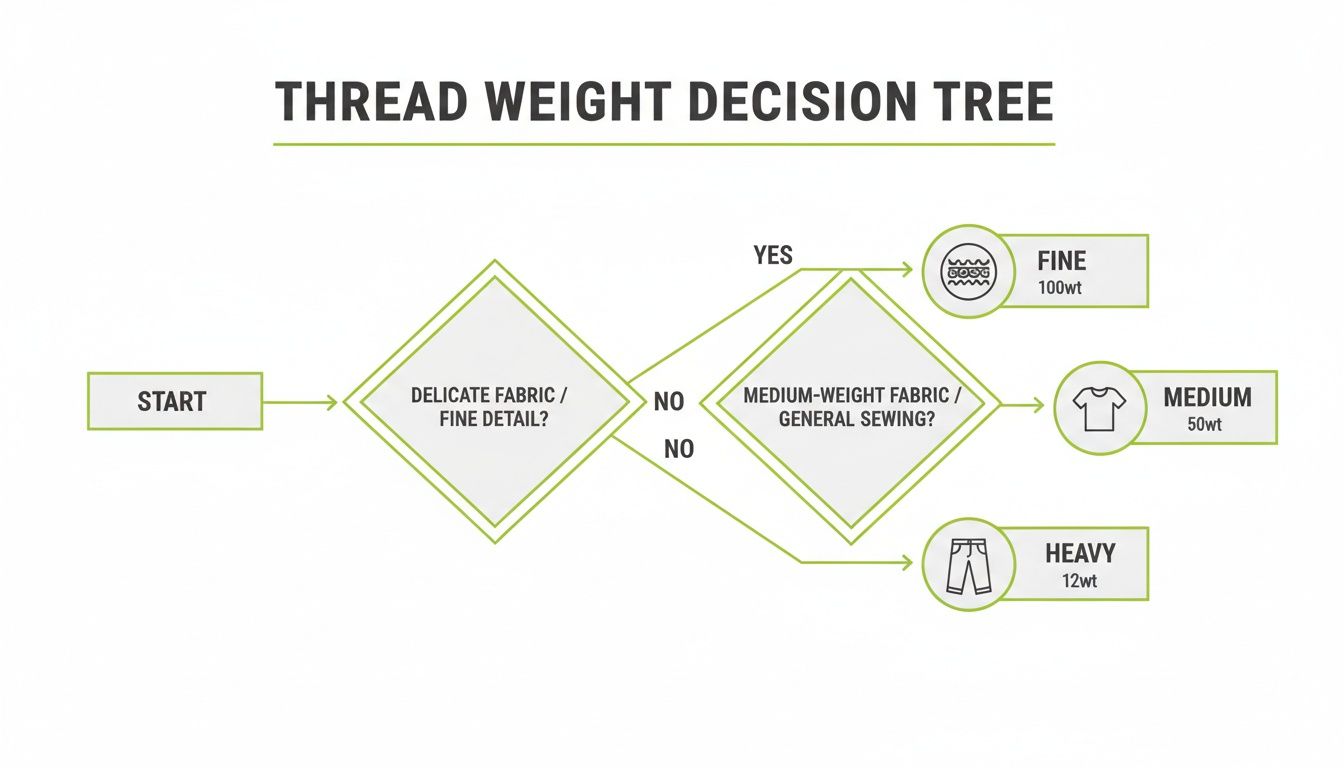
As you can see, a super fine 100 wt thread is perfect for delicate fabrics, a medium 50 wt is your go-to for most clothing, and a beefy 12 wt is what you grab for bold, decorative stitches on materials like denim.
Threads for Quilting
For quilters, cotton is king. When you’re piecing your quilt top, a strong, low-lint 50 wt cotton thread is the gold standard. Why? Because it’s the same fiber as your fabric, so it will wear and wash just like your quilt, ensuring your beautiful creation lasts for generations. It also has almost no stretch, which is exactly what you need to keep your quilt blocks perfectly square and precise.
Now, when it’s time for the actual quilting—stitching through the top, batting, and backing—you can get a little more creative. A lot of quilters stick with that same 50 wt cotton, but this is also your chance to let some decorative threads have their moment in the sun.
Creative Insight: Don't be shy about trying out variegated or multi-colored threads for your quilting! They can add a whole new layer of texture and artistry, turning a simple quilting design into a standout feature.
Threads for Embroidery
Machine embroidery is all about the visuals. You need a thread with a gorgeous sheen that can also glide through your machine at high speeds without a hitch. The two main players here are rayon and polyester embroidery thread, usually in a 40 wt.
Rayon gives you a brilliant, silky luster that really makes designs pop, but it can be a tad more delicate. Polyester embroidery thread, on the other hand, is a true workhorse—it’s super strong, won’t fade, and is even bleach-resistant. It’s the perfect choice for designs that will see a lot of washing, like towels or kids’ clothes.
Threads for Serging
A serger (or overlocker) is a thread-hungry machine. It uses multiple threads at once to sew a seam, trim the fabric, and finish the edge in one go. Because you go through so much of it, serger thread is usually sold on massive cones, which is way more economical than buying little spools.
Most serger thread is a standard-weight polyester that’s both strong and smooth. You can use regular all-purpose thread in a pinch, but the stuff sold on cones is designed specifically to run cleanly through your machine’s high-speed loopers without creating a ton of lint. For most projects, just matching the color to your fabric is all you need to do.
Picking the right thread for the job can feel like a lot to learn, but it quickly becomes second nature. Here’s a quick-glance table to help you match your project to the perfect thread.
Project-Specific Thread Recommendations
| Discipline | Primary Thread Choice | Secondary/Specialty Choice | Key Considerations |
|---|---|---|---|
| Garment Making | All-Purpose Polyester (50 wt) | Heavy-Duty Polyester, Nylon | Strength and slight stretch are key for durable seams that move with the body. |
| Quilting | 100% Cotton (50 wt) | Variegated Cotton, Polyester | Cotton thread ages like cotton fabric. Low stretch is vital for precise piecing. |
| Embroidery | Polyester or Rayon (40 wt) | Metallic, Glow-in-the-Dark | Sheen and smoothness are critical. Polyester for durability, Rayon for high luster. |
| Serging | Polyester Serger Thread (cone) | Woolly Nylon (for knits) | Sold on large cones for value. Must be smooth and strong for high-speed use. |
Ultimately, this table is a starting point. The best way to learn is to sew, experiment, and see what works for you and the incredible sewing machine designs you create.
How Needles and Tension Affect Your Stitches
Getting that perfect, beautiful stitch isn't some kind of sewing magic. It's really just about getting three things to play nicely together: your thread, your needle, and your machine's tension. When this trio is in sync, your stitches lay perfectly flat, look strong and professional, and will hold up for years to come. Honestly, learning to balance these three is one of those foundational skills that takes your sewing from "homemade" to "hand-crafted."
I like to think of the thread and needle as a team that has to be the right size to work together. If you force a delicate, fine thread through the eye of a needle that’s way too small, it’s going to fray and snap from all that friction. But, if you pair a thicker thread with the right-sized larger needle, it’ll glide through like a dream, giving you beautiful, strong stitches without a struggle.
Pairing Your Needle to Your Thread
The first step to a perfect stitch always starts with matching your needle to your thread. The rule is simple and it’s a big one: fine threads need fine needles, and thick threads need thick needles. The whole point is to let the thread pass through the eye of the needle with as little friction as possible.
When you try to sew with a thread that's too thick for the needle, the eye basically acts like a tiny cheese grater. With every single stitch, it strips and weakens the fibers. This is what causes that frustrating shredding, annoying lint build-up, and those thread breaks that always seem to happen at the worst time.
Here's a quick cheat sheet for getting it right:
- For Fine Threads (60 wt - 100 wt): Go for a smaller needle, like a 60/8 or 70/10. These are your best friends for delicate fabrics, heirloom sewing, or fine piecing.
- For All-Purpose Threads (40 wt - 50 wt): This is your everyday workhorse thread. A standard 80/12 universal needle is almost always the perfect match for garment sewing and quilting.
- For Heavy Threads (12 wt - 30 wt): You'll need to bring out the big guns—a larger, stronger needle like a 90/14 or even a 100/16. I often reach for a Topstitching needle in these cases; they have an even bigger eye and a deeper groove to protect that thick thread as it forms the stitch.
At bsewinn.com, our commitment to empowering crafters is demonstrated through our online classes and extensive resources, all designed to help you master these kinds of essential skills. We truly believe that understanding how your tools work together is the key to unlocking your creativity.
Demystifying Machine Tension
Okay, so you've got your needle and thread paired up perfectly. What's next? Tension. Think of your machine's tension as a friendly game of tug-of-war between the top thread (coming from your spool) and the bottom thread (from your bobbin).
For a perfect stitch, you want this tug-of-war to be a dead tie. The top and bottom threads should pull with the exact same amount of force. When they do, the little knot they form—the lock point—gets pulled right into the middle of your fabric layers. The result is a stitch that looks identical on the top and the bottom.
When the tension is out of whack, your machine will give you some pretty clear clues:
- Top Tension Too Tight: The bobbin thread gets yanked all the way up to the top side of the fabric. You'll see little dots of the bobbin thread peeking through between your stitches.
- Bobbin Tension Too Tight (or Top Tension Too Loose): The opposite happens. The top thread gets pulled down to the bottom, creating tiny, messy loops on the underside of your fabric.
The good news is that most modern sewing machines are calibrated so well that you'll rarely need to mess with the bobbin tension. I'd say nearly 99% of tension problems can be fixed just by adjusting the top tension dial. My advice is to always make small, slow adjustments, and test on a scrap of your project fabric until the stitches look balanced. Learning this one little trick is a total game-changer for any sewist.
Smart Storage to Protect Your Thread
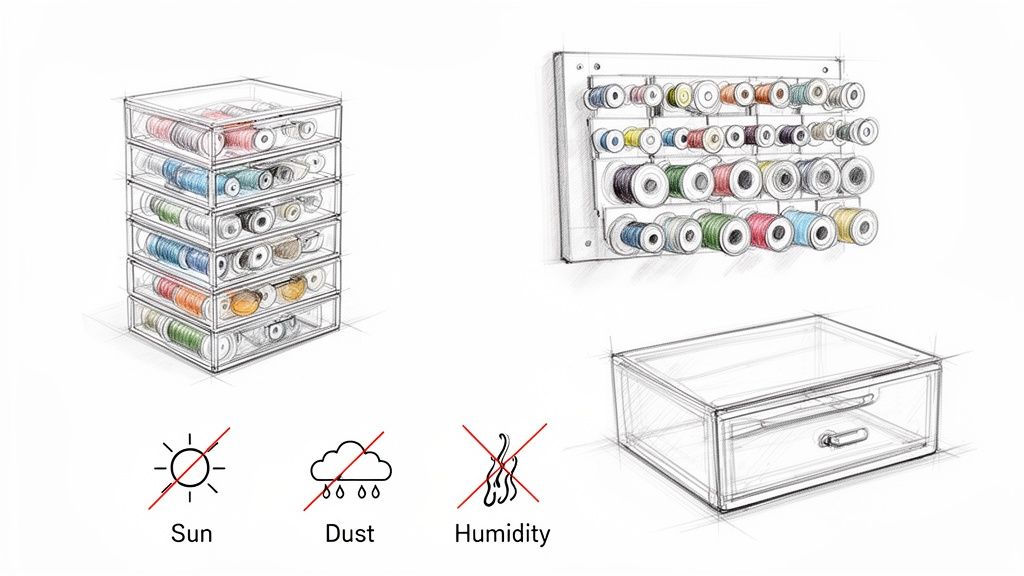
You've put time and money into building a beautiful thread collection. It's a real investment in your craft! And just like any other quality tool, you've got to take care of it so it performs beautifully for years to come.
Proper storage is what keeps your thread strong and its colors true. Trust me, there's nothing more frustrating than a project ruined by a weak, brittle thread that snaps right in the middle of a seam. Taking a few simple steps to protect your spools is really about protecting the integrity of your future creations.
The Enemies of Thread Integrity
Your thread has three main enemies lurking in your sewing space. Shielding your spools from these culprits is the secret to a long and happy thread life.
- Direct Sunlight: UV rays are a thread’s worst nightmare. They fade vibrant colors and break down the fibers, leaving them weak and brittle. A spool left on a sunny windowsill will lose its punch—and its strength—faster than you'd think.
- Dust and Debris: Ever notice that fine layer of dust on everything? When it settles on your thread, it gets pulled right into your sewing machine’s tension discs and can clog up the bobbin area with lint. This doesn't just mess with your stitch quality; it causes unnecessary wear and tear on your machine.
- Extreme Humidity: Big swings in humidity can be rough on thread. Too much moisture can cause natural fibers like cotton to swell or even mildew. On the flip side, super dry air can make threads stiff and more likely to snap. A nice, stable environment is what you're aiming for.
Protecting your thread is about more than just staying organized; it's a simple practice that guarantees every spool you reach for is ready to create strong, reliable stitches for your next masterpiece.
Smart and Simple Storage Solutions
The good news? Keeping your thread safe is easy, and it can even make your creative space look great. You don't need a complicated system, just a thoughtful one.
Clear, stackable bins are a fantastic and affordable option. They keep everything dust-free while letting you see your whole color palette at a glance. No more digging around for that perfect shade of blue!
If you love seeing your collection, a wall-mounted thread rack is a great choice—as long as you hang it away from a sunny window. It turns your spools into a piece of functional art. You can also find specialty options like the Floriani Thread Storage Box that are designed to keep things perfectly organized.
Finally, you have to know when to say goodbye. If a thread feels dry or breaks with a gentle tug, it's past its prime. Toss it. Using old, compromised thread just isn’t worth the risk to that beautiful project you've poured your heart into.
Got Questions About Thread? I've Got Answers.
Even after you get a handle on fibers, weights, and needles, questions always seem to pop up right in the middle of a project. I've been there! So, I've gathered some of the most common head-scratchers I hear from fellow sewists, along with some straightforward answers to help you get unstuck and sew with confidence.
Here at bsewinn.com, we are all about empowering you on your creative journey. Our custom sewing machine designs, deep-dive resources, and online training are all built to help you master these exact kinds of practical, real-world skills.
Can I Really Use "All-Purpose" Thread for Everything?
It's a tempting thought, isn't it? While all-purpose polyester thread (usually a 50 wt) is a fantastic workhorse for a massive range of projects, it's not a one-size-fits-all solution. Its flexibility is perfect for garment seams that need a little give, but that's also where its limitations start to show.
For instance, if you're quilting with 100% cotton fabrics, sticking with a cotton thread is usually the way to go. Why? Because it has zero stretch and will wear at the same rate as your fabric, which is key to preserving the life of a quilt for decades to come. And for machine embroidery? Forget it. You absolutely need a specialized thread, like a shiny rayon or a tough polyester designed to fly through the machine at incredible speeds without snapping.
Help! Why Does My Thread Keep Shredding?
Ugh, there's nothing more frustrating than thread that decides to shred and break every few stitches. The number one culprit is surprisingly simple: a dull, damaged, or incorrect needle. Needles wear out way faster than most people realize, so your first troubleshooting step should always be to pop in a fresh one.
Also, check that your needle size is a good match for your thread's thickness. Trying to force a thick thread through a too-small needle eye is like dragging it over sandpaper with every single stitch. Of course, it's going to shred! Other common suspects are threading the machine incorrectly (we've all done it!) or cranking the tension way too tight, which puts a death grip on the thread.
Should My Bobbin Thread Match My Top Thread?
For the cleanest, most professional-looking stitches, the answer is a big YES. Your bobbin thread should ideally match your top thread in both color and weight. When your machine's tension is perfectly balanced, the top and bobbin threads meet right in the middle of your fabric layers, creating beautiful, identical stitches on both sides.
That said, for construction seams that will be buried inside a garment, plenty of sewists (myself included!) just use a neutral color like white, grey, or black in the bobbin. It's a great way to save time and thread when you're switching between projects.
Quick tip: If you're doing any decorative topstitching or working on something where both sides might be seen (like a quilt or a fancy napkin), always take the time to wind a matching bobbin. It’s one of those small details that makes a huge difference in your finished work.
What's the Difference Between "Piecing" and "Quilting" Thread?
This is a fantastic question and a point of confusion for so many new quilters. The terms simply refer to the two different jobs a thread does when you're making a quilt.
- Piecing Thread: Think of this as your construction thread. It's what you use to sew all the little fabric blocks together to build the quilt top. A fine but strong 50 wt cotton thread is the gold standard here because it creates flat, precise seams without adding bulk or stretch.
- Quilting Thread: This is the "show-off" thread! It's used for the actual quilting stitches that go through all three layers—the quilt top, the batting, and the backing. This thread is all about artistry and can come in countless weights, colors, and cool finishes (like variegated or metallic) to add texture and flair to your finished quilt.
Ready to take your craft to the next level with the right tools and knowledge? The experts at bsewinn.com are here to support you with custom sewing machine designs, accessories, and extensive resources. Our commitment to empowering crafters includes online classes and training for your creative goals. Explore our collection and join our community of passionate crafters today. Visit us at https://www.bsewinn.com to get started.

