
Picking the right sewing machine needle isn't just a minor detail—it's the secret sauce for clean, professional-looking stitches and, most importantly, for avoiding ruined fabric. When you get it right, the needle works with your fabric, not against it, making every stitch a tiny victory. It’s a small tool, but it’s a mighty one, and it's the foundation of everything you sew.
Why the Right Needle Is Your Most Important Tool
I like to think of a sewing machine needle as the translator between your machine and your fabric. It’s that single, crucial point of contact that carries the thread, forms the stitch, and ultimately dictates how good your final seam will look. Using the wrong one is like trying to paint a detailed portrait with a big, clumsy house-painting brush—the results are messy, frustrating, and you can bet you’ll damage your canvas.
At B-Sew Inn, we are committed to empowering crafters to bring their unique visions to life. We believe getting great at your craft starts with mastering the fundamentals, and knowing your tools inside and out is just as vital as your creative vision. That’s why we don’t just offer the best supplies; we pair them with the support you need to use them perfectly, whether through our online classes, expert training, or extensive resources.
A Small Tool with a Big Impact
It’s not just us who think needles are a big deal. The needle segment is actually projected to capture 27.40% of the entire sewing machine components market revenue in 2025. That makes it the leading component type in the whole industry, which really shows how essential it is for stitch quality and machine performance. You can discover more insights about sewing machine components market trends if you like to geek out on the numbers like we do!
This guide is here to demystify all those codes, colors, and types of replacement needles. By the end, you'll feel confident tackling any project, knowing you have the perfect needle to bring your ideas to life.
Matching Needles to Fabrics Instantly
To get you started, here's a quick cheat sheet for pairing the most common needles with the right fabrics. Think of this table as your simple roadmap to sidestepping common headaches like skipped stitches or puckered seams before they even start.
Quick Guide to Common Sewing Machine Needles
| Needle Type | Best For Fabrics | Tangible Project Example |
|---|---|---|
| Universal | Woven fabrics like cotton, linen, and polyester blends | Creating a classic cotton tote bag or a simple home decor pillow. |
| Ballpoint | Knit and stretch fabrics like jersey or spandex | Sewing a comfortable jersey T-shirt or a pair of stretchy leggings. |
| Sharp/Microtex | Tightly woven fabrics like silk, microfiber, and quilting cottons | Piecing a quilt with crisp points or topstitching a tailored silk blouse. |
| Denim/Jeans | Heavy, dense materials like denim, canvas, or twill | Hemming a pair of jeans or constructing a durable canvas work apron. |
Keep this handy, and you’ll be off to a great start! Now, let’s dive deeper into what makes each of these needles unique.
Getting to Know Your Needles: Anatomy and Sizing
To really get the hang of your sewing machine, you have to know your tools. A sewing machine needle looks simple, but every tiny part of it has a huge job in making that perfect stitch. It's kind of like a key—it has to be the exact right fit for the lock (your machine and fabric) to work its magic.
A needle isn't just one piece of metal; it’s actually made up of five key parts, and each one has a specific role. Once you understand them, you'll see why picking the right needle type is a game-changer for your projects.
The Five Core Parts of a Needle
- Shank: This is the thick part at the top that you pop into the machine. Most home sewing machines use needles with a flat back on the shank, which is a brilliant little design that makes it impossible to put it in backward.
- Shaft: This is the long, main body of the needle. The diameter of the shaft is what determines the needle's size.
- Groove: See that little channel running down the front? That's the groove. It acts like a protective slide for the thread, guiding it safely down to the eye and shielding it from nasty friction and shredding as it punches through the fabric.
- Eye: The hole at the bottom where you thread the needle. The eye's size and shape are tweaked to handle different kinds of threads, from super fine to thick and heavy.
- Point: The business end! The shape of the point—whether it's sharp, rounded, or even designed to cut—is what really separates one type of needle from another.
This little diagram sums it up perfectly. It shows how the machine, the needle, and the stitch all depend on each other.
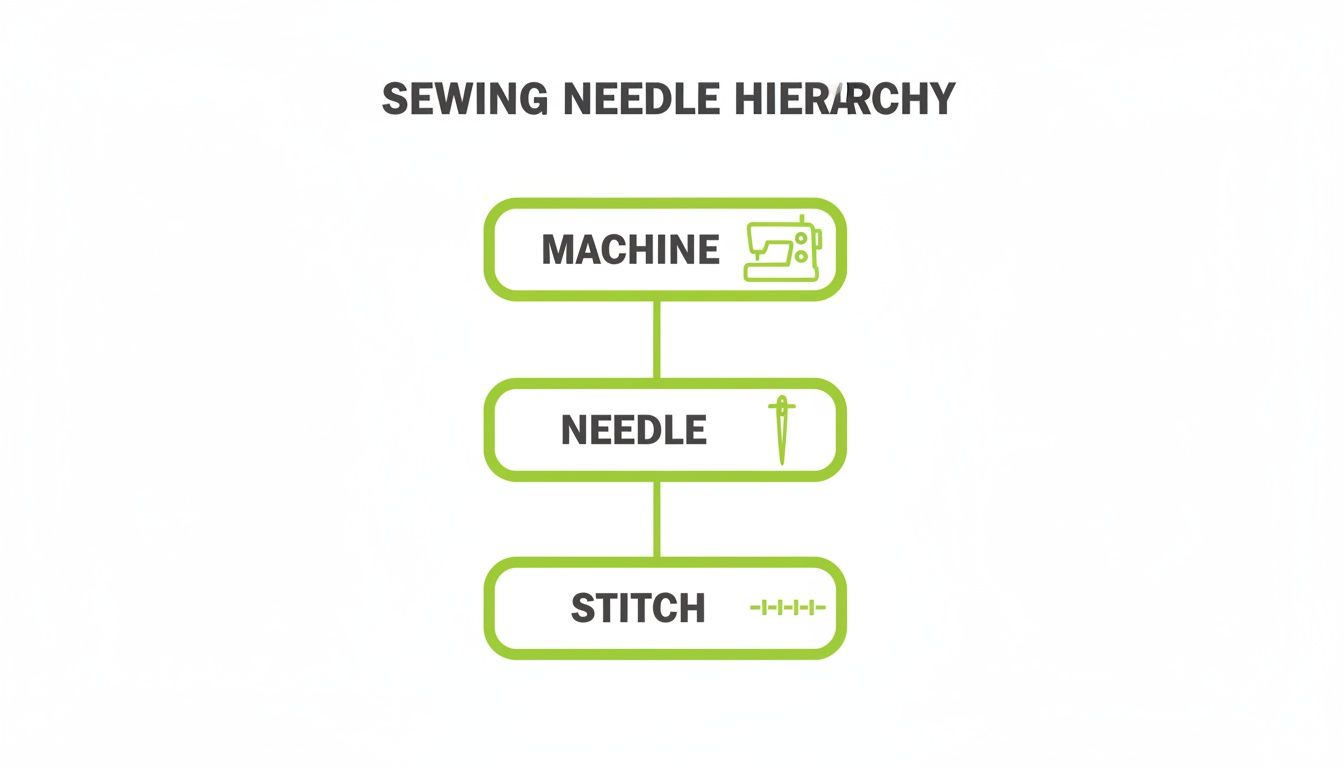
As you can see, the needle is the crucial middleman that lets the sewing machine work its magic on the fabric to create a stitch. No needle, no stitch!
Decoding Needle Sizes
Alright, let's crack the code on those numbers you see on needle packs, like 80/12 or 90/14. It looks a little technical, but it’s just two different ways of saying the same thing, one for the European market and one for the American.
The rule of thumb is simple: the bigger the number, the bigger and beefier the needle. A larger needle is built to muscle through tough, heavy fabrics with thicker threads.
Here’s the breakdown:
- European Sizing: These numbers usually run from 60 to 120. This system is super straightforward—it’s the metric diameter of the needle shaft. So, a size 80 needle has a shaft that's 0.80 mm thick.
- American Sizing: These numbers go from 8 to 19. It’s an older system and the numbers don't directly translate to a measurement, but they mean the same thing.
When you see a needle labeled 90/14, it's a size 90 in Europe and a size 14 here in the States. Same exact needle, just two different names.
Picking the wrong size can really wreck your project. Using a huge needle on a delicate fabric like chiffon will leave behind ugly, obvious holes. On the flip side, trying to punch a fine needle through denim is a recipe for disaster—it'll probably bend or snap, leaving you with skipped stitches and a whole lot of frustration.
Matching your needle size to your fabric is just as crucial as pairing it with the right thread. For a deeper dive into how it all works together, check out our guide on sewing thread sizes. This is the kind of foundational knowledge that takes your sewing from homemade to professional, which is what we're all about here at B-Sew Inn.
Exploring Different Types of Specialty Needles
While a universal needle is a fantastic workhorse, stepping into the world of specialty needles is like a chef discovering a full set of professional knives. Each one is engineered for a specific job, guaranteeing your stitches look flawless and your fabric stays happy. Using the right needle isn't just a "pro tip"—it's the secret to unlocking what your machine can really do.
At B-Sew Inn, we've seen countless projects transformed by this one simple switch. It's why our online classes often start with this foundational knowledge; it prevents so many common headaches right from the get-go. Let's dive into some of these essential tools you'll find in our collection.
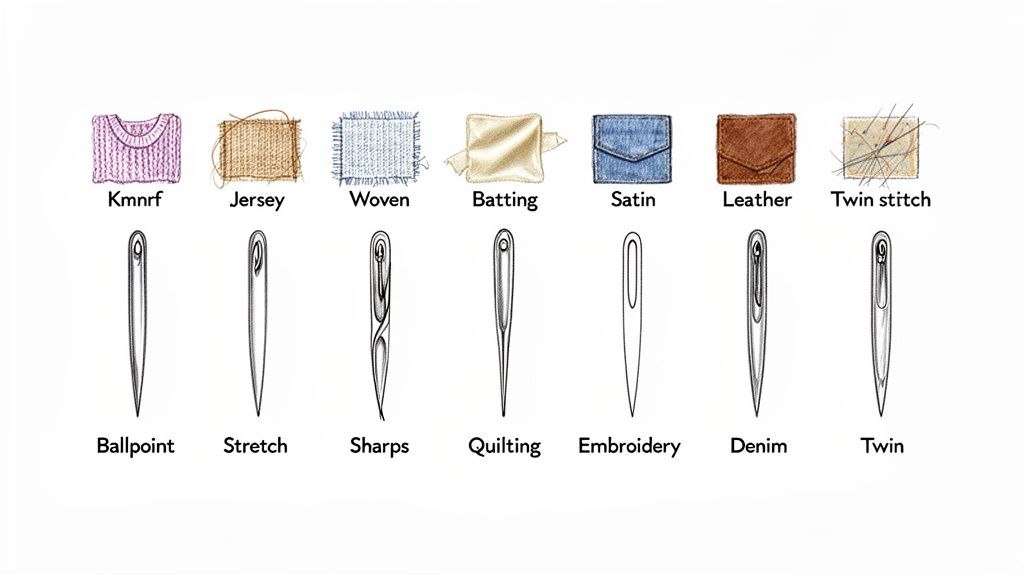
Needles for Knits and Stretchy Fabrics
Working with knits can feel intimidating, but the right needle changes everything. Instead of piercing the fibers, these needles are designed to glide right through the loops, which is the key to preventing snags, runs, and those frustrating skipped stitches.
- Ballpoint Needles: Think about pushing a sharp pin through a sweater—you’d probably break the yarn. A ballpoint needle has a rounded tip that gently nudges the knit fibers apart, sliding between them without causing damage. It's your go-to for stable knits like jersey, interlock, and rib knits. For a tangible example, use a Ballpoint needle when sewing the neckline on a jersey knit t-shirt to avoid holes.
- Stretch Needles: Got fabric with high lycra or spandex content, like activewear or swimwear? A stretch needle is non-negotiable. It has a slightly less rounded point than a ballpoint and a specially designed eye and scarf area that practically eliminate skipped stitches on even the stretchiest fabrics. For example, a Stretch needle is essential for a clean finish on the leg openings of a swimsuit.
Needles for Precision and Strength
When your project demands crisp, clean lines or has to conquer tough materials, you need a needle with a sharp, strong point.
- Sharps/Microtex Needles: These needles have a very slim, acute point made for piercing tightly woven fabrics like silk, microfiber, and quilting cotton. They create perfectly straight stitches with almost no disruption to the fabric's weave, making them perfect for topstitching and precision piecing. Replicate a professional look by using a Sharps needle for the topstitching on a silk camisole.
- Quilting Needles: Designed specifically to tackle multiple layers of fabric and batting, quilting needles have a tapered point that glides through all those layers smoothly. This helps prevent the puckering that can happen when you're stitching through a thick quilt sandwich.
Mastering these needles is a core skill we teach at B-Sew Inn, empowering quilters to get professional results on their custom machine quilting designs.
Needles for Decorative and Heavy-Duty Work
Beyond basic construction, some needles are built for pure embellishment, while others are made to withstand the toughest materials you can throw at them.
- Embroidery Needles: These have a wider eye and a special scarf to protect delicate embroidery threads from shredding at high speeds. This design lets decorative threads flow smoothly, creating beautiful, uninterrupted stitches for your custom embroidery projects. For a tangible example, an Embroidery needle is key for adding a monogram to a set of towels.
- Denim/Jeans Needles: Built tough with a reinforced blade and a sharp point, these powerhouses are made to penetrate dense fabrics like denim, canvas, and twill without bending or breaking. They are an absolute must-have for hemming jeans or sewing a heavy-duty bag.
- Leather Needles: A leather needle is unique—it has a cutting point, often shaped like a tiny wedge, that slices a clean hole in leather and other non-woven materials like vinyl. This allows the thread to pass through without causing friction or tearing the material. For instance, you'd use a Leather needle to attach straps to a handmade leather purse.
The demand for these specialized tools is huge. The Asia Pacific region, for example, accounts for roughly 42% of the total needle market value, largely driven by the massive textile manufacturing in countries like China and Vietnam. You can explore more data about global needle production and see just how vital this tiny component is to the worldwide fabric industry.
"Choosing a specialty needle is about respecting your fabric. You wouldn't use a hammer to place a delicate screw. Similarly, using a sharp on a knit fabric is a recipe for holes and frustration. The right tool makes the job easier and the result better."
Creative Options Like Twin Needles
Finally, don't forget about needles that add a little decorative magic. A twin needle has two needles mounted on a single shank, which creates two perfect parallel rows of stitching on top and a zigzag stitch on the bottom. It’s fantastic for creating professional-looking hems on knit garments, beautiful pintucks, and all sorts of other decorative finishes. Crafters can replicate the look of a coverstitch machine by using a twin needle to hem the sleeves of a knit dress.
Exploring these different sewing machine replacement needles really opens up a new level of craftsmanship. At B-Sew Inn, our goal is to give you both the tools and the expert training to use them confidently, helping you bring even your most ambitious sewing machine designs to life.
Knowing When to Change Your Sewing Machine Needle
So many frustrations in sewing—from skipped stitches to damaged fabric—can be traced back to one tiny, often-overlooked culprit: the needle. I always tell my students to think of a fresh needle as the cheapest and easiest insurance policy for their projects. It's a small step that guarantees cleaner stitches, prevents snags, and keeps your machine humming along happily.
Changing your needle regularly is so fundamental that the demand for them just keeps growing. In fact, global consumption recently hit 51 million units, a huge 42% jump from the year before. That number tells a story: sewists everywhere are realizing just how critical a fresh, sharp needle is for quality results. If you're curious, you can read the full market overview on sewing machine needles to see how this trend is playing out globally.
The Golden Rule of Needle Replacement
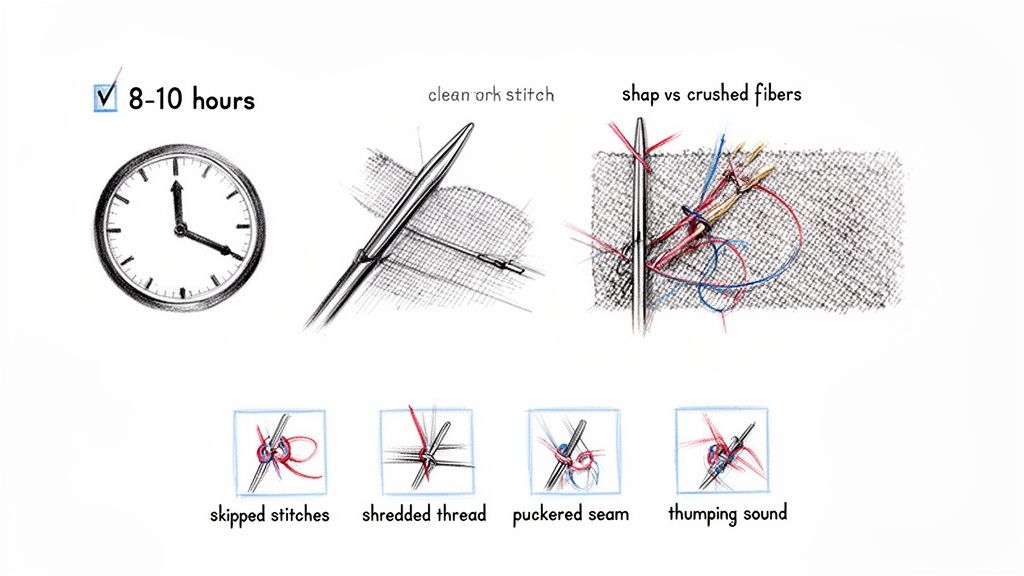
A great rule of thumb to live by is the 8-10 hour rule. This means popping in a new needle after about 8 to 10 hours of active sewing time. An even easier way to remember? Just start every major new project with a fresh needle. It's that simple.
This isn’t just about preventing a needle from breaking mid-seam. Every time that needle punches through fabric, its point gets a little duller. After thousands and thousands of stitches, that microscopic wear and tear starts to affect your sewing.
Telltale Signs of a Worn-Out Needle
Don't worry, your sewing machine will usually give you some pretty clear hints when it's time for a change. Learning to spot these signals is a skill we really focus on in our B-Sew Inn classes because a worn-out needle is behind so many common stitch problems.
Keep an eye (and an ear) out for these warning signs:
- A "Thumping" or "Popping" Sound: A new, sharp needle should glide almost silently through the fabric. If you start hearing a distinct thump... thump... thump... with each stitch, that’s the sound of a dull point forcing its way through the fibers instead of piercing them cleanly.
- Skipped Stitches: This is probably the most common red flag. A dull or slightly bent needle can't form a proper loop with the bobbin thread, leaving you with annoying gaps in your seam.
- Shredded or Fraying Thread: If your thread looks fuzzy or keeps breaking for no reason, check the needle. A worn needle can develop tiny burrs or a rough spot in the eye that snags and shreds thread as you sew.
- Puckered or Damaged Fabric: A dull needle doesn't part the fabric fibers; it pushes them out of the way. This can cause puckering, create visible holes in your fabric, or even cause runs in delicate knits.
Here’s an analogy I love: A dull sewing needle is like a dull kitchen knife. A sharp knife gives you a clean slice through a tomato, but a dull one just squishes and mangles it. Your needle does the same thing to fabric fibers!
Troubleshooting Common Stitch Problems
When your stitches start acting up, the needle is the very first thing you should check. It’s often the quickest and easiest fix. Before you start fiddling with tension dials or rethreading your machine for the tenth time, take a look at this simple diagnostic chart.
| Stitch Problem | Potential Needle-Related Cause | Recommended Action |
|---|---|---|
| Skipped Stitches | Needle is dull, bent, or the wrong type for your fabric. | Change to a new, appropriate needle type and size. |
| Shredding Thread | The needle's eye is rough, or the needle is too small for the thread. | Install a new needle. Try a larger needle size or a Topstitch needle. |
| Puckered Seams | The needle point is dull or damaged, pushing fabric instead of piercing it. | Replace the needle. Ensure you're using a sharp or microtex for wovens. |
| Popping/Thumping Sound | The needle is dull and struggling to penetrate the fabric. | Immediately replace the needle with a fresh one. |
| Uneven or "Wobbly" Stitches | Needle may be slightly bent or improperly inserted. | Remove and re-insert the needle correctly. If the problem persists, use a new one. |
| Fabric Pulls or Snags | Using a sharp needle on knit fabric, or the needle has a burr. | Switch to a ballpoint or stretch needle for knits. Change the needle. |
Remember, a simple needle change can solve a surprising number of sewing headaches. It's always the best place to start your troubleshooting.
Safely Changing Your Sewing Machine Needle
Swapping out your needle is a quick, two-minute task that protects you, your project, and your machine. At B-Sew Inn, we're all about empowering you to keep your machine in top shape. Just follow this simple safety checklist every time.
Safety-First Checklist:
- Turn Off the Machine: The first and most important step! Always power down your sewing machine completely. You don’t want any surprises.
- Raise the Needle Bar: Turn the handwheel toward you to lift the needle up to its highest possible position.
- Loosen the Needle Clamp Screw: Using the little screwdriver that came with your machine, give the screw a counter-clockwise turn. You only need to loosen it enough to release the needle.
- Remove the Old Needle: Gently pull the old needle straight down and out. It's a great habit to immediately put it in a sharps container or an old pill bottle so it doesn't end up on the floor.
- Insert the New Needle: Remember, the flat side of the needle shank always faces the back of the machine. Slide the new needle up into the clamp as far as it will go.
- Tighten the Screw: Firmly tighten the screw. I like to give the needle a gentle tug afterward just to be sure it's secure.
If you’ve changed your needle and are still seeing issues like loopy or uneven stitches, it might be time to look at your tension. You can learn more about tension adjustment on your sewing machine in our deep-dive guide.
How to Choose the Perfect Needles at B-Sew Inn
Let's be honest, walking into the needle aisle can feel a little like trying to read a foreign language. With all the different numbers, colors, and brands, it’s easy to feel overwhelmed. But once you learn to decipher the packaging, you'll be able to grab the perfect tool for any project with confidence. Our goal at B-Sew Inn is to turn that confusion into clarity, so every purchase you make helps bring your creative vision to life.
Think of a needle package as a cheat sheet. It tells you everything you need to know about what that needle does and what machines it's for. Most brands, especially those made for machines like Baby Lock, use a smart system of numbers and colors to make picking the right one a breeze.
Decoding the Colors and Numbers
Many needle makers use a clever color-coding system so you can spot the needle type you need from across the aisle. While the exact colors might vary a little from brand to brand, there are some common conventions that make things easier. For instance, you might see blue indicating a Denim needle or red for an Embroidery needle.
The numbers on the package tell you the needle's size. You’ll almost always see two numbers separated by a slash, like 90/14. The first, larger number is the European size (where 90 stands for a 0.90mm diameter), and the second, smaller number is the American size (14). All you really need to remember is this simple rule: the higher the number, the heavier the fabric it’s designed for.
Picking the right replacement needle is one of the single most important choices you can make for your sewing. It’s not just about buying a supply; it’s an investment in the quality of every stitch and the durability of your finished projects.
Smart Strategies for Building Your Needle Collection
How you stock up on needles really depends on where you are in your sewing journey. Are you just getting your feet wet, or are you a seasoned quilter who knows exactly what you need? We’ve got a strategy for everyone, and our team is always here to help you find the best fit for your machine and your creative habits.
-
For Beginners — The Power of the Variety Pack: If you're new to the craft, a variety pack is your absolute best friend. These kits usually come with a few different sizes of Universal needles, plus a couple of specialty types like Ballpoint and Denim. It’s a fantastic way to experiment with all kinds of fabrics without having to buy a full pack of each type.
-
For Experienced Sewists — Stocking Up: If you’re a passionate garment maker or quilter, you probably have a few go-to needles you reach for again and again. For you, the most efficient approach is to buy your most-used sizes—like an 80/12 or 90/14 Sharps for quilting—in multi-packs. This way, you’re never stuck without a fresh needle when inspiration strikes, and it’s usually more economical.
More Than Just a Purchase
Here at B-Sew Inn, we believe buying a pack of needles is the first step toward your next beautiful project. That’s why we connect every product we sell to our wider world of support and education. For a deeper dive into all the nuances of needle selection, you can learn more by choosing the right needle in our detailed guide.
Our online classes and training resources are here to help you get the most out of the tools you buy from us. When you understand why a Stretch needle is the key to a professional-looking activewear seam, you're not just sewing—you're crafting with expertise. We’re committed to providing both the high-quality supplies and the knowledge you need to turn a simple pack of needles into a gateway for new skills and stunning creations.
Putting It All Together
Whew, that was a lot to cover! But now you're armed with some serious knowledge. It's one thing to know you need to change your needle, but it’s another to understand why a tiny ballpoint is the secret to perfect stitches on your favorite knit sweater, or how a sharp denim needle can sail through thick canvas like it's nothing. This is the kind of stuff that takes your sewing from "I made this" to "Wow, you made this?!"
Honestly, it's all about working smarter, not harder. You've learned the anatomy of a needle, the different types for every fabric imaginable, and the golden rule: swap it out after every 8-10 hours of sewing time. Think of each concept we walked through as a new tool in your sewing box. The more you know, the more confident you'll feel tackling whatever project sparks your imagination. This is exactly what we're all about at B-Sew Inn—we believe true creativity happens when you pair amazing tools with the know-how to use them.
Your Next Stitch Awaits
We're not just here to sell you supplies; we want to see you grow as a crafter. Finding the right needle is a huge step, but it's really just the beginning of the fun. Our whole mission is to be your partner through every step of the creative journey.
The right needle is your project’s best friend. It ensures your stitches are clean, your fabric is undamaged, and your sewing machine runs smoothly. Making a thoughtful choice is the simplest way to guarantee a beautiful result.
Ready to put all this newfound expertise to use? Take a look through our curated collection of high-quality sewing machine needles. You’ll have no trouble finding the perfect match for your next project, whether you're dreaming of a floaty silk blouse or a rugged tote bag.
And if you really want to see these principles in action, why not join one of our online classes? There's nothing like learning and sharing alongside a community of people who are just as passionate as you are. Here at B-Sew Inn, we've got your back from the very first stitch to that final, fabulous masterpiece.
Your Top Sewing Needle Questions, Answered
Even after you've got the basics down, you're bound to run into a few head-scratchers mid-project. It happens to all of us! Here are some quick answers to the questions we hear most often at B-Sew Inn, perfect for saving you time and frustration.
Can I Use Any Brand of Needle in My Sewing Machine?
For the most part, yes! If you have a modern domestic sewing machine—like the fantastic Baby Lock models we carry—it almost certainly uses the standard 130/705 H flat-shank needle system. This means needles from different brands are generally interchangeable.
That said, it never hurts to give your machine's manual a quick glance, especially if you're working with a vintage or highly specialized model. But remember, the real secret to perfect stitches isn't the brand name on the package; it's choosing the right needle type and size for your fabric. That's what truly matters.
What Is the Difference Between a Universal and a Sharps Needle?
Think of it like this: a Universal needle is your reliable, all-purpose family car, while a Sharps needle is a high-performance sports car built for precision.
A Universal needle has a slightly rounded point, making it a fantastic choice for a huge range of woven fabrics and stable knits. It's the one you'll grab for most general sewing. A Sharps needle (sometimes called a Microtex) has an extra-fine, sharp point designed to pierce through tightly woven fabrics like silk, poplin, or microfiber without leaving a trace. It creates a perfectly straight stitch line and prevents damage to delicate materials.
How Do I Know if I Have Inserted the Needle Correctly?
This is probably the #1 cause of stitch problems, and thankfully, it's an easy fix! On a standard home sewing needle, the shank (the top part) has a flat side and a rounded side. The flat side should almost always face the back of the machine.
When you put it in, make sure you push the needle all the way up into the needle clamp until it won't go any further. Then, tighten the screw nice and snug. This alignment is crucial for letting the thread form a perfect loop with the bobbin hook.
If your machine starts skipping stitches right after a needle change, a crooked or partially inserted needle is the first thing you should check. Nine times out of ten, that's the culprit!
How Often Should I Really Change My Needle for Quilting?
Quilting puts a needle through a serious workout, especially if you're doing free-motion work or stitching through multiple thick layers. The old "change it every 8 hours" rule is a decent starting point for general sewing, but quilters need to be a bit more vigilant.
A great habit to get into is starting every new quilt with a fresh needle. Period.
Beyond that, listen to your machine. If you hear a distinct 'popping' or 'punching' sound as the needle goes through the fabric, or if you notice your stitches are getting uneven, it's time for a change. Don't try to push it just to save a needle—your beautiful quilt is worth it!
At B-Sew Inn, we believe having the right tools and knowing how to use them is the key to unlocking your creativity. We've got an incredible collection of high-quality sewing machine needles for any project you can dream up. Come explore our selection online and find the perfect match for your next masterpiece.

