
Nothing kills the creative buzz faster than running out of binding fabric with just a few inches left to go. We’ve all been there. Using a quick bias binding calculator—or just knowing the simple math behind it—takes the guesswork out of the equation. It means you won't get stuck mid-project or, just as bad, waste a chunk of that fabric you love. Getting this number right is the first real step to a clean, professional finish on any quilt or garment. At B-Sew Inn, we're dedicated to empowering crafters like you with custom sewing machine designs and the resources to master every step, and this guide is a perfect example of that commitment.
Why Accurate Bias Calculations Matter

Accurate calculations are about more than just avoiding frustration. They move you past risky guesswork and give you the confidence that you have exactly what you need before you even make that first cut. Once you understand the fundamentals, you'll see how any bias binding calculator is just doing some simple math you can easily do yourself.
This guide will demystify the process and turn what feels like confusing geometry into a reliable tool in your sewing kit. Here at B-Sew Inn, we're all about empowering your craft through our custom sewing machine designs and extensive resources, starting by building a rock-solid foundation of essential skills.
The Magic of the 45-Degree Angle
So, what's the big deal with bias, anyway? The secret to those beautifully smooth curves on a quilt corner or a garment's neckline is all in that 45-degree cut. Unlike fabric cut along the straight grain, which is stable and rigid, a cut on the bias has a natural, gentle stretch. This is what allows the binding to hug rounded edges perfectly without puckering, pulling, or creating awkward, stiff corners.
It’s this built-in flexibility that creates those polished, professional edges that truly elevate your work. This is what makes a project look less like it's "homemade" and more like it's "handmade."
Building Confidence in Your Craft
Learning to calculate your needs is more than just a practical skill; it's a huge confidence booster. When you trust your measurements, you can relax and focus on the joy of creating. Our goal is to arm you with the right knowledge and resources to get there. It's why we offer so many online classes and training sessions—to help you master techniques just like this one, ensuring you get the most out of your custom sewing projects.
If you want to get a better handle on the basics before we jump into the numbers, check out our detailed article on what bias tape is. A little background knowledge ensures you can tackle any project, from a simple placemat to an intricate quilt, with the skills to make it a success.
So, What’s the Math Behind a Bias Binding Calculator?
Ever wondered what magic a bias binding calculator is running behind the scenes? It might feel like it, but it's not magic at all—it’s just a few simple formulas that you can absolutely master yourself.
The whole process kicks off with one key measurement: the perimeter of your project.
Starting with Your Project's Perimeter
First things first, you need to measure the entire distance around the edge you’re planning to bind. For a simple quilt with straight edges, this is a breeze. Just add up the lengths of all four sides.
Let's walk through a tangible example you can replicate. Say you're binding a sweet little baby quilt that measures 36 inches by 48 inches. The math for its perimeter is pretty straightforward:
(36" + 48") x 2 = 168 inches
This number, 168 inches, is your baseline. It's the absolute bare minimum length of binding you'd need to just barely cover the edges. But in sewing, "just barely" isn't a recipe for success. You need some wiggle room.
Why You Always Need a 'Tail'
This is where the non-negotiable "tail" comes in. I, along with pretty much every quilter I know, always add an extra 10 to 15 inches to the total perimeter. This isn’t waste; it’s your secret weapon for joining the two ends of your binding strip neatly without pulling your hair out.
That extra length gives you the overlap you need to create a clean, diagonal seam for a truly professional look.
So, for our baby quilt example, the real formula looks more like this:
(Perimeter + 15 inches) = Total Binding Length
(168" + 15") = 183 inches
That 183-inch figure is the true length of finished binding you need to make. This little bit of insurance is crucial because the diagonal joins and the seam allowances used to connect your strips will eat up a little bit of the usable length.
Factoring in Binding Width
Next up, you have to decide how wide to cut your fabric strips. This choice really boils down to whether you're making single-fold or double-fold binding and the final look you're going for. For quilts, double-fold is the undisputed champion because it’s so much more durable.
Before you can calculate how much fabric you need, you need to know how wide to cut your strips. This depends on whether you're making single-fold binding for a delicate edge or the more robust double-fold binding common on quilts.
Choosing Your Binding Width Single vs Double-Fold
This table breaks down the formulas for single-fold and double-fold bias binding, helping you decide which style best suits the durability and finish your project requires.
| Binding Type | Cut Width Formula | Best Use Cases |
|---|---|---|
| Single-Fold | Finished Width x 2 | Delicate garment edges, decorative finishes, necklines |
| Double-Fold | Finished Width x 4 | Quilt edges, blankets, durable projects requiring a sturdy finish |
Most quilters find that double-fold binding offers the best combination of a clean look and long-lasting wear, which is why it's the go-to for finishing quilts.
A common choice for a double-fold binding that finishes at a neat ½ inch means cutting your fabric strips at 2.5 inches wide. This gives you enough fabric to wrap completely around the quilt edge and includes the necessary seam allowance.
The final piece of the puzzle is figuring out how many strips you need to cut. You'll take your total required length (183 inches for our quilt) and divide it by the usable width of your fabric (WOF), which is typically around 40-42 inches.
- Calculation: 183" ÷ 42" = 4.35 strips
Since you can't exactly cut 0.35 of a strip, you always round up to the next whole number. For this project, you'd need to cut 5 strips of fabric, each 2.5 inches wide, from your yardage.
And that's it! This simple, step-by-step math is exactly what a bias binding calculator does for you in an instant. Now you can do it yourself with total confidence.
Calculating Continuous Bias from a Fabric Square
Making your own continuous bias tape from a single square of fabric is one of those incredibly satisfying sewing tricks. It’s efficient, cuts down on the number of seams you have to join, and leaves you with a beautifully smooth, professional finish. It’s a total game-changer, especially for projects that need one long, uninterrupted strip, like the edge of a big quilt or the hem of a flowy dress.
The magic behind this method is a little bit of simple math often called the "square root method." It lets you work backward from the total length of binding you need to figure out the exact size of the fabric square to start with. No guesswork needed—just a basic calculator.
The Simple Math Behind the Square
To figure out your starting square size, you just need two numbers: the total length of binding you need (don't forget that 10-15 inch tail!) and how wide you plan to cut your strips.
Here’s the core formula:
Total Binding Length × Strip Cut Width = Area
√Area + Strip Cut Width = Side of Your Starting Square
Let's walk through a tangible example. Say you're binding the hem of a circle skirt and you need 140 cm of binding. You’ve decided to cut your strips 5 cm wide.
This flow chart breaks down the thought process for getting your total length before you even start thinking about fabric.

As you can see, getting that initial measurement right—the project's perimeter plus a generous tail—is the bedrock for any accurate calculation.
So, using our numbers: 140 cm (length) x 5 cm (width) = 700.
Next, find the square root of 700, which is about 26.46 cm. Add your strip width back to that number (5 cm) to get 31.46 cm. This extra bit gives you a little margin for squaring up your fabric. For a fantastic deep dive into this technique, check out the tutorial from The Creative Curator.
So, to get your 140 cm of binding, you'd start by cutting a fabric square that's roughly 31.5 cm x 31.5 cm. It feels like magic that such a small piece of fabric can create such a long, perfect strip!
Why This Method is a Game-Changer
Once you master this, you’ll never feel limited by the pre-packaged bias tape at the craft store again. You can create perfectly matched binding from any woven fabric in your stash, giving your projects a truly high-end, cohesive look.
It’s all about empowering you with skills that offer both precision and creative freedom. When you learn to calculate and create your own supplies with support from B-Sew Inn's online classes and training, you take control over every last detail of your project. This is how beautiful handmade items become truly exceptional.
How to Calculate Yardage for Your Binding
Alright, you’ve figured out the total length you need for your binding. Now for the fun part: turning that measurement into actual fabric you can buy. This is where the math meets the real world, and it can feel a little intimidating the first few times. But once you walk through it, you'll be able to march into the fabric store with total confidence.
Let's use a real-world project to make this easy to visualize. A twin-sized quilt is a super common size, typically measuring around 60 inches by 84 inches. We'll use this as our example to go from a simple perimeter measurement to the exact yardage you need to ask for at the cutting counter.
From Perimeter to Strips
First things first, we need the quilt's perimeter. For our 60" x 84" quilt, the math is pretty simple: (60" + 84") x 2 = 288 inches. That's the total length of the edge we need to bind.
But wait! Before you rush off, remember that crucial "safety tail." I always add an extra 10 to 15 inches to make joining the ends a stress-free experience. Trust me, it’s non-negotiable. So, let’s add that in: 288" + 15" = 303 inches. This is the real length of binding we need to make.
Now, how many strips of fabric will it take to get to 303 inches? We figure that out by dividing our total binding length by the usable width of your fabric (WOF). Most quilting cotton is about 42 inches wide after you trim off the selvedges, so that's the number we'll use.
- Calculation: 303 inches ÷ 42 inches ≈ 7.21 strips
You can't cut a partial strip, so you always, always round up. For this project, you’ll need to cut 8 strips of fabric.
Converting Strips to Yardage
Once you know you need 8 strips, the final step is a breeze. Just multiply the number of strips by the width you plan to cut them. For double-fold binding, a 2.5-inch strip is a classic choice that gives a beautiful, durable finish.
- Calculation: 8 strips x 2.5 inches = 20 inches of fabric
This tells you that you need a piece of fabric that's at least 20 inches long to get all your strips. To turn that into yards, just divide by 36 (since there are 36 inches in a yard): 20 ÷ 36 ≈ 0.56 yards.
As a rule of thumb, it’s always smart to round up to the nearest common fabric cut. I’d grab ¾ of a yard for this project. It gives you more than enough for your binding, plus a little wiggle room in case a cutting mistake happens. We've all been there!
Having this manual calculation in your back pocket is a fantastic skill. It’s also helpful to know that when dealing with true bias binding, the math changes slightly because of the 45-degree angle. For that same 60" x 84" quilt, many online calculators would suggest buying 0.9 to 1.1 yards to get the required 303 inches from continuous bias strips.
Feeling confident about your fabric math is a huge step in any sewing project. If you want to dive deeper, we have a complete guide on how to calculate fabric yardage for just about anything. At B-Sew Inn, our whole goal is to give you the skills and training to turn these tricky-seeming tasks into second nature.
Pro Tips for Cutting and Applying Your Bias Binding
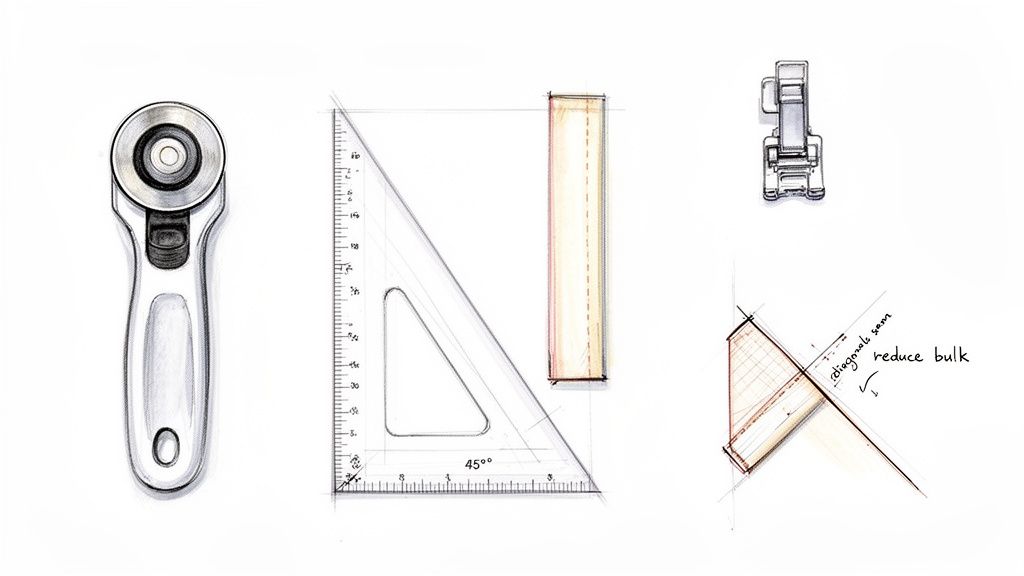
Knowing how to use a bias binding calculator is your first victory, but turning those numbers into a gorgeous finish is where the real artistry begins. It's the execution that separates a good project from a great one, and it all comes down to technique and having the right tools for the job.
Crisp, professional-looking edges start with a precise cut. I can't stress this enough: a sharp rotary cutter, a quality self-healing mat, and a long acrylic ruler are your best friends here. They're what guarantee every strip is perfectly straight and consistent—absolutely essential for an even binding.
Joining Strips for a Flat Finish
One of the most valuable tricks you can master is joining your binding strips with a diagonal seam. Instead of sewing them end-to-end with a straight stitch, which creates a bulky little lump, joining them on a 45-degree angle distributes the seam allowance. Trust me, it makes a world of difference.
Here's the method I swear by:
- Place two of your strips right sides together, forming a right angle.
- Stitch diagonally across, from the top left corner down to the bottom right.
- Trim off the excess fabric, leaving a neat ¼-inch seam allowance.
- Press that seam open.
This little technique gives you one long, continuous strip with seams that are practically invisible. No more bumps on your finished edge. It’s one of those small details that truly elevates your work.
Proper technique transforms your binding from a functional edge into a beautiful design element. It's these professional touches that show off the real craftsmanship of your work.
Avoiding Common Sewing Mistakes
When it's time to attach the binding to your project, tension is everything. One of the most common mistakes I see is accidentally stretching the bias strip while sewing. Because it’s cut on that flexible bias grain, it's incredibly easy to pull it too taut, which leads to puckered, wavy edges. We've all been there!
To keep this from happening, just guide the fabric gently and let your machine's feed dogs do the work. A walking foot is a lifesaver for this step, as it feeds the top and bottom layers of fabric through at the same rate. This ensures your stitching stays even without any stretching or shifting.
At B-Sew Inn, we're all about helping you master these skills. Our online classes often dive deep into finishing techniques that give your projects that polished, store-bought look. For a detailed walkthrough of the entire binding process, check out our guide on how to bind a quilt. With these pro tips in your toolkit, you’ll be creating beautiful, durable binding every single time.
Common Questions About Making Bias Binding
Even with a trusty bias binding calculator on hand, you’re bound to have questions pop into your head as you go from planning to actually cutting and sewing. I’ve been there! Getting these common sticking points sorted out is the key to sewing with confidence and getting that gorgeous, professional finish your projects deserve.
Let’s dig into some of the questions I hear all the time.
Can I Just Use Straight-Grain Strips for Everything?
I get why people ask this—it seems so much easier, right? But while straight-grain binding works fine for straight edges, it's a definite no-go for anything with a curve. For a quilt corner, an armhole, or a neckline, bias binding is absolutely essential.
Here’s why: fabric cut on the bias has a natural, beautiful stretch because the threads run at a 45-degree angle to the selvage. It's this unique quality that lets the binding hug curves smoothly without any weird puckers or stiff, awkward corners. Trust me, it’s the secret sauce for a flat, flawless finish.
How Much Extra Fabric Should I Actually Buy?
My solid rule of thumb is to add at least 10 to 15 inches to whatever total length you calculated. Think of this as your "tail"—it's the extra bit you need to join the ends of your binding cleanly without a fight. It gives you just enough overlap to create that perfect diagonal seam when you join the ends.
Here's a pro tip: if you’re working with a directional print or a large-scale pattern you want to match up, I’d suggest buying an extra quarter yard of fabric. That little bit of insurance gives you the wiggle room to fussy cut your strips for a seamless pattern flow.
What’s the Difference Between Single-Fold and Double-Fold?
Knowing which one to use can really make a difference in your project's final look and feel. They each have their own purpose and offer a different level of durability.
-
Single-Fold Bias Tape: With this type, the raw edges are just folded in to meet at the center. It’s perfect for things like decorative appliqué or finishing an edge that won’t get a lot of wear and tear.
-
Double-Fold Bias Binding: This is my go-to for most projects. It’s just single-fold tape that’s been folded in half one more time. This creates a super durable, fully enclosed edge that wraps right around your fabric, making it the hands-down winner for quilts, blankets, and garment necklines.
Getting these little details right is what really elevates your sewing. At B-Sew Inn, we’re here to support your creative journey with the best tools, advice, and classes out there. Our goal is to empower you to bring whatever sewing machine design you’re dreaming of to life.
Ready to take your projects to the next level? Come explore the world of possibilities with B-Sew Inn. Find the perfect machines, accessories, and educational resources to fuel your passion when you visit B-Sew Inn online.

