

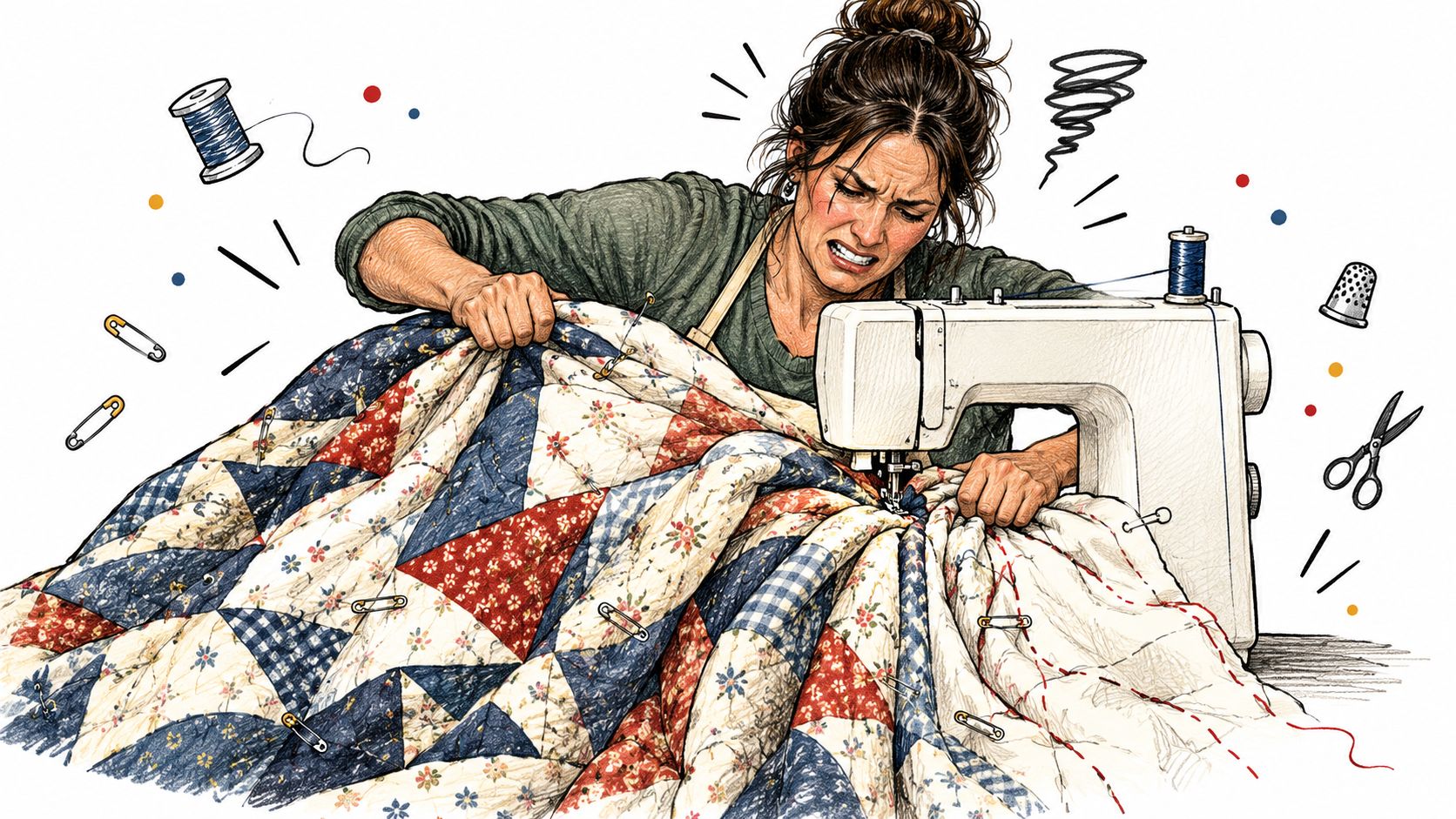
A queen-size quilt can expose the limits of a standard sewing machine quickly. The quilt bunches inside the throat, pins catch on the bed, the batting drags, and carefully planned lines begin to wander. The machine may still sew perfectly, but the quilter is spending more energy wrestling fabric than controlling the design.
Medium arm quilting machines offer a practical step up. They provide more working room than a domestic machine without automatically committing a home studio to a full long-arm frame. The right choice, however, depends on more than throat space. Project size, frame or table layout, body position, thread behavior, and the amount of practice a quilter is willing to invest all matter.
Table of Contents
- What a Medium Arm Quilting Machine Actually Is
- How Quilting Machines Got to the Mid-Arm
- Throat Space, Frames, and Stitch Regulation Explained
- Domestic vs Medium Arm vs Long Arm Machines
- Does a Mid-Arm Actually Fit Your Studio
- Ergonomics, Thread Tension, and the Learning Curve
- Choosing the Right Mid-Arm and Next Steps
What a Medium Arm Quilting Machine Actually Is
A medium-arm quilting machine, also called a mid-arm machine, is a dedicated quilting system positioned between a conventional home sewing machine and a full long-arm setup. Its defining feature is a wider throat, or harp space, which gives the quilt more room to pass beneath the needle. A technical review places mid-arm throat space at approximately 11 to 19 inches, compared with roughly 6 to 7 inches for a conventional home sewing machine. The historical and technical review of quilting-machine development explains why that clearance changes the handling experience.
The extra space doesn't make the quilt weight disappear. It does give the quilter a larger, flatter area for managing blocks, borders, and layered sections. Some machines are used at a sit-down table, while others mount to a compact frame. That distinction matters because the operator either moves the quilt beneath a stationary head or guides the machine head over a supported quilt.
The working difference
A medium arm is not just a domestic machine with a longer arm. Dedicated quilting systems are built around the movement of a quilt sandwich, with controls, handles, bobbin access, and needle visibility arranged for quilting rather than general garment construction. That specialization helps with free-motion work, ruler-guided lines, and repeatable edge-to-edge patterns.
The category suits several kinds of quilters:
- Home quilters who regularly finish large quilt tops and want less fabric wrestling.
- Serious hobbyists who need more control than a domestic machine provides.
- Small-scale quilting businesses that need a more dedicated finishing setup without immediately moving to a production-scale frame.
- Experienced domestic-machine quilters who are ready to learn a different quilting motion.
Before shopping, a quilter should decide whether the priority is sit-down control, a compact frame, or the ability to switch between both approaches. The guide at what a quilting machine does can help clarify that starting point. Throat size matters, but it should be treated as one measurement in a larger workspace and project-capacity decision.
How Quilting Machines Got to the Mid-Arm
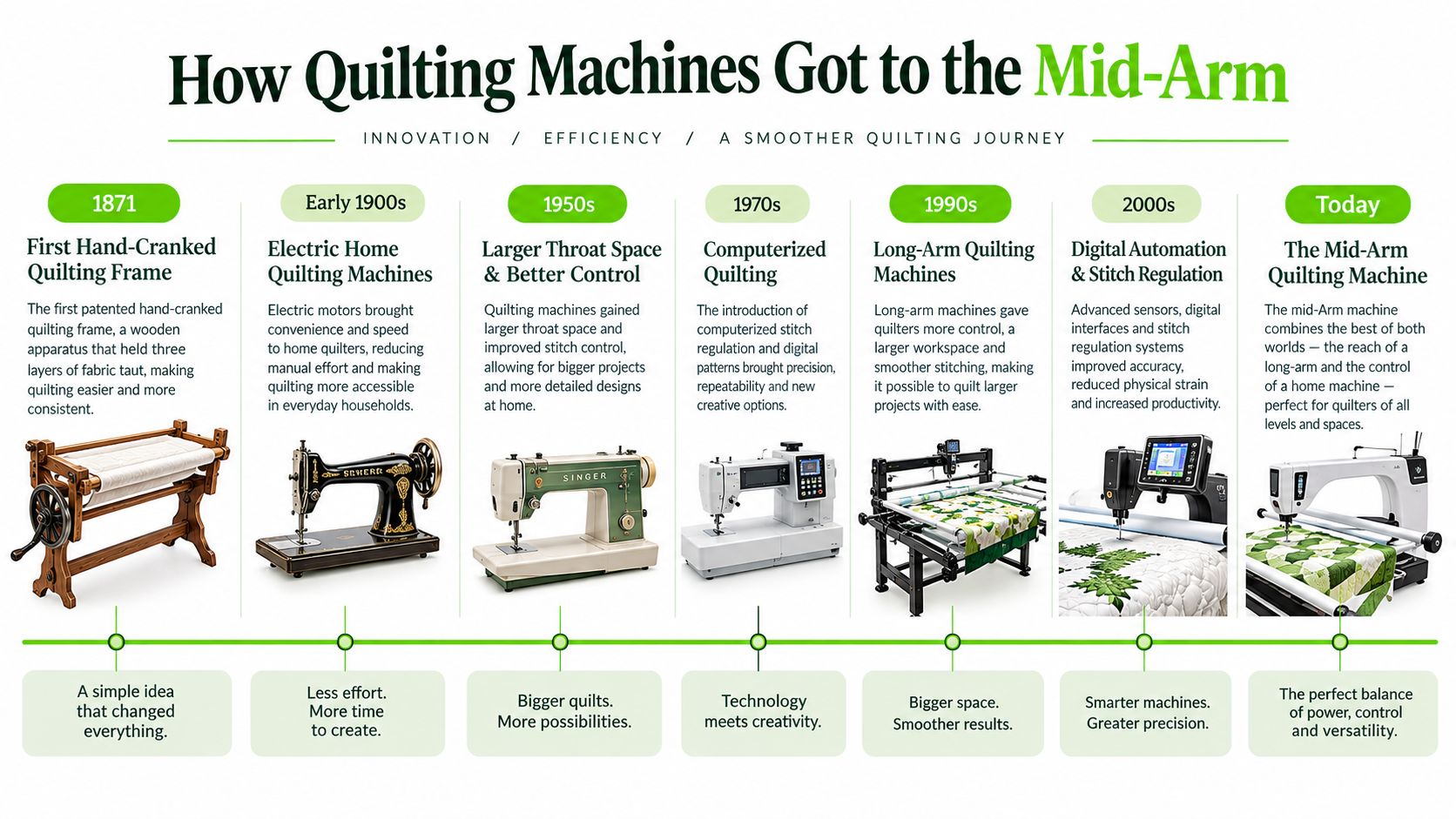
The mid-arm category makes more sense when viewed as an evolution rather than a marketing label. In 1871, the earliest dedicated quilting-machine design consisted of a sewing machine mounted on a wooden frame. By 1877, the sewing machine could move across the quilt with a hand crank, an operating principle that anticipated the motion of modern long-arm systems. These dates and developments are documented in the historical review of quilting-machine technology.
The same review identifies the Smithsonian's earliest known machine-sewn quilt as a crib-size quilt made by Joseph Granger of Worcester, Massachusetts, in 1879. The equipment was basic by modern standards, but the central problem was already familiar: hold the quilt in a manageable position while moving a sewing head across its layers.
Why the middle ground persists
Modern powered and computerized systems refined that same basic concept. A supported quilt moves through a larger working area, while the operator controls the needle path with less bunching than a domestic machine allows. A full long-arm system extends the concept further with a larger frame and more room for continuous quilting, but it also asks more from the room, setup, and operator.
Medium arms exist because many home quilters want dedicated quilting control without building their entire studio around a commercial-style installation. They preserve a more approachable scale while introducing features associated with specialized quilting machines, especially expanded clearance and regulated stitching.
That history also explains why a mid-arm shouldn't be judged as an oversized sewing machine. It belongs to a separate equipment category with its own handling technique. Buyers should evaluate it by the quilts they finish, the way they want to move through those quilts, and the space available for the complete system.
Throat Space, Frames, and Stitch Regulation Explained
Three features deserve more attention than a long list of decorative functions: throat space, support configuration, and stitch regulation.
Throat space determines how much quilt can sit beneath the machine before it must be repositioned. The reviewed technical source places mid-arm machines at approximately 11 to 19 inches, while a conventional home machine has roughly 6 to 7 inches. The technical history of quilting machines shows why even that difference can change how borders, blocks, and bulky layers are managed.
A table-based setup keeps the machine in one place while the quilter moves the quilt. A compact frame supports the quilt and can make advancing more structured. Neither arrangement is automatically superior. A sit-down quilter may prefer familiar seated control, while a frame user may value a more stable quilt surface and the ability to guide the machine head.
The feature that changes consistency
Stitch regulation synchronizes needle cycling with fabric movement so stitch length stays approximately consistent during free-motion work. In the Handi Quilter HQ Sixteen manual, regulated mode allows a selection of 4 to 15 stitches per inch, with higher SPI values producing shorter stitches. The HQ Sixteen user manual provides the operating range and the relationship between SPI and stitch length.
Lower settings suit faster, more open quilting. Higher settings suit finer detail, but they demand steadier movement and can consume more thread. A mismatch between machine speed and hand movement can create uneven stitches, thread buildup, or needle deflection. Regulation helps, but it doesn't replace control of the quilt sandwich.
| Feature | Typical Mid-Arm Range | What It Means |
|---|---|---|
| Throat space | Approximately 11 to 19 inches, according to the technical review | More clearance for blocks, borders, and layered sections than a conventional domestic machine |
| Regulated stitch length | 4 to 15 SPI, as specified in the HQ Sixteen manual | The operator can select a target stitch density for open quilting or finer detail |
| Support format | Sit-down table or compact frame | Determines whether the quilter moves the quilt, the machine head, or a combination of both |
| Quilting control | Regulated or manual operation | Regulation supports consistency, while manual mode relies more heavily on hand and motor coordination |
A quilter should test the chosen SPI with the actual thread, batting, and fabric. Stitch regulation improves repeatability, but balanced results still depend on movement, tension, needle choice, and the quilt sandwich.
For a clearer explanation of how regulation affects machine selection, see stitch regulators for sewing machines.
Domestic vs Medium Arm vs Long Arm Machines
The best machine is the one that matches the workroom and the projects. A domestic machine remains the sensible choice for piecing, general sewing, occasional quilting, and buyers who need the smallest setup. A long arm makes more sense for a dedicated quilting room, frequent large-quilt production, or a quilter who wants the machine head to travel across a supported quilt.
A medium arm wins when the domestic machine feels cramped but a full frame would dominate the room. It offers a meaningful increase in quilting clearance and control, but it won't deliver the same uninterrupted edge-to-edge workflow as a larger frame system.
| Factor | Domestic | Mid-Arm | Long Arm |
|---|---|---|---|
| Purchase commitment | Usually the most approachable category for a general-purpose sewist | A dedicated quilting investment with more specialized capability | The largest equipment commitment and often the most extensive supporting setup |
| Space | Fits a conventional sewing area or cabinet | Requires a substantial table or compact frame plus operator clearance | Requires a dedicated room or carefully planned studio zone |
| Learning curve | Familiar to most sewists | Requires practice with quilt movement, regulation, and bulk management | Requires frame loading, machine-head control, advancing, and often pantograph or computerized workflows |
| Best project fit | Piecing, smaller quilts, garments, and general sewing | Lap, wall, and bed-sized quilting where control and manageable scale matter | Large quilts, repeated edge-to-edge work, and high-volume finishing |
| Main advantage | Versatility and storage flexibility | Balance between working room and studio demands | Efficient movement across a supported quilt |
| Main limitation | Quilt bulk can crowd the throat and bed | Still requires careful room planning and operator adaptation | Footprint, setup, and cost can exceed what a home studio needs |
The practical rule
Choose a domestic machine if quilting is one of several sewing activities and larger quilts are occasional projects. Choose a long arm if quilting is the central activity and the room can support a permanent installation. Choose a medium arm when the quilter wants a dedicated quilting tool for larger projects but still needs a setup that can live in a home studio.
The phrase “can quilt a queen-size quilt” isn't enough. The important question is whether the machine can quilt that project comfortably, repeatedly, and with the operator's preferred motion. A machine with more clearance may still feel wrong if the table, frame, or controls force an awkward posture.
A buyer considering computerized operation or a larger frame should review computerized long-arm quilting machines, then compare that workflow with a sit-down or compact-frame approach.
Does a Mid-Arm Actually Fit Your Studio
Throat size is an incomplete buying test. A machine with a generous throat still needs a table or frame, room for the quilt to advance, a comfortable operator position, and clear access to power, lighting, and storage.
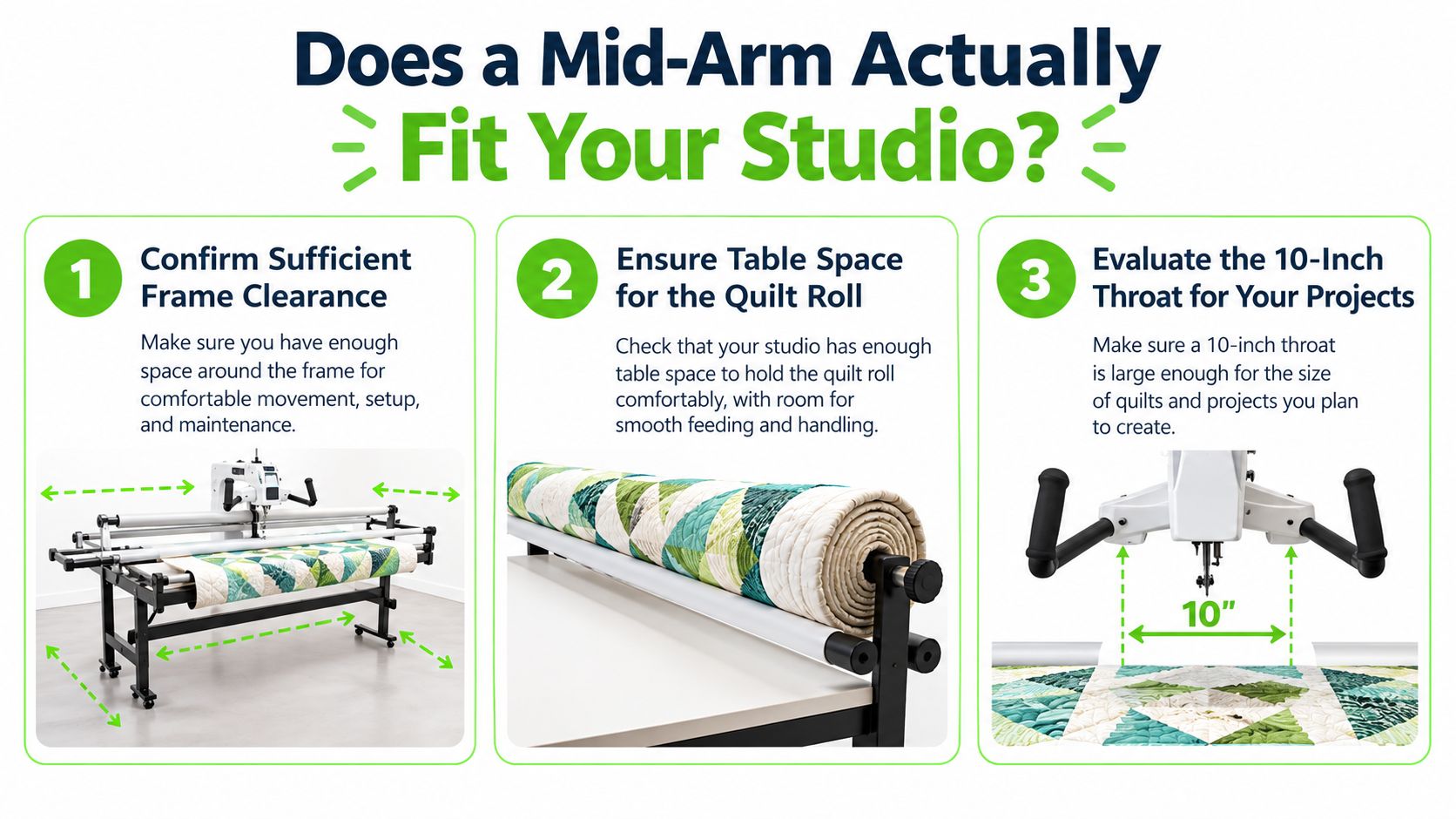
A frame can become the binding constraint before the machine does. Guidance on mid-arm installations notes that some quilting frames can require about 10 feet of room, as discussed in this workspace review. That figure should prompt measurement, not a blind purchase. Doorways, closets, windows, and walkways can make a technically compatible room impractical.
Measure the whole working zone
Before ordering, the buyer should sketch the machine, support furniture, and the operator's position as one layout. The sketch should include:
- Frame clearance: Leave enough room for the machine carriage and for the operator to reach controls without twisting.
- Quilt-roll space: Account for the growing roll of quilted fabric, not just the empty frame.
- Operator access: Mark the chair or standing position, pedal location, and the path used to load or advance the quilt.
- Room infrastructure: Check outlets, task-light placement, door swing, storage, and the route from delivery entrance to studio.
- Service access: Preserve enough working room to clean, adjust, or move the machine when service is needed.
The choice often becomes clear after the layout is drawn. A sit-down mid-arm may suit a room where a frame would block circulation. A compact-frame setup may be preferable when the quilter wants a supported quilt and has a dedicated wall or studio zone.
A ten-inch throat can be appropriate for some projects, but the number alone doesn't determine comfort. Quilt roll diameter, table depth, user reach, and the amount of fabric being handled all change the experience.
The video below offers another visual reference for thinking about quilting-machine space and setup.
For buyers working in a compact sewing room, sewing tables for small spaces is a useful starting point before comparing machine specifications.
Ergonomics, Thread Tension, and the Learning Curve
A machine can produce beautiful stitches and still be the wrong fit for the person operating it. Mid-arm quilting changes the physical task through longer reach, heavier fabric handling, different handle positions, and repeated quilt advancing. A buyer should test the machine with a representative quilt sandwich, not only with a thin fabric sample.
Seat height affects needle visibility and shoulder position. The pedal should sit where the operator can use it without reaching forward, and controls should remain accessible without repeatedly leaning across the table. Frame users should check whether the handle position encourages relaxed elbows rather than locked shoulders.
Test the machine with real materials
Thread tension deserves a system-level approach. Fabric, thread, batting, needle, bobbin, and machine configuration interact, so a dial setting copied from another quilt may not transfer reliably. SCHMETZ quilting guidance recommends using the lowest tension that produces a smooth, pucker-free result and checking each material combination separately.
The Handi Quilter documentation also recommends testing tension on scrap material. A useful sequence is:
- Install the intended needle and thread. Confirm that the thread is fully seated between the tension discs.
- Build a test sandwich. Use the project's actual fabric and batting rather than a substitute.
- Sew from both sides. Look for a balanced lock between the top and bobbin threads.
- Adjust incrementally. Change one variable at a time and record what changed.
- Inspect the symptoms. Excessive upper tension can pull bobbin thread upward and create puckering. Insufficient upper tension can leave loops or a loose underside.
The tension-adjustment guide provides useful background, but an in-store test remains more informative when the buyer can feel the controls and see the stitch formation.
Regulation reduces one problem, not every problem
Stitch regulation can make slow curves and faster movements more consistent, but it doesn't eliminate the need to manage starts, stops, bulk, tension, and design direction. Manual mode can offer direct control, while regulated modes can support repeatable stitch length. The best setting depends on the design and the operator's movement.
A productive demonstration should include:
- Quilting slowly and then changing speed to evaluate how regulation responds.
- Testing needle visibility while seated in the intended posture.
- Moving the machine or quilt through a curve, straight line, and stop.
- Checking pedal response and handle reach.
- Asking how the machine is cleaned, serviced, threaded, and adjusted.
- Testing the intended thread and batting combination where possible.
The learning curve is real, but it becomes manageable when the buyer practices on sample sandwiches and takes an in-person machine mastery session. A machine should build capacity without creating a new source of persistent strain.
Choosing the Right Mid-Arm and Next Steps
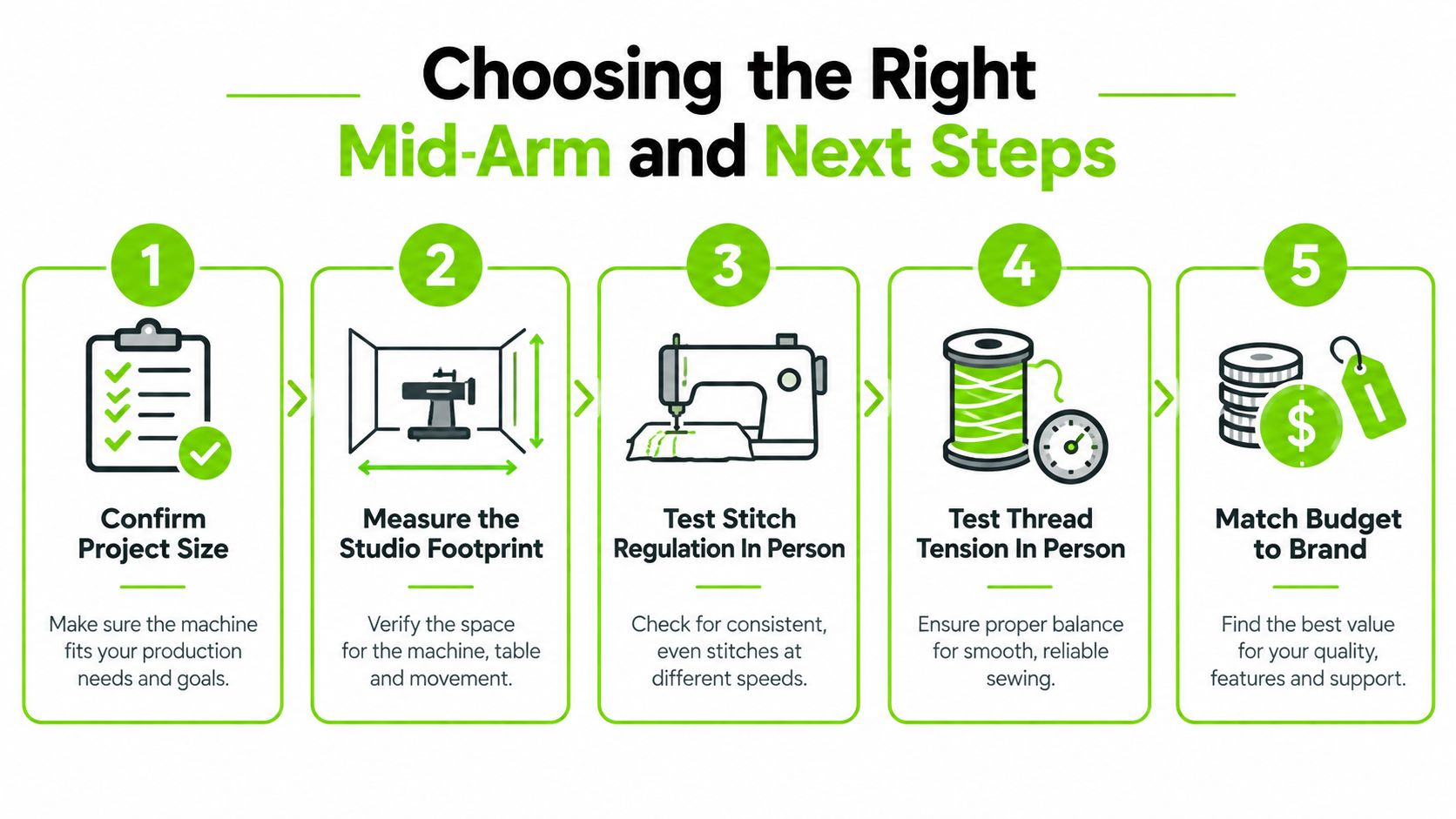
A sound purchase decision follows the project rather than the feature sheet. The buyer should answer five questions before comparing specific machines:
- What project size appears most often? A quilter finishing wall quilts and smaller bed quilts may need a different workflow from one finishing large bed-sized quilts continuously.
- How will the quilt move? Decide between sit-down control, a compact frame, or a machine that supports a flexible setup.
- What does the room hold? Measure the complete table or frame footprint, operator clearance, quilt-roll area, and service access.
- Which controls need testing? Stitch regulation, handle placement, pedal response, screen readability, needle visibility, and bobbin access should be tested in person.
- What belongs in the total purchase? Include the frame or table, leaders, lighting, rulers, thread, needles, batting for practice, delivery, setup, and future service.
The current mid-arm discussion at a specialist dealer can include Baby Lock, Janome, and Grace equipment, but exact model availability and frame compatibility must be confirmed before purchase. A machine intended for a 16-inch class frame shouldn't be assumed to fit an 18-inch class frame, and the reverse is just as important. The salesperson should verify the machine, frame, table, and accessory combination as a complete system rather than quoting a machine-only price.
The direct recommendation
For most home quilters moving beyond a domestic machine, a sit-down or compact-frame medium arm with stitch regulation is the strongest starting point. It provides more quilting control without forcing every buyer into a full-room installation. A full long arm is the better choice only when the room, project volume, and preferred quilting motion justify that commitment.
The final test should happen before checkout. Buyers should bring measurements, describe their typical quilt sizes, and spend enough time at the machine to evaluate reach, visibility, movement, and tension. An in-person demonstration, machine mastery session, service plan, or trade-in discussion can be more valuable than selecting a machine from a specification sheet.
B-Sew Inn is an authorized sewing, quilting and embroidery machine dealer with retail stores in Tulsa, Oklahoma City, Springfield, Humble, and Fayetteville, plus an online store at B-Sew Inn. Quilters can see and test available Baby Lock, Bernina, Bernette, Brother, and Janome machines, ask about Grace setups, purchase quilting supplies, and arrange in-person classes, machine mastery, service, repair, or trade-ins before making a medium-arm investment.

