

A quilter can spend weeks collecting fabric, saving tutorials, and planning a first project, then stall at the first accurate quarter-inch seam. The problem usually isn't motivation. It's a mismatch between the class format, the learner's available time, and the machine or feet sitting beside the cutting mat.
The best quilting classes online solve part of that problem by making instruction repeatable and accessible. They don't replace hands-on machine time, however. A video can demonstrate a walking foot, but it can't inspect a machine's tension, watch a learner guide fabric, or help choose the right presser foot for a specific model. That's why online learning works best when paired with practical equipment guidance, local classes, and access to service support.
| Learner situation | Best online format | What it provides | What it may not provide |
|---|---|---|---|
| Busy beginner | Self-paced video library | Pause-and-replay lessons, patterns, supply lists | Personal feedback and accountability |
| Quilter troubleshooting a technique | Live virtual workshop | Scheduled instruction and real-time questions | Flexible scheduling |
| Maker who needs momentum | Hybrid membership | Recorded lessons, live projects, and community | A single linear project path |
| Machine buyer choosing a setup | Online research plus in-person testing | Broad education before purchase | Hands-on confirmation unless the buyer visits a store |
The right class should help a quilter finish a project, not just accumulate more videos. The sections below compare formats, skill levels, equipment requirements, and the point at which a paid class earns its place beside free tutorials.
Table of Contents
- Why Online Quilting Classes Have Grown Into a Real Option
- The Three Main Formats You Will See Again and Again
- Best Online Quilting Classes by Skill Level
- Comparing the Leading Online Quilting Platforms
- Matching a Class to Your Machine and Notions
- When Free Tutorials Are Enough and When They Are Not
- How to Pick the Right Class and Take the Next Step
Why Online Quilting Classes Have Grown Into a Real Option
A half-finished baby quilt often tells the same story. The fabric is cut, the first blocks look promising, and then the project reaches sashing, borders, or machine quilting. The learner searches for another short video, finds several conflicting methods, and puts the quilt aside.
That pattern became easier to address as online instruction developed beyond isolated tutorials. One major craft platform listed 1,764 total classes in 2026, with quilting included alongside sewing, embroidery, knitting, and other maker subjects, while another platform advertised “over 1000” art and craft classes and included quilting among its core offerings (Craftsy's all-classes catalog). The significance isn't just the size of those catalogs. It's the move toward structured lessons, searchable libraries, live events, and recordings that learners can revisit.
From occasional lecture to repeatable instruction
Online quilting educators now commonly organize lessons around a project or a defined technique. A beginner may find instruction on rotary cutting and patchwork, while an experienced maker can search for free-motion quilting, paper piecing, ruler work, or edge-to-edge design. Supply lists, downloadable patterns, notes, and recorded sessions make the material easier to use beside a sewing machine.
Independent market data also describes a substantial shift after 2020. A quilting-industry report states that virtual quilting classes increased 150% since 2020 and reached 2 million U.S. participants in 2023, while 60% of U.S. quilters attend at least one workshop or class annually (quilting industry participation data). Those figures point to online learning becoming a regular training channel rather than a temporary substitute for gathering in person.
A learner who wants broader background on digital instruction can also review B-Sew Inn's perspective on learning to sew through online classes. The practical takeaway is straightforward: online classes have enough depth to support beginners and advanced makers, but the class still has to match the person, project, and equipment.
Practical rule: Choose a class for the project the learner intends to finish, not for the size of the video library.
The Three Main Formats You Will See Again and Again
Most quilting classes online fall into three delivery formats. Identifying the format before paying prevents a common mistake, choosing a class based on its topic while ignoring how instruction arrives.
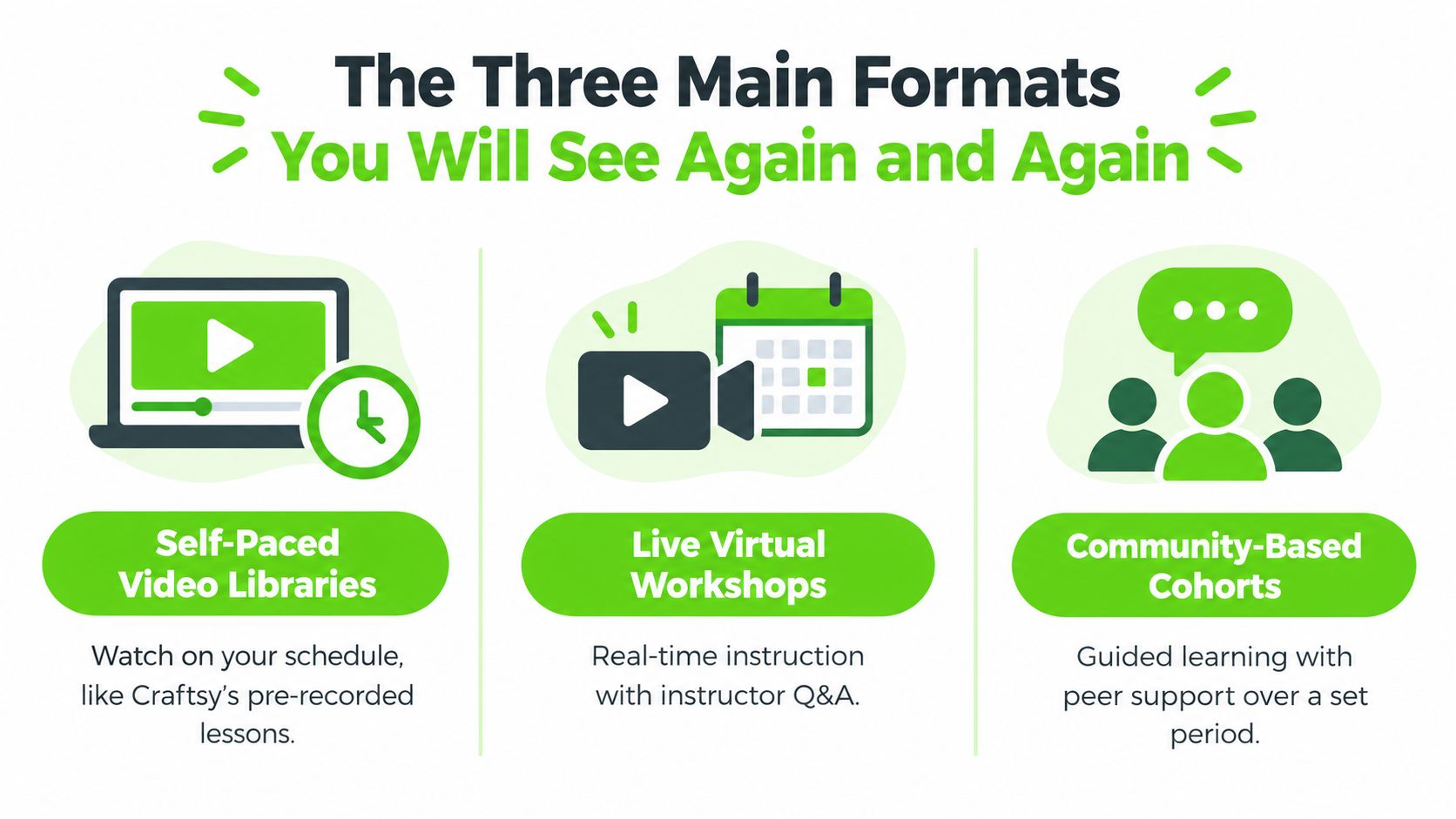
Self-paced video libraries
A self-paced library suits a learner who can sew in irregular blocks of time. Lessons are recorded, divided into manageable segments, and available for replay. One quilting class format provides about 3 hours of video lessons divided into 5- or 10-minute videos, while another offers over 4.5 hours of teaching content (Quilters Question Time class formats). That structure lets a beginner pause after a cutting demonstration, move to the machine, and return when the next step is ready.
The weakness is accountability. A learner who struggles with fabric orientation or seam accuracy may watch the same lesson repeatedly without receiving a diagnosis. The format resembles effective self-paced corporate training in its flexibility, but quilting adds a physical skill that still requires deliberate practice.
Live virtual workshops
Live workshops place instruction on a schedule. Participants attend a video session, ask questions as they work, and often upload progress for feedback. A blended workshop format can include 2 hours of synchronous instruction, 90 minutes of independent sewing, followed by another 2 hours of synchronous instruction (online workshop structure).
This format works well for learners who start strongly but lose momentum. It also exposes problems earlier, before inaccurate cutting or pressing spreads across an entire project. The tradeoff is fixed timing. Missed sessions may be recorded, but the live question period has already passed.
Hybrid memberships and cohorts
Hybrid programs combine an expanding recorded catalog with scheduled projects, printable patterns, and a community space. They provide more breadth than a single workshop and more accountability than a purely self-directed library. The learner gains a place to ask questions and share progress, but the monthly flow can become distracting if the current project doesn't match the person's skill or available machine.
A guide to online sewing courses can help learners compare this broader model with single-purpose instruction. The clearest choice is simple: pick self-paced video for schedule control, live instruction for immediate feedback, and a hybrid community for sustained practice.
Best Online Quilting Classes by Skill Level
Skill level should determine the class, not the other way around. A beginner who enrolls in advanced ruler work may own the right fabric and machine yet lack the piecing habits needed to understand the lesson. An experienced quilter, meanwhile, may find a basic sampler too slow and lose interest before completing it.
Beginners need accuracy before complexity
A strong beginner class should teach rotary cutting, quarter-inch seam control, pressing direction, block assembly, and a complete small quilt. A simple patchwork lap quilt is more useful than a collection of disconnected demonstrations because the learner encounters the transitions where projects commonly stall.
The supply list matters. Basic patchwork generally calls for a sewing machine, rotary cutter, cutting mat, ruler, fabric, thread, and quilting notions. Course listings often specify these requirements in advance, and some identify a walking foot as required equipment (example quilting supply requirements).
A paid class can be worthwhile when it supplies a clear pattern, cutting instructions, and an order of operations. A major quilting publisher currently lists 50 online course offerings, with single-course prices commonly around $24.95 to $34.95 (online quilting course catalog and pricing). The price range isn't a guarantee of teaching quality, but it gives beginners a realistic reference for structured digital instruction.
Readers still building foundational skills can use B-Sew Inn's guide to quilting classes for beginners before selecting a project.
Intermediate quilters should solve a specific problem
Intermediate learners don't need another explanation of how a sewing machine turns on. They need a class that addresses the technique holding back the next project.
Useful subjects include:
- Curved piecing: A class should explain marking, easing, pinning, and pressing without stretching bias edges.
- Half-square triangles: Instruction should cover trimming and layout accuracy, especially when units come from precut strips or rolls.
- T-shirt quilts: The class should address stabilizer selection, bulky seams, fabric preparation, and the difference between piecing and quilting a memory project.
- Machine quilting: A walking foot can handle controlled straight-line quilting, while free-motion work requires different coordination and setup.
The finished outcome should be visible before enrollment. If the class promises a technique without a project, the learner should confirm that the lesson includes enough practice examples to transfer the skill to another quilt.
Advanced makers need feedback on movement and design
Advanced classes should focus on free-motion feathers, ruler work, paper-pieced art quilts, thread choices, and design control. At this level, the challenge is rarely understanding a definition. It's developing consistency, judging scale, and correcting movement before the quilt becomes difficult to recover.
Ruler work requires a compatible ruler foot, a stable surface, and a specialty ruler that matches the class. Free-motion quilting generally requires a free-motion or darning foot and a machine setup that allows the quilter to control fabric movement. A class that demonstrates advanced work without identifying the required foot leaves learners to solve the most important equipment question alone.
The best advanced format is often blended. Recorded demonstrations allow repeated study of hand position and stitch movement, while live critique helps identify why curves flatten, feathers crowd, or designs drift. A learner should choose depth and feedback over a large catalog when the goal is to produce a polished finished quilt.
Comparing the Leading Online Quilting Platforms
A platform should be judged by its delivery model, not by its marketing language. Before enrollment, a quilter should confirm whether the purchase covers one course, a subscription, or access to a rotating collection.
| Platform | Price Model | Access | Project Focus | Feedback/Community |
|---|---|---|---|---|
| Broad craft library | Single courses or membership access | Usually recorded access, terms vary | Patchwork, machine quilting, appliqué, and general techniques | Often limited on single courses |
| Dedicated quilt school | Course-based pricing | Course access, replay policy varies | Technique-led projects and structured workshops | May include instructor contact |
| Subscription hub | Recurring membership | Catalog access while membership remains active | Monthly projects, patterns, and mixed skill levels | Community forum or group support may be included |
| Free tutorial channel | No course fee | Self-paced viewing | Individual techniques and project demonstrations | Usually no personal critique |
| Locally supported membership | Membership or class-based access | Recorded lessons plus scheduled activities | Quilting, sewing, and machine-related learning | Online support with possible in-store help |
How the models differ in practice
Broad libraries suit learners who want to sample several techniques. Their strength is variety and replay, but a beginner can easily collect lessons without completing a project. A dedicated quilt school is usually a better choice when the learner has one specific outcome, such as a curved-pieced quilt or a machine-quilted finish.
Subscription hubs make sense for quilters who enjoy ongoing projects and community participation. They also require discipline. A membership can become expensive in practical terms if the learner keeps paying while rarely opening the lessons.
Free channels are useful as a technique sampler. They help a quilter evaluate an instructor's pace and explanations before paying. They're less useful when a learner needs an ordered curriculum, downloadable cutting instructions, or feedback on a photograph of a problem block.
The locally supported option matters when online instruction intersects with equipment. B-Creative, backed by B-Sew Inn, can serve as a bridge between digital lessons, machine guidance, and in-person support. B-Sew Inn is an authorized dealer for Baby Lock, Bernina, Bernette, Brother, and Janome machines, along with sergers, longarm quilting machines, embroidery designs, thread, stabilizer, notions, cabinets, and cutting tables. The company sells and services equipment, but it doesn't manufacture machines or create custom machine designs.
Course access policies deserve close attention. Some classes offer lifetime access, others allow downloads for only five days, and some state that refunds aren't available because recorded materials remain permanently accessible (example of varied replay and refund policies). Read those terms before checkout.
Matching a Class to Your Machine and Notions
A class can be well taught and still be the wrong purchase if the learner's machine cannot perform the required setup. Before enrollment, the quilter should audit three things: the machine type, the presser feet, and the cutting and quilting notions already available.
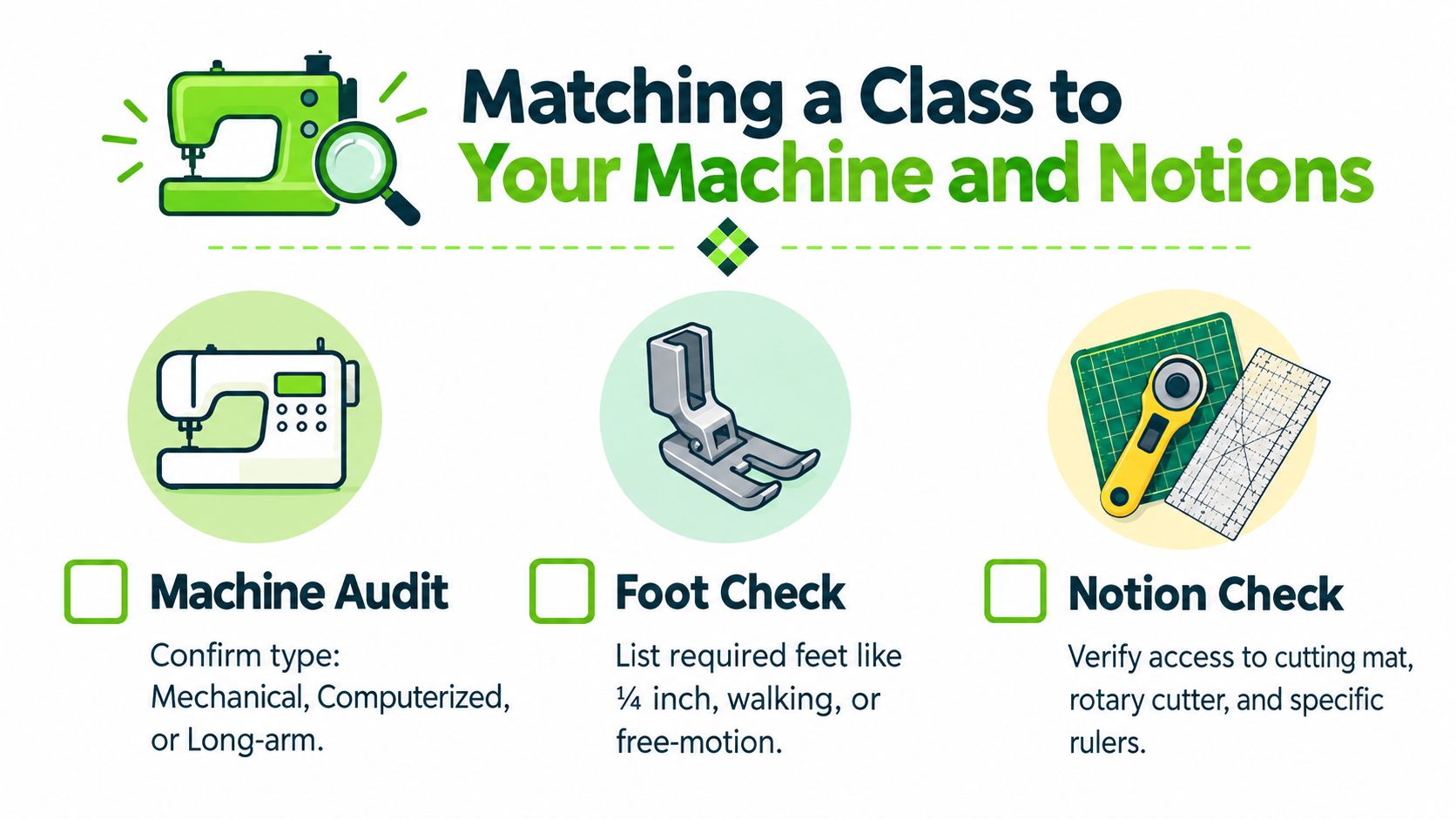
Start with the machine
A mechanical machine may provide dependable straight stitching with fewer automated features. A computerized machine can add needle-position control, speed adjustment, decorative stitches, and convenience features that help with repetitive quilting tasks. A longarm machine serves a different purpose, giving the quilter a larger working area and specialized control for quilting a basted quilt sandwich.
The phrase “quilting machine” covers several setups, so learners should review what the class requires. B-Sew Inn's explanation of what a quilting machine is can help separate a standard sewing machine with quilting features from a dedicated longarm system.
Match the foot to the technique
Straight-line piecing needs a consistent quarter-inch seam. A quarter-inch foot can make that seam easier to maintain, but the learner still needs to test the actual finished measurement and adjust needle position when necessary.
A walking foot helps feed multiple quilt layers evenly during straight-line quilting. Free-motion quilting typically calls for a darning or free-motion foot and a machine that allows the feed dogs to be lowered or covered. Ruler work requires a true ruler foot with the correct height and clearance. A generic foot is not a safe substitute because the ruler must pass beside the foot without striking the needle.
Embroidery-focused quilting or embellishment classes may require embroidery features found on machines carried by B-Sew Inn, including Baby Lock Destiny or Brother Luminaire models. The class listing should identify hoop size, stabilizer, thread, and design-file requirements before the learner buys anything.
Run this checklist first
- Machine audit: Confirm whether the class expects a mechanical, computerized, embroidery, or longarm machine.
- Foot check: Identify the required quarter-inch, walking, free-motion, or ruler foot.
- Notion check: Gather the cutting mat, rotary cutter, accurate ruler, thread, fabric, batting, and binding supplies.
- Access check: Verify replay length, downloads, recordings, and refund terms.
- Practice check: Reserve enough uninterrupted machine time to repeat the demonstrated technique.
When Free Tutorials Are Enough and When They Are Not
Free tutorials do several jobs well. They can refresh a single technique, show how to troubleshoot one seam, or let a learner sample an instructor's teaching style before paying. A quilter who forgets how to attach binding doesn't necessarily need a full course.
Free content becomes inadequate when the learner has a project to finish and no reliable sequence for getting there. A beginner may follow separate videos for blocks, then stall at sashing and borders because no single tutorial explains the construction order, cutting math, pressing plan, and final assembly.
The value of paid structure
Paid classes usually earn their cost through organization and support, not through information that can't be found anywhere else. A structured series puts skills in a logical order, gives the learner a defined project, and may include patterns, supply lists, community access, or instructor critique. Those features reduce the number of decisions a beginner must make alone.
One independent quilting-learning guide describes free channels as self-paced but lacking personal feedback, while paid instruction may add pattern materials, community access, and instructor critique. That distinction matters even more for advanced learners, who often need someone to identify a movement problem or design inconsistency rather than repeat a basic demonstration.
Free is excellent for a single technique. Paid is the better choice for a project that deserves a finish.
A useful rule is free for technique singles, paid for projects intended for completion. If the learner needs accountability, troubleshooting, or a complete pattern, the paid option is usually the more efficient path.
Readers looking for a local supplement can also review B-Sew Inn's free sewing lessons, then decide whether a structured class or hands-on help is the next practical step.
How to Pick the Right Class and Take the Next Step
Start with the outcome. “Learn quilting” is too broad to guide a purchase. “Finish a patchwork lap quilt,” “improve free-motion feathers,” or “learn ruler work on a domestic machine” gives the learner a useful target.
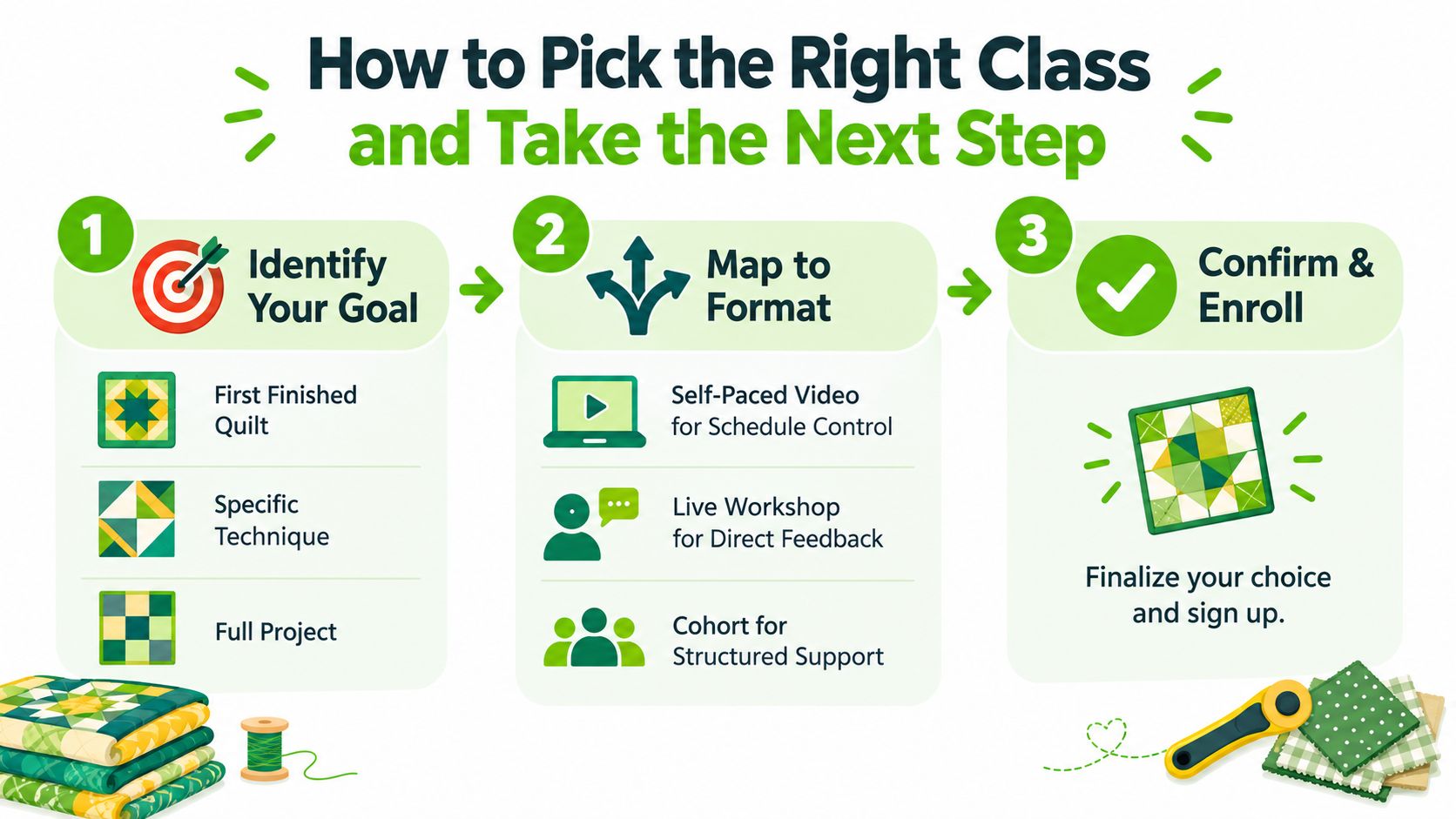
Then match the goal to the delivery format:
- First finished quilt: Choose a self-paced beginner project if the schedule changes often.
- Specific technique: Choose a focused workshop when the learner needs concentrated instruction.
- Full project with accountability: Choose a live cohort or hybrid membership with checkpoints and community support.
A total beginner who needs a machine first should visit a store and test basic controls, quarter-inch accuracy, speed adjustment, and the available quilting feet before enrolling. A returning sewist with a mid-tier machine should identify the next technique, then confirm that the required foot and stitch settings are compatible. A confident maker ready for ruler work or free-motion quilting should purchase or test the specialty foot, ruler, and extension support before class begins.
Course creators and educators comparing production options may find it useful to compare course creator tools, but learners should focus on the result: clear instruction, usable materials, and an equipment list that matches the machine at home.
The practical bridge is B-Creative membership combined with in-person machine fittings and classes. A learner can study online, bring questions to a retail location, and test whether a machine, foot, or notion supports the chosen quilting technique. Readers in Tulsa and Oklahoma City, Oklahoma, Springfield, Missouri, Humble, Texas, or Fayetteville, Arkansas, can see and try machines in person before making a significant purchase.
The final decision checklist is short: define the finished project, choose self-paced, live, or hybrid support, confirm the required machine and feet, read the access policy, and take one concrete action. That action may be enrolling, booking an in-person class, scheduling service, or visiting a store to test the setup.
B-Sew Inn offers quilting machines, feet, notions, service, trade-ins, B-Creative learning, and in-person classes at retail locations in Oklahoma, Missouri, Texas, and Arkansas. Visit B-Sew Inn to browse quilting equipment, book hands-on help, or arrange an in-store machine fitting before choosing the next online quilting class.

