
Picking the right machine is easily the biggest decision you'll make when you're dreaming of creating gorgeous quilts or detailed embroidery. The best sewing machines for quilting and embroidery are often either highly specialized or do-it-all combination models, each built to handle the unique needs of its craft—from wrangling huge pieces of fabric to stitching out tiny, colorful designs. What you choose really comes down to what you love to create, the kinds of projects you have in mind, and where you see your craft going.
Your Guide to Quilting and Embroidery Machines
Welcome! Think of this as your personal guide to finding the perfect machine for your passion, whether that's quilting, embroidery, or both. If you're a quilter mapping out a family heirloom or an embroidery artist getting a custom apparel business off the ground, this guide will go way beyond boring feature lists. We're going to dive into how to create various designs, showcasing tangible examples you can replicate to build your skills.
Here at bsewinn.com, our commitment is to empower crafters like you. We truly believe the right machine, combined with the right skills, is what turns a creative idea into something you can be proud of. Through our extensive resources, including hands-on online classes and training, we provide the support you need to master your custom sewing machine designs and bring your vision to life.
Understanding Your Creative Needs
Before we get into specific models, let's take a moment to get clear on your goals. Are you all-in on one craft, or do you want the freedom to jump between quilting and embroidery? Your answer here is the first major fork in the road, pointing you toward either a dedicated machine or a versatile combo model. Each path has its own perks depending on how you like to work.
For example, a quilter tackling a king-sized project absolutely needs a machine with a huge throat space to manage all that fabric. On the flip side, someone personalizing hats needs a machine that can hoop up small, tricky items and stitch with incredible precision. A tangible example is creating a "quilted memories" throw pillow, which would involve piecing fabric squares (quilting) and then adding an embroidered monogram (embroidery), a project perfectly suited for a combination machine.
Choosing the right machine is like selecting the right paintbrush for an artist. While many can create art, the specialized tool makes the process smoother and the final product more refined.
To help you figure out which direction is best for you, let’s break down the core differences between machines built for quilting versus those designed for embroidery. This will set the stage for a closer look at the specific features that really matter in each category.
| Machine Focus | Primary Functionality | Ideal For | Key Consideration |
|---|---|---|---|
| Quilting | High-speed straight stitching, handling bulky layers, and free-motion work. | Large quilts, piecing, and finishing projects that need lots of workspace. | Throat space and stitch regulation are everything. |
| Embroidery | Automated, precise stitching of digital designs within a hoop. | Monogramming, custom apparel, decorative art, and detailed logos. | Hoop size and built-in design editing capabilities. |
| Combination | Offers both quilting/sewing and embroidery capabilities in one unit. | Crafters who enjoy both disciplines and want to save space. | Balancing specialized features against all-in-one convenience. |
Comparing Machine Types for Your Creative Focus
Picking the right sewing machine is a lot like choosing the right tool for any craft—it’s the first and most important step. When you’re looking at the incredible world of sewing machines for quilting and embroidery, what you love to do should be your number one guide. Are you dreaming of piecing intricate quilts or stitching out crisp, detailed logos? Your answer will point you to the right machine.
Each type of machine is built for a specific job, and knowing their strengths will help you make a smart investment. Let’s break down the main players: dedicated quilting machines, dedicated embroidery machines, and the ever-popular combination models that try to do a bit of everything. We'll even touch on why a serger might be a great addition to your sewing room.
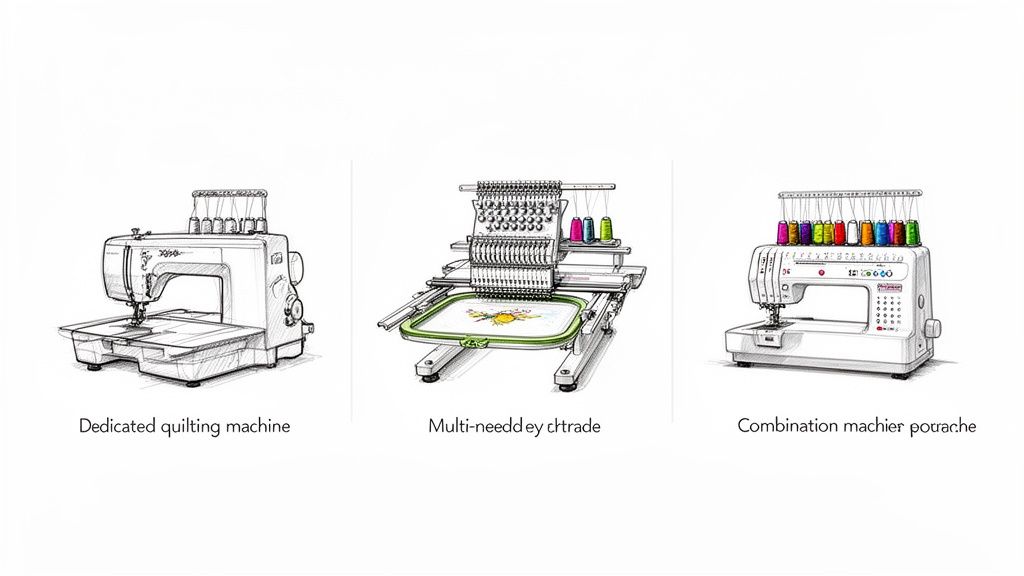
Dedicated Quilting Machines
A dedicated quilting machine is a true workhorse. Its main mission in life is to help you handle big, bulky projects with both speed and precision. The most noticeable feature, and the one quilters rave about, is the generous throat space—that’s the open area to the right of the needle. A large throat space is non-negotiable when you’re wrestling a king-sized quilt under the needle without it bunching up.
These machines are built for high-speed straight stitching, letting you chain-piece blocks together in no time. For a tangible project like a "Log Cabin" quilt block, this speed is invaluable. They’re also packed with features that support a quilter’s workflow, like a powerful motor that punches through layers of fabric and batting without skipping a stitch. And for free-motion quilters, advanced functions like stitch regulation are a game-changer, ensuring every single stitch is perfectly uniform. If your heart is set on making bedspreads and wall hangings, this machine is your best friend.
Dedicated Embroidery Machines
On the flip side, a dedicated embroidery machine is all about artistry and precision. Think of it as a creative robot that flawlessly stitches digital designs onto fabric held perfectly taut in a hoop. These machines are engineered for detail, using an embroidery arm to move the hoop while the needle does its work. You can create everything from delicate monograms for a wedding gift to complex, multi-colored logos for custom team jackets—a perfect tangible example of its capabilities.
The key things to look for here are hoop size, which determines the maximum area of your design, and multi-needle capability. A single-needle machine means you'll be stopping to manually change thread for each color. A multi-needle model, however, holds several colors at once and stitches complex designs automatically—a massive time-saver for anyone running a small business personalizing apparel or for hobbyists who just love adding intricate flair.
Combination Machines: The Best of Both Worlds?
Combination machines are the jack-of-all-trades, designed for the crafter who loves to do it all. These machines work as a standard sewing and quilting machine but also come with a detachable embroidery unit. With a simple swap, you can go from piecing a quilt top to stitching a design on a tea towel.
The real trade-off with a combination machine comes down to specialization versus convenience. You get incredible versatility in one machine, which saves a lot of space. But dedicated machines almost always outperform them in their specific craft—think larger throat spaces for quilting or faster, multi-needle embroidery.
This category has seen amazing innovation, largely because so many people are getting into crafting at home. The global sewing machine market, which was valued at around USD 5.59 billion in 2025, is expected to hit USD 7.26 billion by 2029. That growth really shows how much demand there is for powerful machines that can handle more than one creative outlet.
For many people, these machines are the perfect way to explore both quilting and embroidery. To help you get the hang of it, bsewinn.com offers tons of online classes and training to help you master both sides of your new machine. Another big part of this decision is understanding what a computerized machine offers over a mechanical one. For a deeper dive, check out our guide on computerized sewing machines vs mechanical.
To make the decision a bit easier, here’s a side-by-side look at what each machine type really focuses on.
Quilting vs. Embroidery Machine Feature Comparison
This table breaks down the critical features of dedicated quilting, dedicated embroidery, and combination machines to help you see exactly where their priorities lie.
| Feature Focus | Dedicated Quilting Machine | Dedicated Embroidery Machine | Combination Machine |
|---|---|---|---|
| Primary Function | High-speed straight stitching, piecing, and quilting | Automated stitching of digital designs | General sewing, quilting, and embroidery (with unit) |
| Throat Space | Very large (often 9" to 18") for quilt maneuvering | Standard size; not a primary design focus | Medium to large (often 7" to 11") to accommodate both |
| Key Strength | Power, speed, and space for large fabric layers | Precision, automation, and intricate detail work | Versatility and space-saving for multi-crafters |
| Needle Type | Single needle, built for power and speed | Single or multi-needle for color changes | Single needle for all functions |
| Automation | Stitch regulation, thread cutting, needle up/down | Automated embroidery arm, design processing | Automated sewing stitches and embroidery functions |
| Ideal For | Avid quilters making bed-size or larger projects | Hobbyists or businesses focused on personalization | Crafters who enjoy both disciplines and value flexibility |
Seeing it all laid out like this can really clarify which machine aligns best with the projects you’re excited to start.
Critical Features for Quilting Success
When you move from simply piecing quilt tops to the actual art of quilting them, the machine you use becomes everything. Let me tell you, the right tools don't just make it easier—they completely change the quality of your finished quilt. For any serious quilter, some features are simply non-negotiable if you want beautiful, professional-looking results.
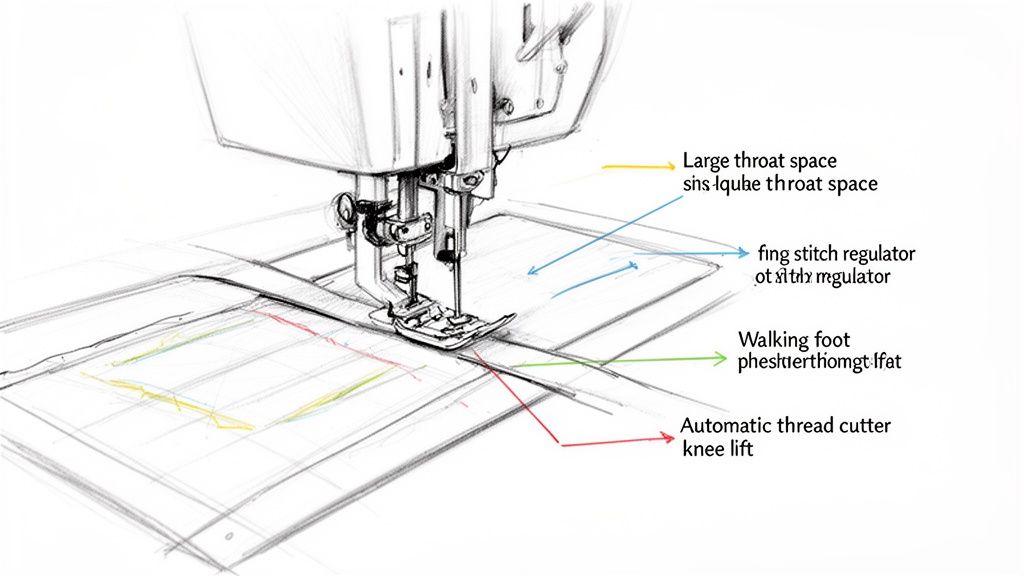
These are the specialized features that really separate a standard sewing machine from true sewing machines for quilting and embroidery. They’re designed from the ground up to solve the unique headaches quilters face, from wrestling bulky layers to keeping your stitches perfect over a huge quilt.
Throat Space: The Quilter’s Best Friend
If there’s one feature I’d call absolutely critical, it’s throat space (sometimes called the harp). This is the open area to the right of your needle, and it dictates how much rolled-up quilt you can cram in there while you work. A small throat of 5-7 inches turns quilting anything bigger than a baby blanket into a frustrating shoving match with bunched-up fabric. You just can't win.
A machine built for quilting, on the other hand, will give you a wonderfully expansive throat space—we’re talking 9 inches, 11 inches, or even more. That generous room lets you glide a queen or king-sized quilt smoothly without it getting compressed, freeing you up to create gorgeous free-motion designs or stitch long, straight lines without your fabric distorting.
Achieving Perfect Stitches
Consistency is what makes a quilt look truly high-quality, and a couple of features are essential to get you there: stitch regulation and a built-in walking foot.
- Stitch Regulation: For anyone doing free-motion quilting, this is a total game-changer. A stitch regulator uses a sensor to match the machine's stitching speed to how fast you're moving the quilt. Move faster, it stitches faster. Slow down, and it slows right down with you. The result is perfectly even, uniform stitches every time—no more of those tiny, tight stitches or long, loopy ones that can spoil a beautiful design.
- Built-in Walking Foot: Remember, you’re sewing through three layers: the top, batting, and backing. A regular presser foot can push the top layer forward, causing ugly puckers. A walking foot (or an Integrated Dual Feed system) has its own little set of feed dogs to grip that top layer, moving it at the exact same speed as the bottom layer. It ensures everything feeds through evenly for flat, beautiful quilting. If you want to dive deeper into this amazing tool, check out our guide on how to use a walking foot.
A high stitches-per-minute (SPM) rate, often 1,000 SPM or higher, is another thing to look for. While not essential for small projects, it makes a huge difference in how quickly you can finish large quilts, especially when you're doing an edge-to-edge design on a bedspread.
Workflow and Efficiency Boosters
Beyond those big-ticket items, several smaller features make the quilting process so much more enjoyable by saving you time and physical strain. An automatic thread cutter is a perfect example. Just press a button or tap your heel on the foot pedal, and the machine snips both the top and bobbin threads. It saves you from constantly reaching for scissors.
Another favorite of mine is the knee lift. This handy lever lets you raise and lower the presser foot with your knee, which means both of your hands can stay on your quilt at all times. It's incredibly helpful for pivoting at corners or repositioning a big project without losing your grip. When you have features like these working together, you get a smooth, uninterrupted workflow that lets you focus on your creativity, not the mechanics of the machine.
Essential Features for Flawless Embroidery
Where quilting is all about space and power, embroidery is a game of absolute precision. Getting those crisp, professional-looking results you see on custom hats and home decor boils down to having a machine with the right set of features. The best tools are what turn a digital file into a piece of stitched art, making the whole process feel less like a task and more like magic.
These are the capabilities that really set high-quality sewing machines for quilting and embroidery apart, turning them into your go-to for personalization. Whether you're monogramming towels for a wedding gift or stitching detailed logos for a side hustle, the right machine makes sure every single stitch lands perfectly.
Hoop Size and On-Screen Editing
If I had to pick the single most important feature for embroidery, it would be hoop size. The hoop is what holds your fabric perfectly taut, and its dimensions set the maximum area you can stitch in one go. Smaller hoops are perfectly fine for simple monograms, but larger hoops—think 5"x7" or even 8"x12"—are where the fun really begins. They let you tackle big, complex designs, like a floral spray on the back of a denim jacket, without the headache of re-hooping, which is a notorious culprit for misaligned stitches.
Most modern machines also come with some impressive on-screen editing tools. This feature lets you resize, rotate, mirror, and even combine different designs right on the machine's LCD screen. Picture this: you can add a beautifully scripted name underneath a floral design or perfectly line up several small motifs for a jacket back, all without ever touching your computer.
At bsewinn.com, we've seen firsthand how on-screen editing can completely change a person's workflow. It gives you the freedom to play with placement and layout in real-time, so you can be confident the finished product will match your vision.
Multi-Needle Machines and Design Transfer
For anyone running a small business or just tackling ambitious multi-color projects, a multi-needle machine is a total game-changer. These powerhouses hold anywhere from four to ten spools of thread at once and automatically switch between colors as the design dictates. It completely eliminates the tedious process of stopping to re-thread the needle for every color change, which boosts your productivity like you wouldn't believe.
Once you have your design picked out, you need an easy way to get it from your computer to your machine. Most machines today use a simple USB stick for design transfer, but many of the newer models now offer Wi-Fi connectivity. This lets you send designs wirelessly from your computer or a dedicated app, which really streamlines the whole setup.
The Power of Software and Stabilizers
An embroidery machine really comes to life when you pair it with the right software and supplies. It’s no surprise that the computerized sewing machine market is projected to grow at an 8.5% CAGR from 2025 to 2033. It's a booming industry, expected to hit USD 7.89 billion by 2033, and it's all driven by hobbyists and small businesses who rely on these amazing tools.
Software is what unlocks your limitless creativity, letting you digitize your own artwork or access advanced editing tools that aren't on the machine itself. But just as important is using the right stabilizer—it's the foundation of any good embroidery project, preventing your fabric from puckering and shifting while the needle does its work. If you want to dive deeper, check out our guide on how to use embroidery stabilizer. Our machines provide the kind of precision that makes all the difference for projects big and small, even for those seeking professional-quality graduation stole embroidery services. With our online classes and hands-on support, we're here to help you master these essentials and bring any design to life.
Making Your Decision with the B-Sew Inn Advantage
Choosing a new sewing machine is a big deal—it’s an investment in your creativity, and we want to make sure you find the perfect one for your journey. It’s about more than just comparing features; it’s about finding a partner that will grow right along with your skills. At bsewinn.com, we’re here to support you long after you’ve unboxed your new machine. We see it as the start of a lasting creative partnership.
Our team is genuinely passionate about helping you sort through all the options. We'll take the time to listen to what you want to create, consider where you're at with your skills, and keep your budget in mind to point you toward the right machine. Whether you’ve got your eye on a robust Baby Lock quilting machine or a multi-needle embroidery setup, we’re here to explain the little differences that matter so you can feel completely confident in your choice.
Empowering Your Creativity Through Education
We truly believe that getting better at your craft comes from learning and trying new things. That’s exactly why we created extensive resources to help you get the absolute most out of your new machine. Our commitment to empowering you includes access to a huge library of online classes, hands-on training events, and a whole community of fellow crafters.
With these resources, you can jump into new techniques without hesitation. Imagine learning edge-to-edge quilting from a pro or finally mastering embroidery software to bring your own custom designs to life. Our classes cover it all, from the basics of setup and maintenance to advanced project workshops, making sure you have the support you need, no matter what you're working on.
At bsewinn.com, we don’t just sell machines; we empower crafters by providing the tools, knowledge, and community support needed to turn ambitious ideas into beautifully finished projects.
This kind of educational support is so important, especially as sewing technology keeps getting better. The global market for sewing machines was valued at USD 6,815.2 million back in 2025 and is expected to jump to USD 11,027.44 million as industries like apparel manufacturing expand. All this innovation means crafters like you get access to amazing new technology, and bsewinn.com is here to provide the training you need to actually use it. You can read more about the sewing machine market growth and see just how fast things are moving.
A Partnership for Long-Term Success
Beyond the classes, we offer all-around support to make your creative life a little easier. We know that premium sewing machines for quilting and embroidery can be a significant purchase, which is why we offer flexible financing options to make them more attainable. This way, you can invest in the machine you really want without stretching your budget too thin.
This decision tree gives you a great visual for how to narrow down your embroidery machine features based on the kinds of projects you do.
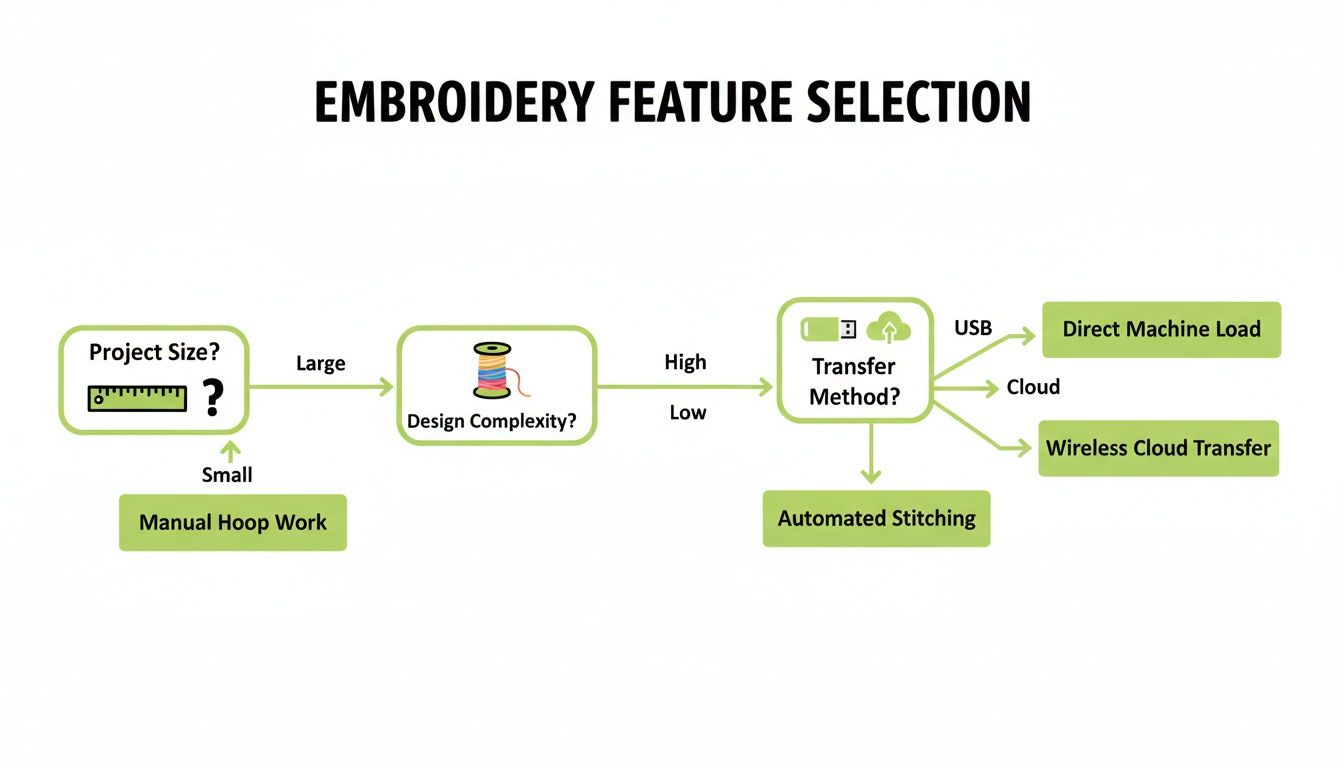
As you can see, once your projects get bigger or more complex, having larger hoops and more advanced design transfer methods becomes a real game-changer for efficiency. Our team also helps you pick out the right supplies—from threads and stabilizers to specialized presser feet—to make sure you’re set up for professional-level results right from the start. Choosing bsewinn.com means you’re not just buying a machine; you’re joining a community that’s dedicated to helping you succeed.
Answering Your Top Questions
When you're diving into the world of sewing machines for quilting and embroidery, a few questions always pop up. It doesn't matter if you're buying your very first machine or looking to upgrade an old friend—getting clear answers is the key to making a smart investment. Let's tackle some of the most common questions we hear from fellow crafters.
Can I Use My Regular Sewing Machine for Quilting and Embroidery?
You absolutely can use a standard sewing machine for piecing a quilt top—it’s perfect for that! But you'll hit a wall pretty quickly when it comes time to actually quilt the layers together. A regular machine just doesn't have the throat space to wrestle with the bulk of a quilt, and it lacks game-changing features like stitch regulation that give you those beautifully consistent free-motion stitches.
When it comes to embroidery, though, it's a different story. You really need a dedicated embroidery machine or a combo model. Embroidery requires a whole different setup: a specialized embroidery unit, hoops to hold the fabric taut, and the software to read digital designs. Trying to make do with a standard machine will honestly just lead to frustration and limit what you can create.
What's the Real Difference Between a Combo Machine and Two Separate Machines?
A combination machine is a brilliant solution if you're tight on space. It’s incredibly convenient to have one machine that can pivot from sewing to embroidery with just a few adjustments. The only catch is that switching back and forth can interrupt your flow, especially if you like to have multiple projects going at once.
Having two dedicated machines—one for sewing/quilting and one for embroidery—is all about productivity. You could be chain-piecing a new quilt top while your embroidery machine is humming away on its own, stitching out a detailed design. Plus, dedicated machines are often workhorses built for a specific job, meaning you might get more specialized features, like a massive throat space on a quilting machine or multi-needle capabilities on an embroiderer.
The decision really boils down to your workspace and how you like to create. If you're a multitasker who values a seamless workflow, two machines is the dream setup. But if you're trying to make the most of your space and love both crafts, a quality combination machine is a fantastic choice.
What Are the Must-Have Accessories to Get Started?
Getting the right tools from the get-go makes all the difference. For both quilting and embroidery, there are a few accessories that are pretty much non-negotiable if you want great results right away.
- For Quilting: A walking foot is essential for evenly feeding all those layers of fabric and batting. You’ll also need a free-motion (or darning) foot for any kind of decorative quilting. We always recommend a large extension table to support your quilt's weight and a stock of high-quality quilting thread to prevent frustrating breaks.
- For Embroidery: A good variety of hoop sizes is a must to handle different project dimensions. You'll also want a solid collection of colorful embroidery threads and a supply of both cut-away and tear-away stabilizers to give your fabric the right support while the machine stitches.
Our team at bsewinn.com is great at helping you build the perfect starter kit with everything you actually need.
How Important Is Software for an Embroidery Machine?
Think of embroidery software as the key that unlocks your machine’s full potential. Most machines come loaded with some lovely built-in designs, but the software is what lets you take the driver's seat. It's how you can create, edit, manage, and even digitize your very own custom sewing machine designs.
Good software gives you granular control over things like stitch density, color order, and custom lettering. It's what allows you to turn a simple line drawing into a beautifully stitched work of art. At bsewinn.com, we offer training and online classes designed to help you get comfortable with the software, so you can make your machine a true extension of your creativity.
Ready to find the machine that will bring your creative ideas to life? Come explore our collection at bsewinn.com. We have the tools, support, and expertise to help you take your craft to the next level. Visit us at https://www.bsewinn.com today

