

The machine fits on the desk, but the project keeps sliding off the edge. Bobbins disappear into a deep drawer, the pedal bumps against a cabinet panel, and a longer sewing session ends with raised shoulders. A sewing storage desk should solve those problems, not just hide more supplies.
The strongest buying decision starts with the body and machine, then considers storage. Height, usable surface, legroom and stability matter more than drawer count, especially when the same room also serves as a bedroom, office or family space.
Table of Contents
- Sewing Storage Desk Dimensions to Check First
- How to Match Desk Height to Your Body and Machine
- Where Each Sewing Tool Belongs in the Desk
- Materials That Control Vibration and Noise
- Lighting and Seating That Complete the Setup
- Choosing a Desk by How You Sew
- Try the Desk in Person Before You Buy
Sewing Storage Desk Dimensions to Check First
A desk can fit the room and still leave too little space for fabric, the machine, or your legs. Check task dimensions first, then measure the full footprint, including parts that open or move.
Working heights and clearances by task
| Task or check | Target value | Source basis |
|---|---|---|
| Seated machine sewing surface | 28–30 in (71–76 cm) | Compact sewing-station guidance |
| Standing cutting surface | 34–36 in (86–91 cm) | Compact sewing-station guidance |
| Adjustable height range discussed in a workstation study | 762–787 mm, approximately 30–31 in | Professional sewing-operator workstation study |
| Machine surface above seated elbow | 5–15 cm above elbow level | Sewing-machine operation study |
| Close work above elbow height | 2–4 in above elbow height | OSHA fine-work guidance |
| Pedal clearance | Room for both feet and pedal, pedal axis behind needle | Sewing-machine operation study |
Treat these as screening dimensions, not universal prescriptions. Sewing calls for controlled fabric feeding and access to the needle; cutting requires room to handle fabric without sustained bending. Staging projects may call for more surface area, but not necessarily the same height.
The study's adjustment range describes a particular workstation, not a requirement for every home setup. Elbow-relative measurements also need a comfort check: raising close work can improve visibility, while raising it too far can lift the arms.
Measurements worth taking before shopping
Record the room's usable width and depth, allowing for open drawers, deployed leaves, and chair movement. For help planning the footprint, check furniture sizing for your space. If an extension must fold away, the small-space sewing table guide can help you weigh space savings against working surface.
The machine opening must accommodate the machine bed and intended insert. The surrounding worktop must support the extension table or provide equivalent fabric support. A large outside measurement alone does not guarantee a usable sewing surface.
A desk with many drawers can still be a poor fit if the machine or project area does not fit comfortably. Start with the dimensions that affect your main task, then check the room footprint.
How to Match Desk Height to Your Body and Machine
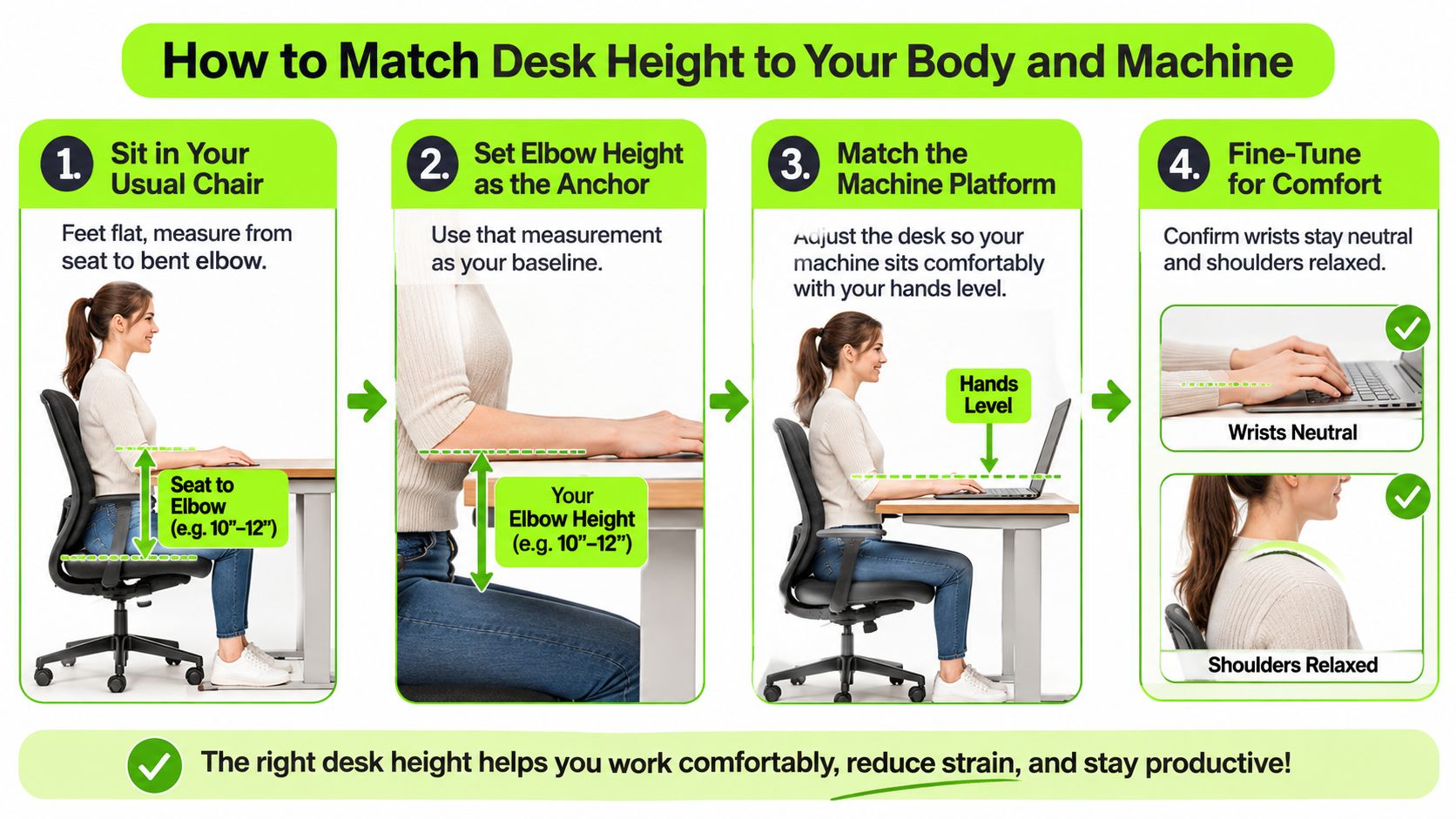
Set the chair and machine in their working positions before judging desk height. A machine sitting on top of the desk raises the sewing surface, changing where your hands meet the fabric.
A workstation study involving 10 professional sewing-machine operators recommended 762–787 mm height adjustment, approximately 10° inclination toward the operator, and a sewing distance positioned 140 mm toward the operator. These figures offer a starting point, but your machine-and-chair combination still needs a practical fit check.
Establish the seated position
- Set the chair first. Sit with feet supported and shoulders relaxed. Measure from the seat to your bent elbow, then add the seat height to get a floor-based reference.
- Align the sewing surface. The needle plate and fabric-support area matter more than the cabinet's decorative top. A slightly higher position can improve visibility on close work, provided your elbows stay near your sides and your shoulders remain relaxed.
- Bring the work into view. A recessed platform should let you see the needle without leaning over unused tabletop. Use a tilt only when the furniture supports it securely.
Fine-tune the machine platform
For flatbed sewing, the machine bed should sit flush with the surrounding support surface. A sudden height change can catch fabric and make wrist positioning awkward, especially when piecing or guiding a quilt.
Place the pedal where your leg rests comfortably. A drawer unit that pushes you sideways can interfere with steady control. Sew a short practice seam with your usual presser foot, needle and thread. Watch for bent wrists, a craned neck or raised shoulders, then adjust the setup before buying.
Fit check: You should be able to guide fabric without reaching around the machine or holding your shoulders up.
An office adjustable desk needs checks for machine support, clearance and stability before it suits sewing. The Indian River Furniture adjustable desk illustrates an adjustable-height format; the machine platform and working position still need to fit your setup.
The height-adjustable sewing table guide offers a sewing-specific comparison. The Horn Model 9100 Height Adjustable Sewing Table has sitting and standing options and a surface for cutting, piecing or embroidery. Judge its fit against the machine you use and the room available.
Where Each Sewing Tool Belongs in the Desk
Daily reach, within arm's reach and secondary storage describe how frequently the operator needs an item, not how neatly it fits into a drawer. The best arrangement keeps seam-by-seam tools close and moves bulky supplies away from the working position.
Where each sewing item belongs
| Item | Reach zone | Storage type |
|---|---|---|
| Needles and bobbins | Daily reach | Shallow top drawer with dividers |
| Presser feet | Daily reach | Shallow tray near the machine |
| Scissors and seam ripper | Daily reach | Shallow drawer or hanging rail |
| Thread spools | Within arm's reach | Wall rail or top shelf |
| Rulers and pattern tools | Within arm's reach | Pegboard or wall rail |
| Bulk fabric | Secondary | Lower drawer or rolling cart |
| Project staging | Secondary | Shelf or cart beside the desk |
Shallow drawers suit notions because their contents remain visible. Deep bins work for fabric bundles but turn small accessories into a digging exercise; labelled dividers keep compatible bobbins and presser feet together without loose parts migrating underneath other tools.
Wall rails and pegboard can free the desktop without consuming floor space. Their placement matters: scissors shouldn't require a reach across the needle, and frequently used rulers shouldn't hang behind the operator.
Storage should support the working sequence
Integrated machine support and organization have a long precedent. The Iowa State University museum's New Home sewing-machine cabinet combines drawers with a broad fabric-guiding surface, demonstrating the practical value of treating workspace and storage together.
Modern layouts should preserve that relationship. A rolling cart can carry the secondary zone in a multipurpose room, provided its parked position doesn't block the chair or an exit. The sewing-room storage ideas guide offers layout considerations, while Display Guru's guide helps readers compare sewing tables with built-in storage.
More storage isn't better when essential tools end up farther from the seam.
A useful home test starts with the most-used tools placed in daily reach. The operator then walks through a typical project, noting unnecessary trips between sewing, cutting and pressing. Moving a tray may solve more than adding another cabinet.
Materials That Control Vibration and Noise
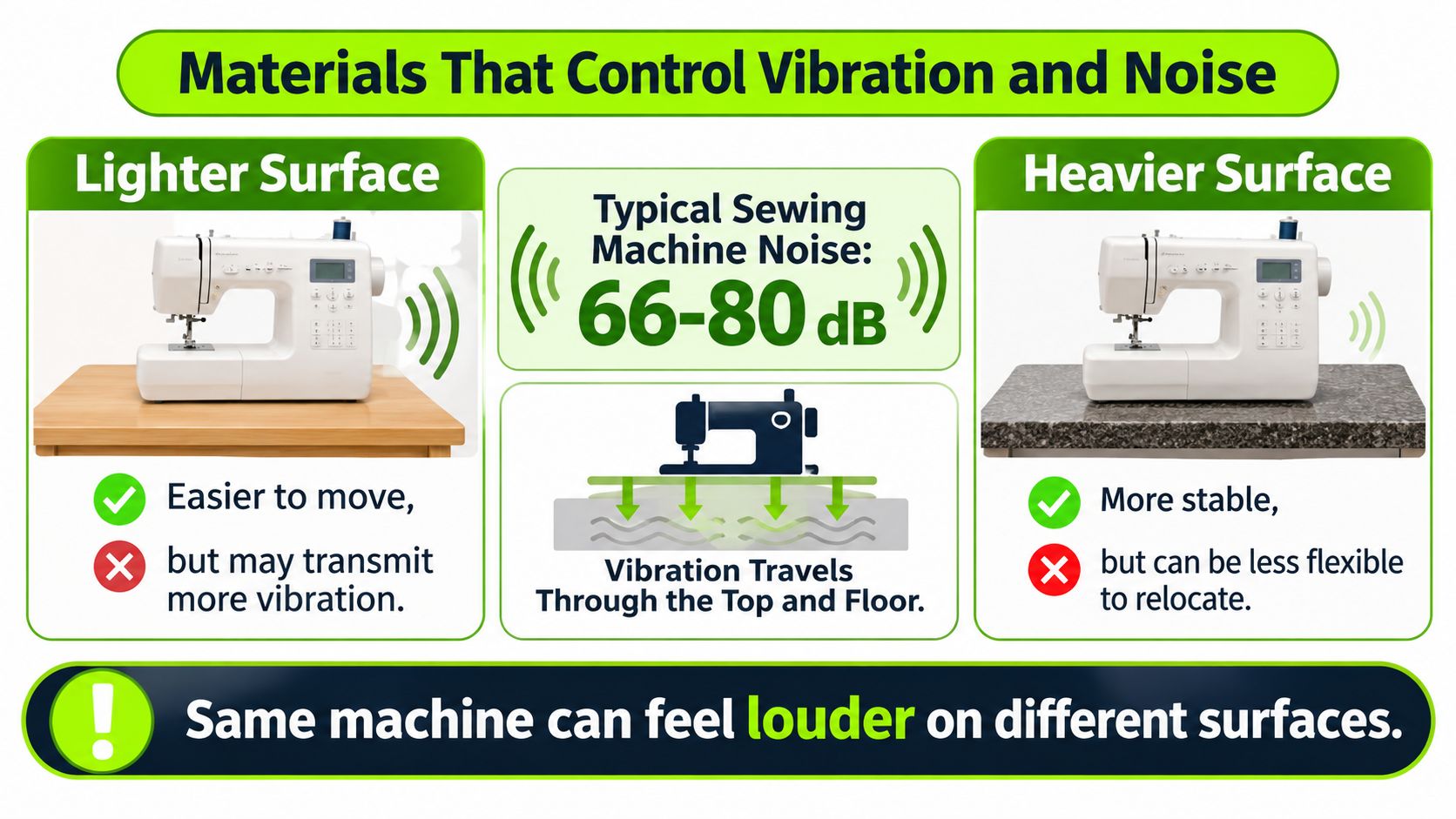
A heavier desk isn't automatically a quieter desk. Mass helps, but loose joints, unsupported spans and uneven feet can undermine an otherwise substantial worktop.
Typical sewing-machine noise falls around 66–80 dB in CHOICE's sewing-machine buying guidance. That range doesn't predict a particular room: airborne machine sound and vibration transmitted through furniture and flooring need separate attention.
Compare construction, not just finish
| Construction choice | Useful benefit | Trade-off to check |
|---|---|---|
| Solid wood or thick engineered top | Adds mass and resists flex | Harder to relocate |
| Lightweight panel | Easier to move or fold | May flex, hum or shift |
| Cross-braced base | Limits sideways movement | Bracing must not obstruct legs |
| Rubber or cork isolation pad | Can reduce transmitted vibration | Excess softness can destabilize the machine |
| Enclosed cabinet | Conceals equipment | May amplify sound or restrict airflow |
Machine placement matters. A machine near a supported section of the top generally has less opportunity to flex the surface than one positioned over a broad unsupported span. A rigid base and properly tightened connections deserve as much attention as the material label.
Rubber or cork pads need an installed test, not an assumption of improvement. The machine should remain level, its feet securely supported, and its controls unobstructed; a pedal mat should prevent sliding without making pedal pressure uncertain.
Run a repeatable home comparison
A phone sound-meter app can provide a relative comparison, not a certified noise assessment. With the same fabric, stitch setting, speed and phone position near the operator's ear, the operator can compare the bare desk against a pad or a different floor position.
A rug may change transmitted vibration, but it can also make a desk rock or hinder chair movement. Heavy fabric in drawers adds mass only within the furniture's load limits, and it shouldn't be used to disguise a loose frame.
No universal sound reduction should be promised. During an in-store furniture assessment, listening while the machine runs and feeling the tabletop for movement is more useful than choosing between an open table and enclosed cabinet by appearance alone.
Lighting and Seating That Complete the Setup
Garment-workstation guidance recommends seat heights of 41.5 cm for women and 43 cm for men, associated with a 105° trunk-to-thigh angle, plus at least 400 lux and additional needle-point lighting in its studied setting, according to the ergonomic intervention document. These are reference values, not reasons to assign a chair setting by sex instead of actual body fit.
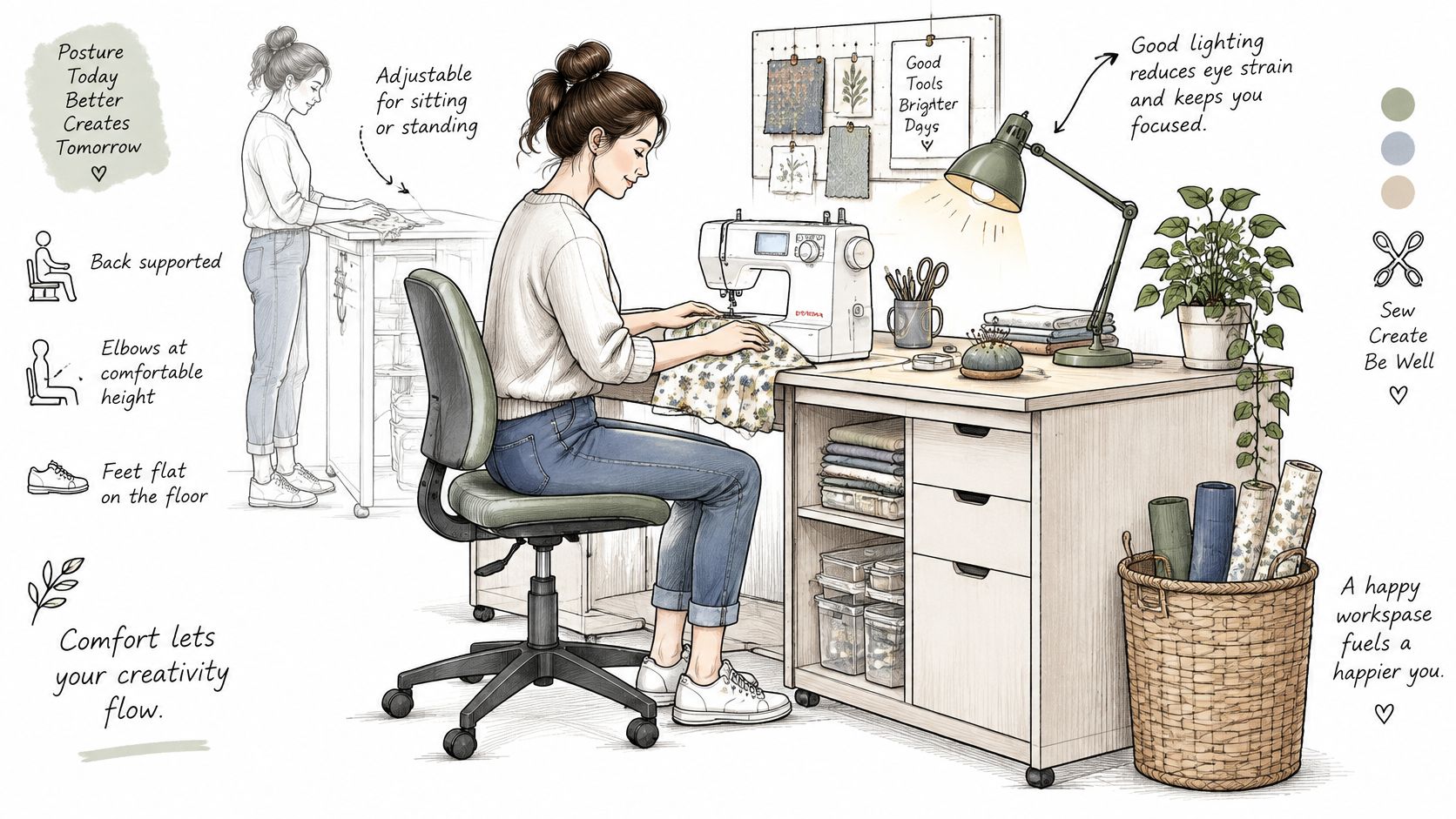
A chair needs enough adjustment to suit the operator and the machine platform together. Supported feet, comfortable pedal operation and an unobstructed cabinet opening matter more than matching a published seat measurement.
Check visibility from the sewing position
Threading the needle in the normal seated position is a useful lighting test. If a hand casts a shadow across the needle area, an adjustable task light or compatible machine light can improve visibility without requiring the operator to lean forward.
More brightness isn't always the answer. Light reflected from a glossy bed can create glare, so the lamp should be repositioned before additional lamps are added.
- Chair adjustment range: The seat should reach a suitable working position without leaving the feet unsupported.
- Light placement: The beam should illuminate the needle and seam path without shining into the operator's eyes.
- Desk-and-chair pairing: The chair must fit beneath the worktop without armrests or drawer rails blocking access.
For a listed seating option, the Koala SewComfort Chair page is a place to check current specifications before comparing the chair with the intended desk.
Standing can be useful for cutting and project handling, while seated machine work offers different support needs. A sit-stand arrangement should permit a genuine posture change, not just raise the same awkward setup. Raising close work too far can lift the shoulders and increase discomfort, so a better view of the needle shouldn't come at the expense of relaxed arms.
Choosing a Desk by How You Sew
Desk priorities by sewing habit
| Sewing habit | Priority feature | Storage emphasis |
|---|---|---|
| Garment sewing on one machine | Height-adjustable frame and flush machine opening | Shallow drawers for notions |
| Quilting on a large machine | Rigid base and extension surface | Deep drawers or cart for bulk fabric |
| Serger or coverstitch beside main machine | Room for a second machine | Thread rail and shallow drawers |
| Embroidery | Depth to fit the embroidery module, checked against its dimensions | Thread storage and hoop storage |
| Small or shared room | Compact footprint and rolling base | Rolling cart for tools and fabric |
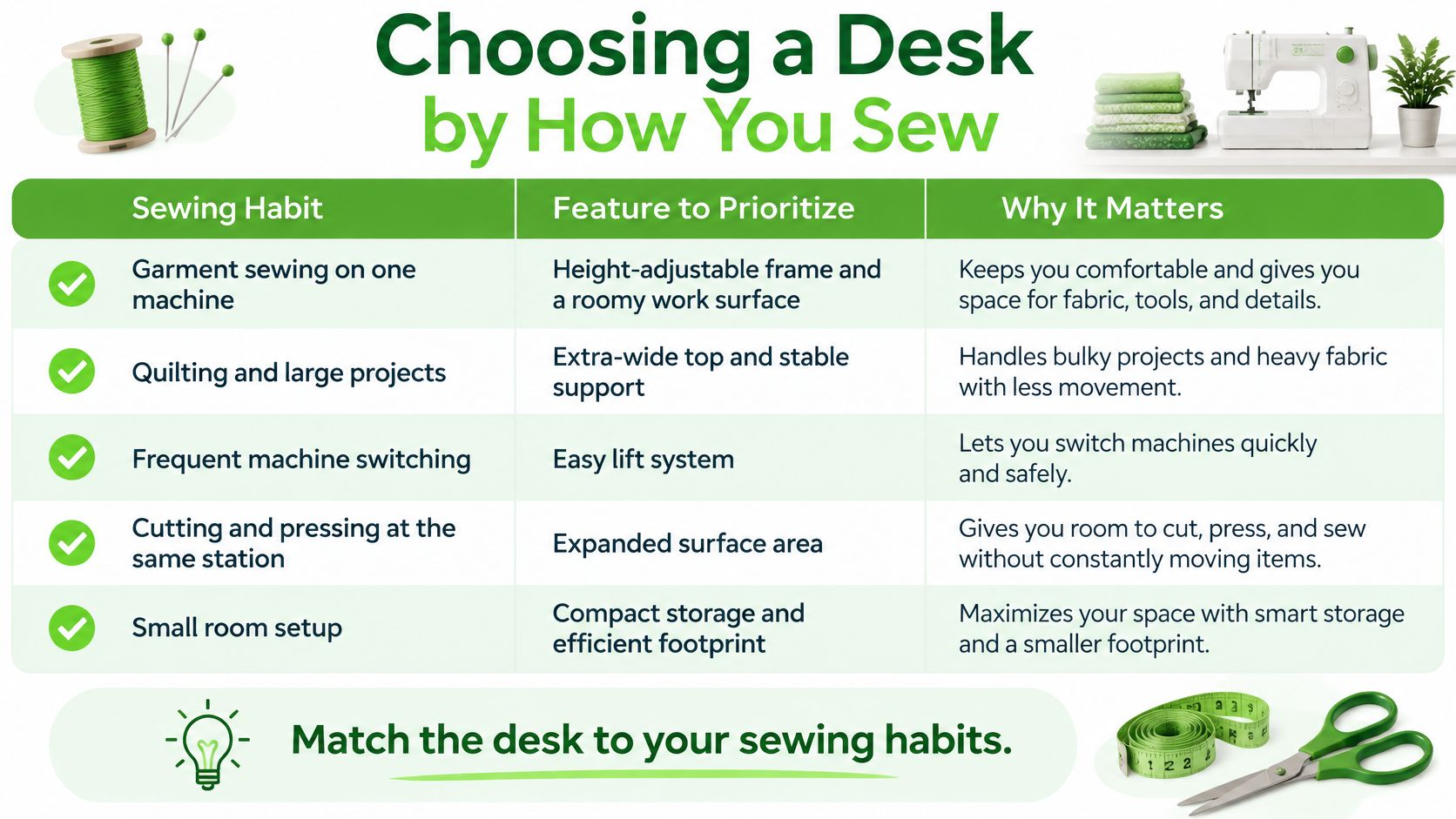
Garment sewing benefits from quick access to feet and notions without sacrificing fabric support. Quilting puts greater demands on the extension surface: a large top helps only when its outer sections remain adequately supported under the project's weight.
A serger or coverstitch machine needs its own operating space, not merely a storage shelf. Thread paths, waste collection and access for threading should remain clear when the main machine is also in use.
Match the footprint to the complete task
Embroidery requires checking the module's actual dimensions and its moving envelope. A cabinet deep enough to store a module may still leave insufficient operating clearance for the attached hoop.
For a shared room, a rolling base helps only when the route and parking space are practical. Casters need to secure the workstation during use, and folding sections must open without blocking access. Where pressing competes with machine space, hideaway ironing-board options can inform a separate pressing arrangement rather than crowding the sewing surface.
A useful buying filter asks:
- Time spent sewing: Which activity occupies most of the weekly sewing time?
- Largest project: What needs support at its bulkiest or widest stage?
- Shared use: Who else needs the room, and what must be packed away?
Before purchase, the specification check should cover rated load, opening size, pedal clearance, drawer runners and floor levelling. The ANSI furniture ergonomics overview distinguishes furniture dimensions from safety, durability and structural standards, a useful reminder that generous dimensions alone don't establish adequate construction.
A desk rarely serves every sewing habit equally well. The strongest choice supports the activity taking the most time and makes the remaining compromises explicit.
Try the Desk in Person Before You Buy
A desk can look roomy in a photo and still leave your knees cramped or your machine platform shaking. If you can assess the setup in person, check how the furniture, machine and your seated posture work together.
Bring a useful measurement sheet
Before arranging a visit, note:
- Machine dimensions: Include the extension table, embroidery module and accessories that stay attached during sewing.
- Chair measurements: Record your usual seat height and the distance from the seat to your elbow.
- Room constraints: Measure the available floor space, doorway access and clearance for extensions when open.
- Typical project: Bring suitable fabric or describe the tasks that take up most of your sewing time.
At the workstation, sit in your usual sewing posture and check knee room, pedal access and how easily you can reach the controls. Guide fabric across the surface to see whether the machine sits at a comfortable height and whether the work area feels stable. Ask ahead whether the location has the furniture and machine combination you want to assess.
Test the pairing rather than the desk alone
B-Sew Inn sells sewing and embroidery machines, serger and coverstitch machines, long arm quilting machines and preowned machines, as well as sewing cabinets, sewing tables, cutting and craft tables, and sewing chairs. Its selection also includes machine accessories, supplies and embroidery designs. Bring the dimensions of your own machine when comparing options, since fit and operating clearance depend on the machine and its accessories.
A desk change can improve posture, access and work support. It cannot correct a machine problem or make an unsuitable machine-and-furniture pairing comfortable.
A worthwhile showroom test ends with a clear decision about fit.
Contact B-Sew Inn to ask about available furniture and machines before visiting, and bring your measurements and project needs for a more focused assessment.

