

The listing looks tempting. The machine head appears clean, the frame is included, and the asking price is far below a new system. Then the practical questions arrive: Does the stitch regulation work? Does the warranty transfer? Is the frame correctly matched to the head? Are the bobbin winder, leaders, software, cables, and manuals part of the deal, or does “package” mean little more than a machine sitting on a stand?
A used longarm quilting machine can be an excellent purchase, but only when the buyer evaluates the entire ownership cycle. The right machine must suit the quilts being made today, remain serviceable tomorrow, and retain enough value to support a future upgrade or trade-in. Price matters, but condition, support, included equipment, and documented service matter more.
Table of Contents
- What a Used Longarm Actually Buys You in 2026
- Understanding Longarm Specs That Matter Most
- Inspecting and Test-Stitching Before You Pay
- What Is Really in the Package
- Where to Find the Best Deals and How to Pay
- Maintenance and Service After the Sale
- Your Next Step Toward the Right Machine
What a Used Longarm Actually Buys You in 2026
A serious buyer entering the used market in 2026 is usually balancing two pressures. New equipment can require a substantial investment, while a carefully selected preowned system may offer a significant discount and immediate availability. One buyer's guide places used machines in good condition at 40% to 60% of new price, while another gives a 30% to 50% savings range, depending on source and condition. Those benchmarks are useful for negotiation, but they aren't permission to buy the cheapest listing. (used longarm pricing guidance)
The true purchase isn't a machine head. It's a working system with a remaining service life, a compatible frame, usable electronics, and a support path. Longarm machines trace their modern origins to the early 1960s, when Fred Nolting reportedly rebuilt a sewing machine with a 24-inch throat. By 1972, he had built a machine described as the first long arm similar to current models, and by 1984 he was selling machines under the Nolting brand. (longarm quilting history) That history matters because these machines are production tools, not disposable appliances.
Practical rule: Treat the purchase as a lifecycle decision. The best deal is the system that can be tested, serviced, supported, and eventually traded, not simply the one with the lowest sticker price.
Start with four questions:
- What quilts will the machine handle? A smaller throat may suit personal projects, while larger quilts and regular client work demand more capacity.
- What is included? A frame, automation system, bobbin winder, leaders, accessories, and software can change the overall value dramatically.
- Who will support it? Dealer inspection, service records, training, and warranty coverage reduce ownership risk.
- What happens at the next upgrade? A documented machine with a known history is easier to value and trade.
A buyer who wants to understand the broader workflow should review this explanation of what longarm quilting involves. The key decision is simple: verify the machine's remaining usefulness before paying for its past.
Understanding Longarm Specs That Matter Most
Used pricing follows usefulness more closely than age. A clean machine with limited capacity may be a poor bargain, while an older, well-maintained system with the right throat, frame, and regulation can remain highly practical.
Throat space sets the working limit
Throat space is the distance between the needle and the machine body. Common longarm sizes range from 15 to 21 inches, and larger systems are also available. An industry review indicates that a 15-inch throat handles blocks up to about 14 inches wide, while 19-inch and 21-inch throats are better suited to queen and king quilts without frequent rolling.
Buyers should choose throat space from the quilt backward. A 15-inch machine can be sensible for personal quilts and a smaller studio. A buyer routinely handling large tops should prioritize a longer throat before paying for advanced automation.
Regulation determines control
Basic systems may offer needle-stop control or continuous operation. More advanced systems use stitch regulation with encoders, allowing the machine to adjust needle movement as the carriage speed changes. Test both regulated and free-motion operation if possible. A buyer who quilts occasionally may value simplicity, while a production quilter will notice inconsistent regulation quickly.
Frame compatibility affects the whole studio
A machine head can be mounted on a table, used in a sit-down configuration, or installed on a track system with a carriage and rear handles. The frame must fit the head, the room, and the quilt sizes. A mismatched frame can erase the apparent savings through replacement parts, difficult assembly, or poor carriage travel.
Automation is valuable only when used
Automation may include progressive quilting, channel lock, and automated patterns. These features can help a solo operator repeat designs and manage edge-to-edge work, but they also introduce software, firmware, and compatibility questions. Compare systems from brands carried by B-Sew Inn, including Handi Quilter, the Bernina Q Series, and APQS, by the functions the buyer will use.
| Spec Category | Common Options | What It Affects | Used Price Impact |
|---|---|---|---|
| Throat space | 15 to 21 inches and larger formats | Block width, rolling frequency, quilt capacity | Larger working space generally commands more value |
| Stitch regulation | Needle stop, continuous, regulated encoders | Stitch consistency and free-motion control | Reliable regulation can justify a premium |
| Frame system | Table, sit-down, track carriage, rear handles | Room fit, ergonomics, quilt loading | A matched frame adds practical value |
| Automation | Progressive, channel lock, pattern quilting | Repeatability and operator efficiency | Software condition and compatibility affect value |
A useful model-by-model starting point is this guide to longarm quilting machine options. Prioritize throat space first, regulation second, and automation third.
Inspecting and Test-Stitching Before You Pay
A seller's description is only an invitation to inspect. The machine earns its price during a live test on its actual frame.
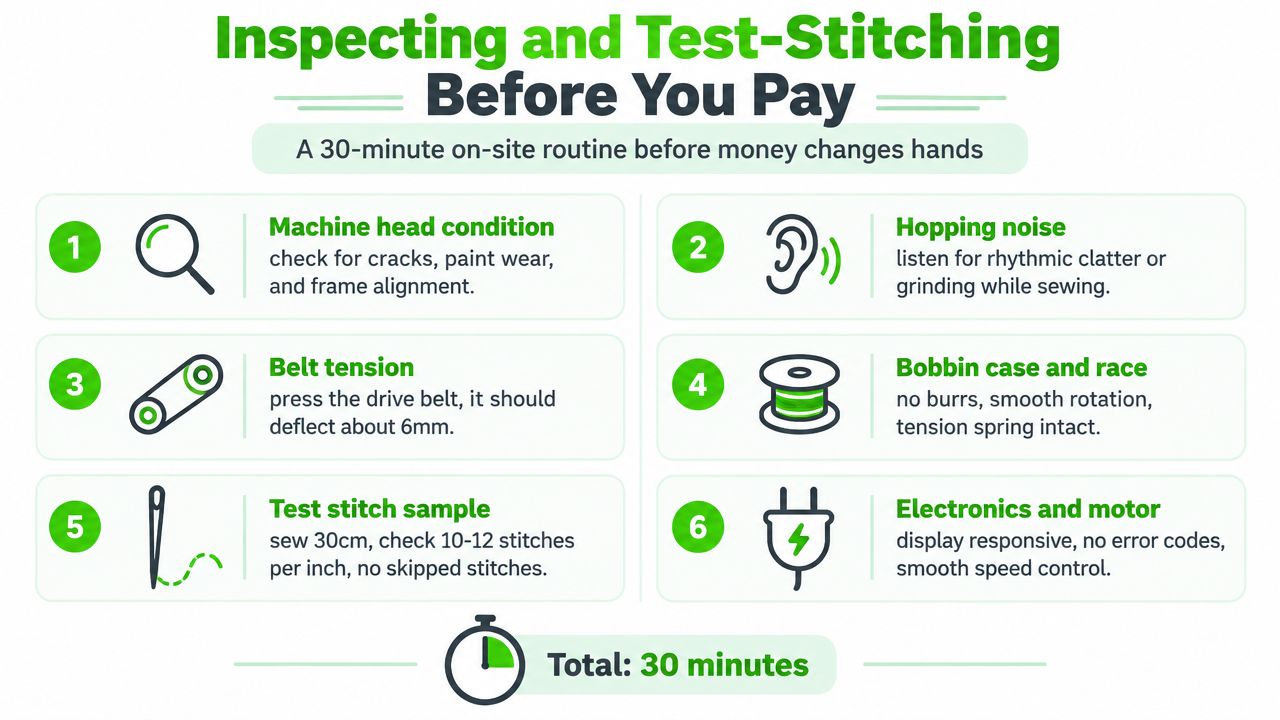
Start with the head
Bring a flashlight, a small notepad, and a sample of the thread normally used for quilting. Check the head for cracks, heavy paint wear, rust, oil leakage, missing covers, and signs of impact. Ask the seller to explain any unusual marks rather than assuming cosmetic wear is harmless.
Listen while the machine is running. Hopping noise, rhythmic clatter, grinding, or a harsh change in sound under speed can indicate mechanical wear. Check belt tension, the bobbin race, the bobbin case, the thread tension assembly, encoder sensors, and the power supply. A live stitch test should include stitch regulation, carriage movement, handle response, and button operation. Independent longarm guidance specifically recommends checking stitch regulation, carriage glide, frame rail alignment, handle and button response, visible wear, and serviceability before purchase.
Test the frame, not just the needle
Move the carriage slowly across the full working area. The track should feel straight and consistent, without tight spots or lateral wobble. Inspect wheel bearings, carriage belts, rail surfaces, and frame alignment. Test every handle and control from the front and rear if the system has rear operation.
Run a sample using the seller's thread and backing. Sew straight lines, curves, stippling, and a pantograph-style design if automation is installed. Change speed deliberately. Watch for skipped stitches, thread nests, irregular tension, uneven stitch length, or encoder drift when the carriage accelerates and slows.
Record the machine's identity
Before money changes hands, photograph the serial number and record the software and firmware versions. Request service invoices, repair notes, warranty documents, and any registration information. A buyer should also ask why the seller is selling, whether the machine sat unused, and which accessories are included in writing.
Print this checklist and mark each item:
- Machine head: Look for cracks, rust, impact marks, oil leakage, and missing covers.
- Sound: Run the machine at varied speeds and listen for hopping, grinding, or rhythmic clatter.
- Drive system: Check belt tension, carriage travel, wheel bearings, and rail alignment.
- Stitch quality: Test straight lines, curves, stippling, and regulated stitching on the frame.
- Controls: Confirm handles, buttons, display, encoders, foot control, and speed response.
- Records: Photograph serial numbers and document software, firmware, service history, and included parts.
A practical tutorial collection covering longarm quilting techniques can help a buyer identify the motions and controls worth testing. If a seller won't allow a complete live test, the safest recommendation is to walk away.
What Is Really in the Package
“Machine included” is not the same as “ready-to-quilt system.” A used package may contain the head only, or it may include the frame, leaders, bobbin winder, accessories, automation, software, manuals, and original paperwork. Each missing part creates a replacement or compatibility problem.
The machine head is the obvious component, but the frame often determines whether the purchase works in the buyer's studio. Confirm the exact frame model, length, carriage, rails, leaders, side clamps, rear handles, and table or stand. Check whether the bobbin winder, hopping foot, foot pedal, cables, power supply, manuals, needles, bobbins, and rulers are included.
Warranty status requires written confirmation. Dealer trade-ins may have clearer records and a defined support process. Factory recertified equipment may come with its own coverage. Private transfers often provide no transferable factory warranty, so the buyer must confirm the policy with the manufacturer or authorized service channel rather than relying on the seller's wording.
| Package Element | Authorized Dealer Trade-In | Recertified / Refurbished | Private Seller |
|---|---|---|---|
| Machine head | Usually identified and inspected | Serviced to the program's standard | Condition depends on disclosure |
| Frame and fit | Often checked as a system | May be matched or sold separately | Buyer must verify compatibility |
| Accessories | Listed more clearly | Varies by inventory | Missing parts are common |
| Warranty | Transfer terms can be documented | Program coverage may apply | Often limited or absent |
| Service history | More likely to be available | Service work may be recorded | Records may be incomplete |
| Setup support | Dealer assistance may be available | Depends on seller | Buyer handles assembly and setup |
The buyer should request an itemized invoice, not a casual promise that “everything comes with it.” Leaders are essential for loading quilts correctly, so buyers should understand their role through this guide to leaders for longarm quilting machines.
Shipping and setup also belong in the price calculation. A heavy machine head, frame assembly, replacement needles and bobbins, and software or firmware updates can turn an attractive listing into an expensive project. A package is valuable only when its parts work together.
Where to Find the Best Deals and How to Pay
A private listing can show the lowest asking price, but it also transfers nearly every ownership task to you. You must inspect the machine, confirm frame compatibility, arrange transport and setup, resolve warranty questions, and plan future service. That route suits an experienced owner with reliable technical help. For a first longarm purchase, the apparent saving often does not justify the added risk.
An authorized dealer trade-in gives you a more controlled buying process. Request the inspection findings, frame check, service records, warranty terms, and setup options before you commit. B-Sew Inn is an authorized sewing, quilting, and embroidery machine dealer with retail stores in Tulsa and Oklahoma City, Oklahoma, Springfield, Missouri, Humble, Texas, and Fayetteville, Arkansas. Its inventory includes machines and service support across major quilting and embroidery brands.
Recertified inventory can also fit a defined budget, but investigate the work behind the label. Ask which components were replaced, which were only cleaned, whether the program or seller performed the work, and whether any coverage is factory-backed or seller-backed. Stock changes quickly, so verify the exact machine head, frame, accessories, service work, and written terms attached to the unit you are considering.
| Buying Channel | Typical Price Range | Warranty / Support | Inspection Condition |
|---|---|---|---|
| Authorized dealer trade-in | Typically 40-60% of new, package-dependent | Service records and support may be available | Dealer inspection is more likely |
| Recertified inventory | Typically 50-70% of new, program-dependent | Confirm whether coverage is factory-backed or seller-backed | Refurbishment details should be documented |
| Private seller | Often discounted, but highly variable | Usually limited or absent | Buyer must arrange and perform inspection |
| Quilting show or local event | Depends on trade-in stock and package | Ask for written terms | Inspect the actual unit before purchase |
Negotiate against missing value, not an arbitrary percentage. Price a missing frame component, absent automation license, unknown service, transport, or required repair. Ask the seller to include setup, a service appointment, accessories, or a written warranty when those additions protect the machine's long-term value.
Pay the same attention to financing. Dealer financing, personal loans, and layaway can produce different total costs. Promotions on new machines may also change the value of used floor inventory. Compare the complete financed amount, included equipment, service obligations, and warranty terms. The monthly payment alone cannot tell you whether the purchase works over the machine's full ownership cycle.
Maintenance and Service After the Sale
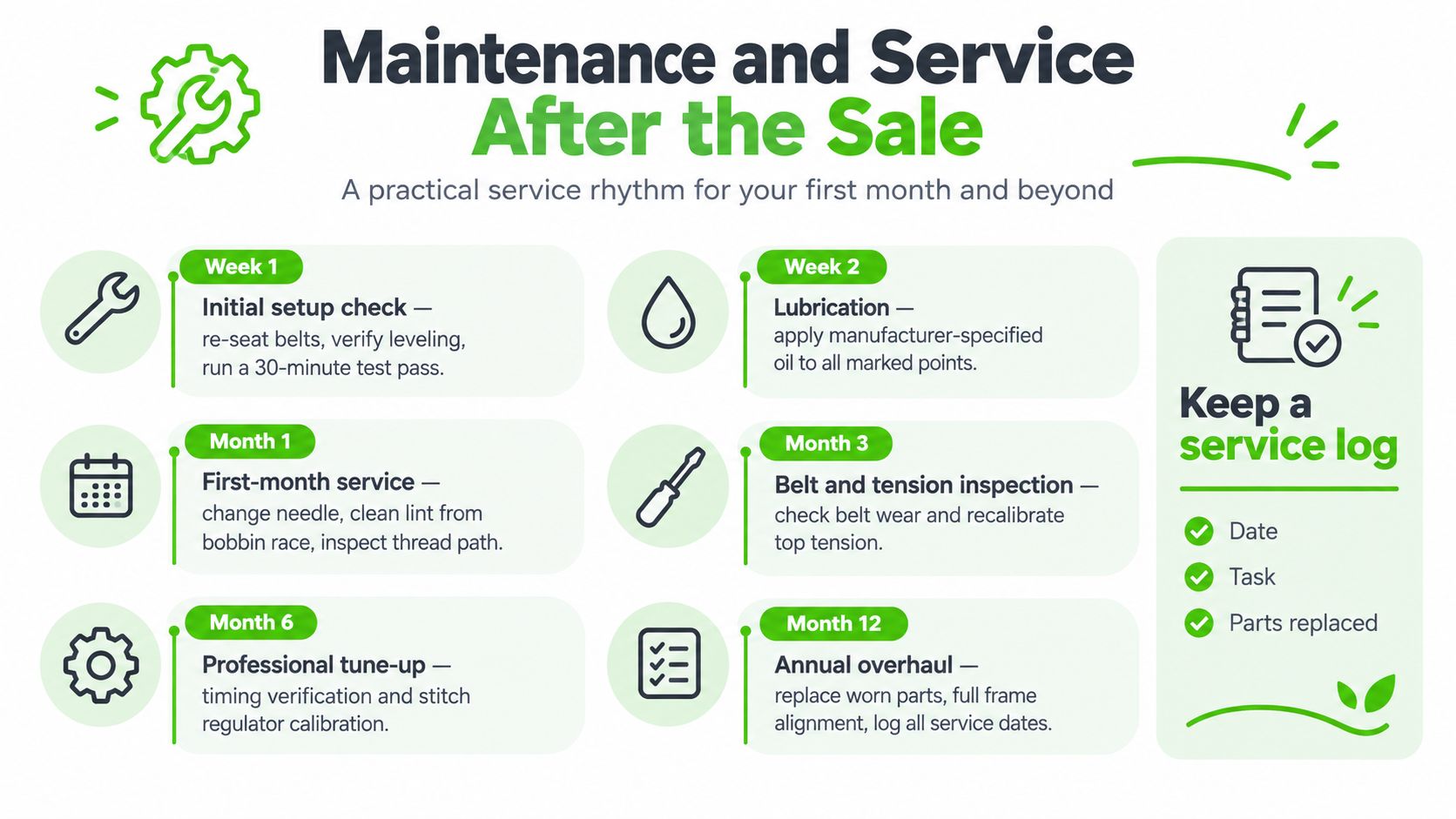
A used machine needs a baseline service plan immediately after purchase. The first month should establish whether the system is correctly tensioned, aligned, lubricated, and calibrated. It should also create a reference sample showing how the machine stitches when ownership begins.
The first month
During setup, verify frame leveling, carriage travel, belt seating, needle position, thread path, bobbin condition, and top tension. Clean lint from the bobbin race and inspect the hook area. Use only the lubricant specified by the manufacturer, because oiling points and maintenance requirements differ by machine.
Create a service log with the purchase date, serial number, starting stitch sample, service findings, and parts replaced. This record helps diagnose changes later and protects resale value when the machine is eventually traded.
The recurring rhythm
One major longarm brand recommends professional servicing every two years or every 10 million stitches, whichever comes first. That service includes opening the machine, removing lint, checking timing and tolerances, and re-lubricating internal parts. The same guidance makes service especially important when a machine has been unused for a year or more. (longarm professional servicing guidance)
Manufacturer instructions should control oiling, needle changes, bobbin care, and frame lubrication. A general schedule copied from another machine can cause problems, so the owner should keep the manual with the service log.
Know the warning signs
Book service promptly when the machine develops skipped stitches, thread nests underneath, unusual noise, inconsistent stitch length, or carriage wobble. These symptoms can come from a simple needle or tension issue, but they can also indicate timing, hook, encoder, or frame problems.
Service standard: If stitch quality changes and basic cleaning doesn't restore it, stop quilting and arrange a professional inspection. Continued use can turn a small adjustment into a larger repair.
An authorized technician who knows the specific model can identify normal operating sounds, source correct parts, and document repairs. Buyers can connect ownership with sewing machine maintenance and repair before a preventable issue interrupts a quilting schedule.
Your Next Step Toward the Right Machine
Research can narrow the field, but it can't reveal how a machine feels under the hands. Throat space, stitch regulation, carriage glide, motor sound, handle placement, and frame height become obvious when a buyer stands at the system. Those details often decide whether the machine gets used regularly or becomes expensive storage.
The strongest next step is an in-person showroom visit. A serious buyer should bring two quilt tops, or representative fabric samples, and ask to run a tension test on each shortlisted system. The comparison should include slow curves, faster movement, regulated stitching, free-motion control, and the frame position needed for comfortable quilting.
A dealer can also clarify the questions that private listings leave vague. Ask staff to confirm service records, warranty transfer status, included accessories, frame compatibility, and the likely trade-in value of the buyer's current machine. That conversation can replace weeks of messages, uncertain shipping arrangements, and incomplete seller disclosures with a direct evaluation.
The visit isn't a final commitment. It's the fastest way to replace online guesswork with hands-on evidence and choose a used longarm quilting machine that fits the buyer's quilts, room, skill level, and future plans.
B-Sew Inn offers longarm machines, accessories, service, trade-ins, and in-person machine mastery sessions at its stores in Oklahoma, Missouri, Texas, and Arkansas. Visit B-Sew Inn to review available options, then schedule a showroom visit to test the frame, regulation, and stitch quality before purchasing.

