
You find the perfect embroidery design, choose a vivid thread color from a screen, and place the order. When the spool arrives, the magenta looks more like muted berry, the label says little about weight, and the first test run produces skipped stitches. Buying embroidery threads online can feel like a gamble, but the problem usually isn't online shopping itself. It's the lack of operational detail behind the listing.
A reliable purchase starts with three checks: fiber performance, thread weight, and machine compatibility. Color accuracy, bobbin pairing, stabilizer choice, and seller reliability then determine whether that attractive spool becomes a dependable part of the thread cabinet or an expensive source of frustration. The broader market is substantial. The U.S. online hobby and craft supplies industry is valued at $25.3 billion in 2026, with 11,119 businesses operating in the category, while tracked online sewing and crafting supplies reached $607 million in 2025. IBISWorld's industry overview places embroidery thread inside a mature e-commerce channel where assortment and repeat purchasing matter.
For makers selling decorated goods, dependable thread also protects production time and customer expectations. Anyone building a product range can pair sound embroidery planning with resources such as best Etsy products to sell, then use a repeatable thread-buying process instead of relying on attractive photos alone. B-Sew Inn's guide to machine embroidery supplies is another useful starting point for assembling thread, needles, stabilizer, and related necessities.
Table of Contents
- The Reality of Shopping for Thread on the Web
- Choosing the Right Fiber for Your Machine
- Decoding Thread Weights and Bobbin Pairings
- Evaluating Online Listings for Color and Quality
- Matching Thread to Stabilizers and Fabrics
- Smart Ordering and Thread Care Strategies
- The Advantage of Testing In Person
The Reality of Shopping for Thread on the Web
A screen can show a color, but it can't show how that color behaves under daylight, warm indoor bulbs, or the sheen of a satin stitch. A spool photographed against a white background may appear electric blue on one monitor and subdued teal on another. Even a carefully calibrated display can't remove differences caused by lighting, photography, dye lots, or the surrounding fabric.
That mismatch becomes more serious when the listing omits the details that control machine performance. A product page may display a large color assortment without clearly stating whether the thread is rayon or polyester, whether it is intended for home or industrial embroidery, or how its weight relates to the needle already installed. A beautiful spool can still be the wrong choice for a dense design, a frequently washed garment, or a machine running at a demanding speed.
A repeatable buying check
Experienced embroiderers treat an online listing like a technical specification sheet, not a color catalogue. Before adding a spool to the cart, check:
- Fiber: Identify polyester, rayon, cotton, silk, or a recycled or biodegradable alternative.
- Weight: Look for a stated thread weight, such as 40 wt, rather than relying on spool size or marketing language.
- Construction: Denier, filament count, and whether the thread is continuous filament reveal more about consistency than a generic “premium” label.
- Use case: Confirm whether the product suits machine embroidery, hand embroidery, decorative stitching, or industrial equipment.
- Color information: Prefer a named shade, color code, physical chart, and clear return policy over a stock image alone.
- Bobbin requirements: Determine whether the thread system calls for a specific bobbin weight or pre-wound format.
The most dependable approach is to buy a small test quantity first when the fiber, color, or brand is unfamiliar. Stitch a sample on the actual fabric, wash it if the finished item will be washed, and record the needle, stabilizer, tension, and machine speed. That record turns a successful purchase into a repeatable specification for the next order.
Choosing the Right Fiber for Your Machine
A thread that looks perfect on a screen can still cause breaks, lint, or unstable tension once it reaches the machine. Fiber affects break resistance, sheen, wash performance, lint, and tension behavior, so match it to the finished item and the machine settings it can tolerate. For a deeper comparison of fiber behavior, see this guide to good embroidery thread from B-Sew Inn.
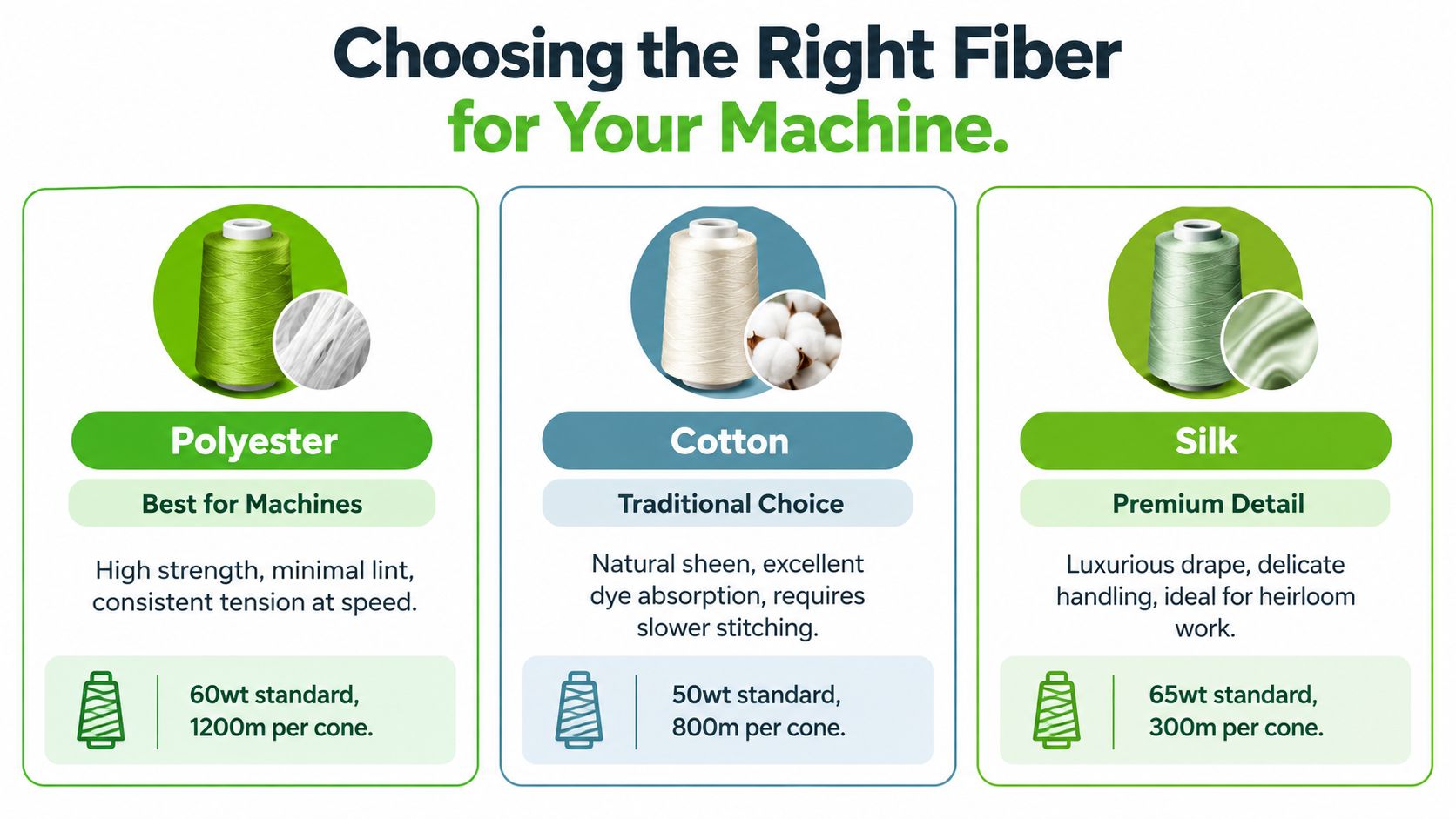
Polyester is the practical default for machine embroidery because it combines strength with consistent performance. Published technical summaries place 40-weight polyester at roughly 500–700 cN tensile strength, compared with 300–420 cN for rayon, and list polyester tenacity at about 4.5–6.0 cN/dtex, versus 2.0–3.0 cN/dtex for rayon. The technical comparison of thread sizing and performance explains why polyester usually handles faster stitching and frequent use more comfortably.
Rayon suits decorative work where a softer, high-sheen finish matters more than maximum durability. It typically needs 15–25% lower tension and slower top speeds than polyester, and it can lose up to 30% of its tensile strength when wet, according to the same technical source. Use it for projects receiving gentle care. Repeated washing, abrasion, or demanding production conditions leave less room for tuning.
Match the fiber to the finished item
Cotton and silk remain useful for decorative needlework, while engineered fibers dominate many machine applications. J&P Coats commercially introduced cotton embroidery thread in 1842, and by the 1930s, mercerized cotton had become standard for its luster and reduced lint. DuPont commercially launched polyethylene terephthalate filament yarns under the Dacron trade name in 1958. This documented history of embroidery thread production helps explain why online listings separate fibers by finish and performance.
Use the finished item as your starting point:
- Choose polyester for garments, uniforms, bags, children's items, and projects washed often.
- Choose rayon for decorative designs where shine and a smooth appearance take priority, provided the machine supports gentler settings.
- Consider cotton or silk for heirloom-style work where natural hand and visual character matter more than production speed.
- Investigate recycled polyester, lyocell, and biodegradable threads when environmental impact affects the purchase.
Several manufacturers now offer recycled-polyester and lower-water-dyeing threads, described in their own materials as using post-consumer PET content or reduced water in dyeing. Buyers should still verify certification, care instructions, and machine test results for the exact product. Check the listing for machine-embroidery compatibility, then test tension and bobbin balance before committing a full design.
Decoding Thread Weights and Bobbin Pairings
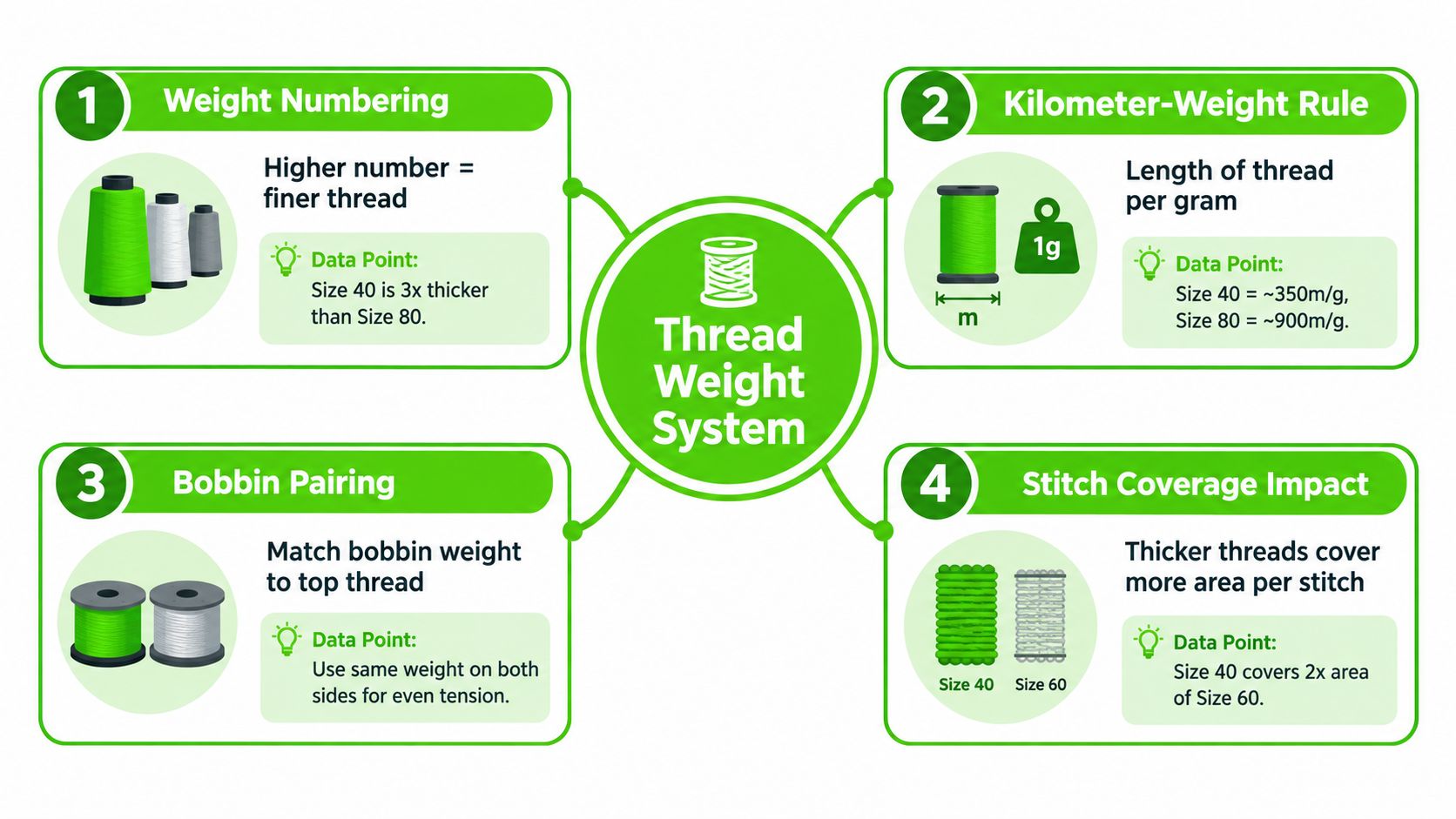
A thread listing can look suitable online, yet the wrong weight may cause poor coverage, excess friction, or repeated breaks. A higher weight number generally means a finer thread, so a 40 wt thread is thicker than a 60 wt thread.
The numbering system describes thickness through length and mass. 40 kilometers of 40 wt thread weigh 1 kilogram, according to This machine embroidery thread-weight guide. That comparison helps when listings use different labeling systems, but it does not predict how long a spool will last. Spool length, cone size, design density, and stitch count all affect consumption.
The practical role of 40 wt
For machine embroidery, 40 wt remains a useful middle ground. It provides solid stitch coverage without asking the machine to handle an unusually thick thread. Common constructions include 120D/2 or 150D/2 filament, approximately Tex 27–35, with a general needle pairing of Nm 75/11. The thread-weight and denier reference relates denier, filament construction, coverage, and needle selection.
A finer 60 wt thread suits delicate fabric and detailed designs. Moving to 40 wt increases coverage, which can make lettering and satin columns look more opaque. The added thickness also increases friction at the needle eye. If the eye is too small, the thread can shred, heat up, break, or produce skipped stitches.
Bobbin selection affects the same stitch balance. Pre-wound bobbins are commonly around 70 weight, considerably finer than the top thread. A bobbin and thread guide explains why machine embroidery commonly uses fine bobbin thread, unless reverse stitching or a visible back requires a different setup.
Pair the top thread with the machine's bobbin system, then test both together. A 40 wt top thread may work correctly with a fine bobbin, but bobbin-case style, upper and bobbin tension, fabric, and design density determine the final result.
Before adding a spool to an online order, check these specifications:
- Top thread weight and construction: Do not estimate weight from cone size or product photography.
- Needle size: Match the eye to the thread thickness and fabric.
- Bobbin format: Confirm whether the machine accepts the listed pre-wound bobbin or requires a wound bobbin.
- Tension behavior: Stitch a sample using the same fabric, stabilizer, and density as the finished design.
- Reverse visibility: Choose a different bobbin arrangement if the back will remain visible.
A thread weight chart from B-Sew Inn can help translate labels before purchase. The goal is not to memorize every numbering system. Confirm that the listed weight, construction, needle, bobbin, and machine format work together before committing to a full design.
Evaluating Online Listings for Color and Quality
Online demand is large, but high demand doesn't guarantee clear product information. Niche market tracking reports 3.0 million annual searches for embroidery thread, with 1.7% search growth over 90 days. The same tracking reports 68% of demand concentrated in the top five brands, while complaints commonly involve color, quality, and differences between advertised and actual products. The embroidery thread demand analysis shows why buyers need to inspect listings rather than select the first attractive assortment.
A trustworthy page gives the buyer enough information to reproduce the purchase later. Look for a manufacturer color code, thread weight, fiber content, spool or cone length, intended machine use, and photographs that show the actual product. A generic image with dozens of bright shades and no specifications may be acceptable for experimentation, but it isn't a strong choice for a logo, matched set, or repeat customer order.
Listing signals worth comparing
| Listing Feature | Red Flag, Avoid | Green Flag, Buy |
|---|---|---|
| Color presentation | Generic stock image with no color code | Named shade, code, and physical color chart |
| Fiber information | “High quality” without fiber details | Clearly identified polyester, rayon, cotton, silk, or recycled content |
| Thread size | No weight or denier listed | Stated weight and construction |
| Machine use | Industrial language with no home-machine guidance | Clear use case and compatible machine information |
| Consistency | Mixed assortments with unclear manufacturing details | Matched collection from an identifiable manufacturer |
| Reviews | Repeated complaints about shade or breakage | Reviews that describe actual stitching, fabric, and washing |
| Returns | No policy for incorrect or damaged goods | Written return and exchange terms |
Color management requires discipline. Save the product page, color code, and order details when a shade works. When the spool arrives, compare it beside the intended fabric in the light where the finished item will be viewed. For critical color matching, order a physical chart or one sample spool before committing to a full set.
A seller with a clear supply chain also reduces the risk of receiving an unlabeled spool or an incompatible industrial format. Authorized dealers can clarify whether a thread is intended for a home embroidery machine, a multi-needle setup, or industrial equipment. B-Sew Inn's guide to embroidery thread color offers a practical reference for building a more controlled color selection process.
Matching Thread to Stabilizers and Fabrics
Before ordering a large spool, check how the thread will behave on the actual fabric and with the planned stabilizer. Thread that stitches cleanly on denim may pull or distort a lightweight blouse. The result depends on thread thickness, stitch density, fabric movement, hooping, and stabilizer support. Buying thread without considering the backing leaves the setup unfinished.
A medium fabric often handles 40 wt polyester with cut-away or tear-away stabilizer, but fabric movement should guide the decision. Dense lettering creates more pull than an open running-stitch motif. Soft knits usually need support that stays with the garment, while stable woven fabrics may release cleanly from tear-away backing.
Use fabric weight as a warning signal
Light fabric generally needs a lighter stitching load. Guidance on the stabilizer and fabric relationship notes that fabrics under 70 g/m² may suit 60–80 wt thread to reduce distortion. The same reference gives a 25–35 gram tension target for certain medium-fabric combinations.
Treat those figures as testing starting points, not universal machine settings. Hoop size, design density, needle condition, fabric grain, and stabilizer quality can change the result. If satin columns cause puckering, inspect the entire setup. The thread may be too heavy, the design too dense, the stabilizer too weak, or the tension unbalanced.
Run a controlled sample before committing the online order to production:
- Match the sample fabric. Use the same material and, where possible, the same cut direction.
- Use the intended stabilizer. Different backing changes support and pull.
- Start with the recommended needle. Replace a worn or damaged needle before blaming the thread.
- Inspect both sides. The top should remain smooth, and the bobbin should not show through the design face.
- Wash or handle the sample. Care can reveal distortion that was invisible in the hoop.
Record which thread, needle, stabilizer, and density produced the cleanest result. A lighter thread can preserve drape on delicate material, while standard 40 wt polyester remains practical for medium fabrics and durable items. The sound online purchase is a matched setup, not an isolated spool.
Smart Ordering and Thread Care Strategies
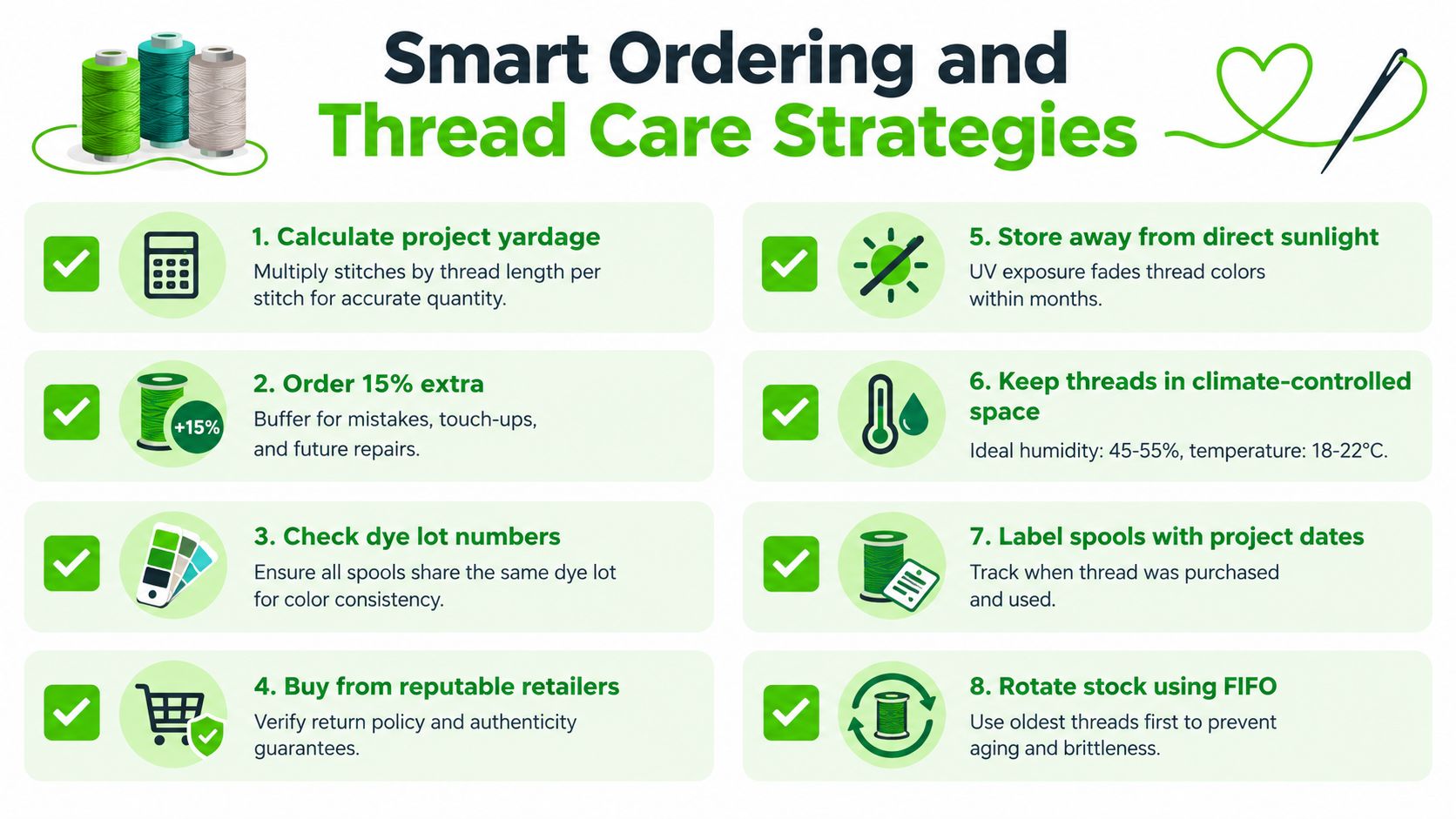
A machine can stop mid-design for a simple reason: the online order covered the headline color but not the bobbins, test runs, or replacement spool. Plan around the complete setup before checking out. Use the design's stitch count to estimate top and bobbin thread, then allow for color changes, trimming, sampling, and repairs. For repeat work, record actual consumption from the first finished sample. That record is more useful than a rough estimate on the next order.
Review the listing before adding thread to the cart. Confirm the fiber, weight, color code, winding format, and machine compatibility. Top thread and bobbin thread must work together, and the bobbin weight should suit the selected top thread and bobbin case. A listing that omits those details creates avoidable tension problems.
For repeat production, keep a small order record with the thread code, lot information, bobbin choice, needle, and machine settings. Order by project when possible, grouping the thread, bobbins, needles, and stabilizer required for one design. Buy enough of a matched shade to avoid visible differences between garments, and inspect every spool when it arrives. Look for crushed flanges, loose winding, damaged ends, and label changes before shelving it.
Shipping can also shape a sensible order. B-Sew Inn offers free standard shipping on orders over $100, according to its publisher information. That threshold may suit a planned purchase that already includes stabilizer, needles, or storage. It should not justify supplies you do not need.
Store thread cleanly, away from direct sunlight, dust, and unstable humidity. Keep spools upright or in a dedicated container, retain their labels, and sort them by color family or manufacturer code. A Floriani thread storage box keeps spools protected and visible, reducing search time and the risk of choosing the wrong shade. Good storage makes the next online order easier to match accurately.
The Advantage of Testing In Person
Online ordering works especially well for replenishing a thread that has already been tested. The color code is known, the fabric combination is familiar, and the machine settings are recorded. For a first purchase, however, a physical store solves problems that product photography can't.
Natural and indoor light can reveal whether two shades belong together. A physical chart lets the embroiderer compare neighboring colors without the display settings, compression, or lighting used in a product photograph. Handling a spool also reveals winding quality, surface feel, and whether the thread has a finish suited to the intended design.
Technical help changes the buying decision
A specialized dealer can connect thread selection to the machine rather than treating every spool as interchangeable. The relevant questions include:
- Is the machine a single-needle or multi-needle model?
- Does the design require rayon's sheen or polyester's durability?
- Is the chosen bobbin compatible with the bobbin case?
- Does the fabric need cut-away, tear-away, or another stabilizer?
- Is the needle eye appropriate for the selected weight?
- Does the tension problem come from thread, hooping, needle condition, or design density?
B-Sew Inn is an authorized sewing, quilting, and embroidery machine dealer with retail stores in Tulsa, Oklahoma City, Springfield, Humble, and Fayetteville, plus an online store. Its inventory and services include machines from Baby Lock, Bernina, Bernette, Brother, and Janome, along with sergers, longarm quilting machines, embroidery designs, thread, stabilizer, notions, cabinets, and cutting tables. The company sells and services equipment, but it doesn't manufacture machines or create custom machine designs.
Readers in Oklahoma, Missouri, Texas, and Arkansas can see, test, and try machines in person before committing to a significant purchase. In-person machine mastery sessions and classes can also help isolate persistent tension problems, while service, repair, and trade-in support matter when a machine needs more than a new spool.
For a known color and tested fiber, online convenience is sensible. For uncertain compatibility, recurring thread breaks, or a major machine decision, hands-on support is the more efficient route. A short test stitched on the actual machine can prevent a much larger order of unsuitable thread.
B-Sew Inn offers embroidery thread, bobbins, stabilizers, storage, machines, service, repair, trade-ins, and in-person classes to help makers build a dependable setup. Browse the supplies online or visit B-Sew Inn to compare colors, test machines, and get practical guidance before placing the next thread order.

