
Welcome to the amazing world of sewing! It’s a place where a single thread and a good idea can bring just about anything to life. If you're just starting out, the thought of picking a sewing machine can feel a little daunting, but the right beginning sewing machines are built to be your creative partner, not a puzzle. This guide will serve as your comprehensive "how-to" for choosing the perfect machine, showcasing tangible examples of what you can create.
Embarking on Your Sewing Journey
Choosing your first machine is a huge moment. Try to think of it less like buying a tool and more like meeting a new friend—one who will be right there with you as your skills grow. Here at B-Sew Inn, we truly believe that this process should be exciting, not frustrating. This guide is here to cut through the confusion and give you a clear path forward, from understanding the different types of machines to confidently replicating beautiful projects.
Our whole philosophy is built on empowering crafters. We don't just want to sell you a machine; we are committed to giving you a complete ecosystem to help you succeed. That includes:
- Expert-led online classes perfect for any skill level.
- Comprehensive training to help you get the most out of your new machine.
- Extensive resources and a community of fellow makers to connect with.
From Old Ideas to Modern Marvels
Today's machines might feel incredibly modern, but their roots go back centuries. The real leap from clunky early designs to practical tools happened between 1790 and 1860. Back in 1830, a French tailor named Barthélemy Thimonnier patented a machine that used a chain stitch. He reportedly used 80 of them to mass-produce army uniforms, proving that machine sewing was ready for the big time!
In this guide, we’ll walk you through everything you need to know to find your perfect match. We'll break down the differences between mechanical and computerized models, point out the features that really matter, and help you line up a machine with your creative goals.
If you want a quick primer before we dive deep, check out our guide covering sewing machine basics for beginners.
With the right machine and a supportive partner like B-Sew Inn, you have everything you need to start creating. Let's get this exciting journey started.
Choosing Between Mechanical and Computerized Machines
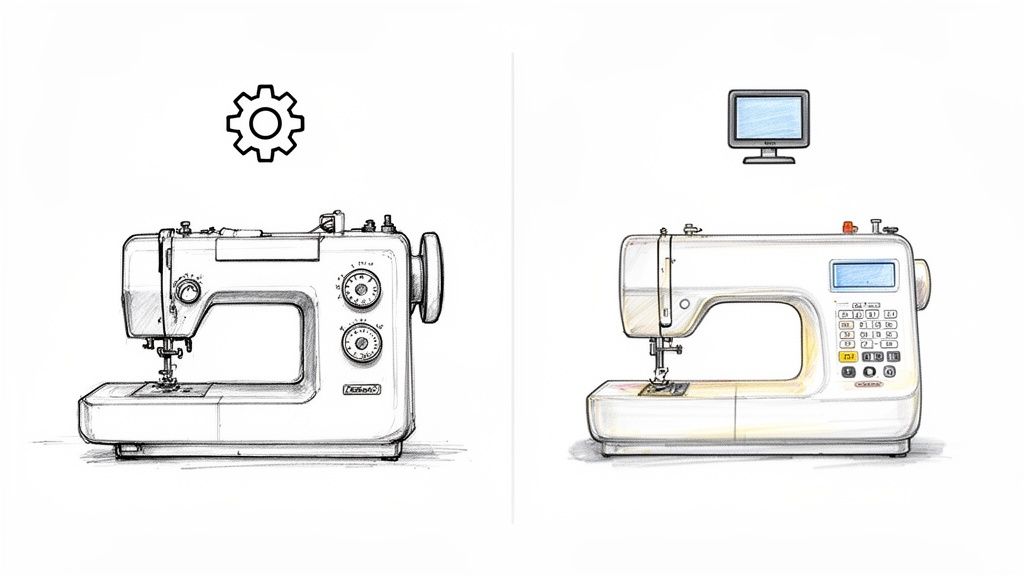
When you start shopping for your first sewing machine, one of the first big questions you'll face is a classic one: mechanical or computerized? It’s a bit like choosing between a vintage car and a new one. Both will get you where you’re going, but the ride and the experience are totally different.
Think of a mechanical sewing machine as that trusty, classic car. It’s all about the hands-on connection. You select stitches by turning physical knobs and dials, feeling the click as you lock in your stitch length or width. There’s no screen, just pure, tactile control.
This direct approach is fantastic for truly understanding the nuts and bolts of how sewing works. You’re the one in charge of every single adjustment, which builds an incredible foundation of skill. Plus, these machines are famous for being absolute workhorses—sturdy, reliable, and easier to maintain.
A computerized sewing machine, on the other hand, is like a modern car with a slick dashboard and push-button start. It has an LCD screen and a whole suite of automated features that make your sewing life a whole lot easier, right from the get-go.
These machines come packed with a huge variety of stitches and game-changing features like automatic needle threaders, one-step buttonholes, and perfect speed control. For a beginner, this automation can be a massive confidence booster.
A Look at Mechanical Machines
The real charm of a mechanical machine is its straightforward simplicity. With fewer electronic components, there’s often less that can go wrong. Many sewists (myself included!) find the satisfying clunk of turning a dial to be part of the fun. They are built to do the essential tasks and do them well for years.
- Pros: Generally easier on the wallet, incredibly durable, and they force you to learn the core principles of sewing.
- Cons: You’ll have a limited number of built-in stitches and will need to make most adjustments manually.
That hands-on control really helps you understand what the machine is doing and why, which is a skill that will serve you forever.
Exploring Computerized Machines
Computerized models just blow the doors open on creative possibilities, and they do it with very little fuss. Imagine scrolling through dozens, or even hundreds, of stitch options with a simple button press. It lets you dive into decorative stitching and fun patterns from your very first project. At B-Sew Inn, many of our project classes are designed to help you explore these features.
These machines are brilliant at handling tricky tasks that might frustrate a beginner. They can stitch a perfectly uniform buttonhole every single time or be programmed to always stop with the needle down—a lifesaver when you’re pivoting on a sharp corner. This built-in assistance helps you achieve clean, professional-looking results much faster.
To give you a clearer picture, here’s a quick breakdown of how they stack up.
Mechanical vs Computerized Sewing Machines at a Glance
| Feature | Mechanical Machines | Computerized Machines |
|---|---|---|
| Stitch Selection | Manual dials and knobs | Push-button on an LCD screen |
| Number of Stitches | Limited (typically 10-30 basic stitches) | Extensive (often 50-200+ stitches) |
| Key Features | Basic, manual controls for tension, stitch length/width | Automated features like needle threader, thread cutter, speed control |
| Best For | Learning fundamentals, durability, basic repairs & sewing | Creative versatility, quilting, embroidery, achieving polished results faster |
| Price Point | Generally more affordable | Wider price range, often starting higher |
| Learning Curve | Steeper for understanding settings, simpler operation | Easier to start, but more features to learn over time |
So, what’s the right call? It really comes down to your personality and what you want to create. Do you love the idea of mastering the craft from the ground up with manual control? Or are you itching to jump into decorative projects with a little help from modern technology?
For a deeper dive, check out our guide on the differences between computerized and mechanical sewing machines. The good news is, there’s no wrong answer. Both paths lead to the wonderful world of creating something beautiful with your own hands.
Essential Features Every Beginner Machine Should Have
When you start looking at beginning sewing machines, the list of features can feel like you’re trying to read another language. It’s easy to get wowed by machines that boast hundreds of stitches and all sorts of fancy functions, but for a frustration-free start, there are a few key features that are truly non-negotiable. These are the practical, everyday heroes that will make your first projects a joy, not a chore.
Think of these features as your sewing co-pilots. They handle the tricky bits, letting you focus on the important stuff—learning how to guide the fabric and actually put a project together. The goal is to find a machine that feels more like a helpful partner, one that lets you start creating with confidence right out of the box.
The Must-Haves for a Smooth Start
Let’s cut through the noise and talk about what really makes a difference for someone new to sewing. These aren't just "nice-to-haves"; they're the essentials that will help you build skills without hitting unnecessary roadblocks.
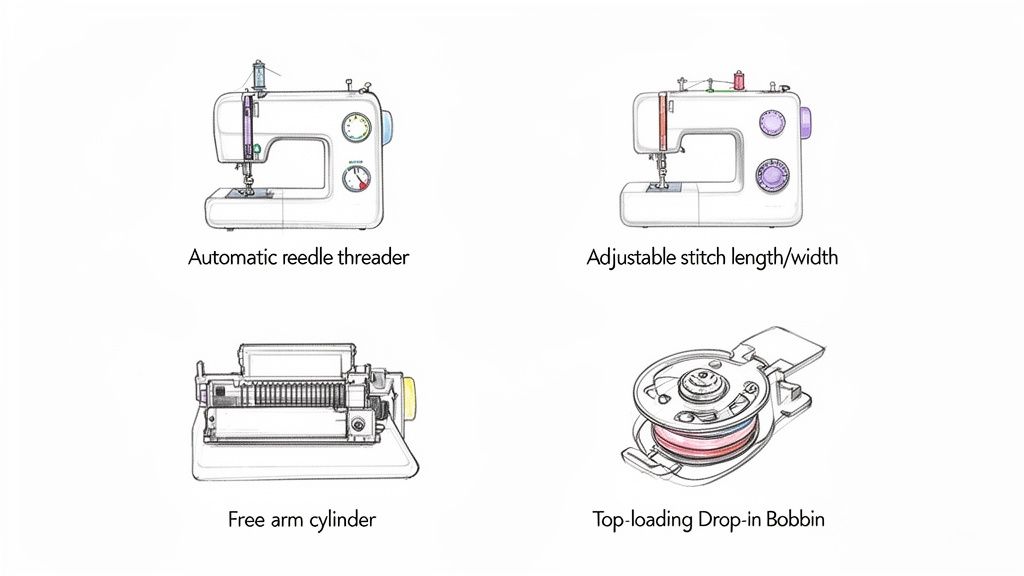
- Automatic Needle Threader: This tiny feature is a sanity-saver. It saves you from squinting and struggling to get the thread through that teeny-tiny needle eye. A simple lever does the work for you, which means you get to the fun part—the sewing—that much faster.
- Adjustable Stitch Length and Width: Having control over your stitches is everything. You'll need to lengthen a stitch for basting or widen a zigzag to finish a seam securely. This adjustability gives you the versatility to work with different fabrics and techniques from the get-go.
- Top-Loading (Drop-In) Bobbin: Trust me on this one. A drop-in bobbin system is so much easier for a beginner to handle. You just pop the bobbin in from the top, and the clear cover lets you see how much thread you have left. No more running out of thread mid-seam and not realizing it for ten minutes!
- Free Arm Capability: The free arm is the secret to sewing small, round things. You just slide off a piece of the sewing bed to create a smaller surface, which is perfect for hemming a pair of jeans, sewing a sleeve cuff, or finishing a tiny baby outfit.
These core features are the foundation of a great learning experience. They directly solve the most common beginner headaches—like impossible threading, thread jams, and sewing in tight circles—making the whole process feel much more natural.
Why These Features Actually Help You
Each of these functions serves a practical purpose you’ll be thankful for on almost every single project. An automatic threader isn’t a luxury; it’s a timesaver that prevents eye strain and keeps your creative momentum flowing. In the same way, being able to adjust your stitch settings is what separates a project that looks "homemade" from one with a polished, professional finish.
At B-Sew Inn, we're committed to empowering crafters by focusing on these user-friendly features in the machines we recommend. We believe your first machine should build you up, not hold you back. Through our online classes and training, we show you exactly how to make the most of these features, turning what seems intimidating into simple, repeatable steps. It’s all about making sure your first sewing machine is a gateway to a lifelong passion.
Matching Your Machine to Your Creative Dreams
So, what do you dream of making? Answering that question is probably the most important step in figuring out which of the many beginning sewing machines is the right one for you.
When you're shopping for a machine, it’s about so much more than a list of features. It’s about finding a partner that can keep up with your creative passion. Let’s walk through three of the most popular paths new sewists take. Once you connect your goals to specific machine functions, you can find a machine that’s truly ready to bring those dreams to life.
For the Aspiring Dressmaker
Do you picture yourself whipping up custom-fit dresses, perfectly tailored blouses, or maybe even your own unique cosplay costumes? If making your own clothes is the goal, you’ll want a machine that’s both a workhorse and a perfectionist. A model with a strong motor is non-negotiable—it needs to handle everything from delicate chiffon to sturdy denim without skipping a beat.
You don't need hundreds of decorative stitches to get started. Instead, look for a machine that absolutely nails the essentials:
- A perfect straight stitch: This is the foundation of pretty much all garment construction. It has to be good.
- A versatile zigzag stitch: You'll need this for finishing your seams to keep the fabric from fraying.
- A one-step buttonhole function: This feature is a lifesaver, creating consistent, professional-looking buttonholes every single time, without the guesswork.
These are the stitches that form the backbone of your future handmade wardrobe, giving you the control you need to build beautiful, durable clothes.
For the Future Quilter
Maybe you’re more drawn to the cozy comfort and intricate patterns of quilts. If so, your machine needs are a little different. Quilting means stitching through multiple layers of fabric and batting, and that takes some specialized gear.
A machine with a larger workspace is a huge plus. This area, often called the "throat space," gives you more room to maneuver bulky quilt projects without feeling like you're wrestling an octopus.
A walking foot is another absolute game-changer for quilters. This special attachment has its own little set of feed dogs that grip the top layer of your quilt, while the machine's feed dogs grip the bottom. This makes sure all the layers move together perfectly, preventing all that frustrating puckering and shifting.
For the Home Décor Enthusiast
Is your vision all about refreshing your living space with custom curtains, throw pillows, or stylish table runners? Home décor projects often mean working with heavier fabrics like canvas, upholstery, or twill. Just like with garment sewing, a strong motor is a must-have to power through these dense materials without a struggle.
The quest for power and speed isn't new. Back on September 10, 1846, American inventor Elias Howe patented his lockstitch machine, which could famously sew at 250 stitches per minute—outpacing five hand sewers working at once! That leap in efficiency shows why a powerful motor is still so critical for tackling big projects today. You can learn more about Elias Howe’s groundbreaking invention and how it shaped modern sewing.
No matter which path you’re excited about, B-Sew Inn is here to cheer you on. Our custom machine bundles and huge library of online classes are designed to help you master these exact skills, turning your creative vision into something real and beautiful.
The Tools You Actually Need to Get Started
Your new sewing machine is the star of the show, but the right accessories are what really get the production underway. Think of it this way: you can have the best oven in the world, but you can’t bake a cake without measuring cups, mixing bowls, and a pan. The same goes for sewing!
At B-Sew Inn, we’re not just here to sell you a machine and wave goodbye. Our commitment is to empower you for the long haul. That means making sure you have the right starter toolkit so you can skip the frustration and get straight to the fun part—bringing your ideas to life.
Building Your Beginner Toolkit
There's nothing worse than getting halfway through a project only to realize you're missing a crucial tool. A well-stocked sewing station keeps those little hiccups from turning into project-ending disasters.
Here are the absolute essentials we tell every new sewist to grab:
- High-Quality Fabric Scissors: This is non-negotiable. A sharp pair of scissors used only for fabric will give you clean, crisp cuts. Using them for paper will dull them in a heartbeat, leading to frayed edges and heartache.
- A Variety of Needles: One of the most common beginner mistakes is using the wrong needle for the fabric. Different materials need different needles. You'll save yourself a world of skipped stitches and broken threads by having universal, stretch, and denim needles on hand from day one.
- Extra Bobbins: Trust us on this one. You’ll want several bobbins pre-wound with your most-used thread colors like black, white, and a neutral gray. It’s a huge time-saver when you’re in the creative zone.
- Good Quality Thread: This isn't the place to cut corners. Cheap thread breaks easily, frays, and leaves a ton of lint in your machine, which can lead to problems down the road. Investing in good all-purpose polyester or cotton thread is one of the smartest things you can do.
We've put together a more comprehensive guide to help you stock your sewing space—check out our list of essential sewing machine accessories for more ideas.
Don't Forget the Most Important "Accessory"
Honestly, the most valuable tool you can have isn’t a physical object—it’s knowledge. The history of sewing is full of inventors trying to make these machines more user-friendly. When Isaac Singer made improvements like adding a presser foot back in the 1850s, he turned a complicated industrial machine into something people could actually use at home. That spirit lives on in today's incredibly intuitive machines.
But even the most advanced features are useless if you don't know how to use them. This is where a little guidance can make a huge difference. Our B-Sew Inn online classes and training are designed specifically to help you bypass those common beginner hurdles. Our expert instructors will walk you through everything, making sure your sewing journey is filled with "I did it!" moments instead of frustration.
Your Final Checklist for Choosing a Machine
Alright, feeling ready to make a decision? This last step is all about tying everything we've talked about together. The best beginning sewing machines are the ones that just feel right for what you want to create, so let’s get honest about your goals to land on the perfect choice.
Think of this as a quick self-assessment. It’ll help you cut through the noise and zero in on the machine that truly fits your creative vision, ensuring you invest in something you'll love from the very first stitch.
Key Questions to Ask Yourself
Before you pull the trigger, run through these final questions:
- What’s my real budget? Remember, a good machine is an investment in your creativity. Here at B-Sew Inn, we offer financing options to help you get a durable, feature-rich machine that will last for years without breaking the bank.
- What projects am I most excited about? Are you dreaming of cozy quilts, handmade clothes, or unique home décor? Go back and peek at the project-matching section to double-check that your top contender has what you need, like a beefy motor for denim or a walking foot for quilting.
- Do I want hands-on control or automated ease? A mechanical machine is a fantastic way to learn the nuts and bolts of sewing. On the other hand, a computerized model offers features that build confidence and can really speed things up. There's no wrong answer!
Answering these questions honestly helps separate the "must-haves" from the "nice-to-haves."
This little chart breaks down the core actions you'll take with any project, whether you’re cutting fabric, winding a bobbin, or sewing a seam. It’s a great reminder of the fundamentals.
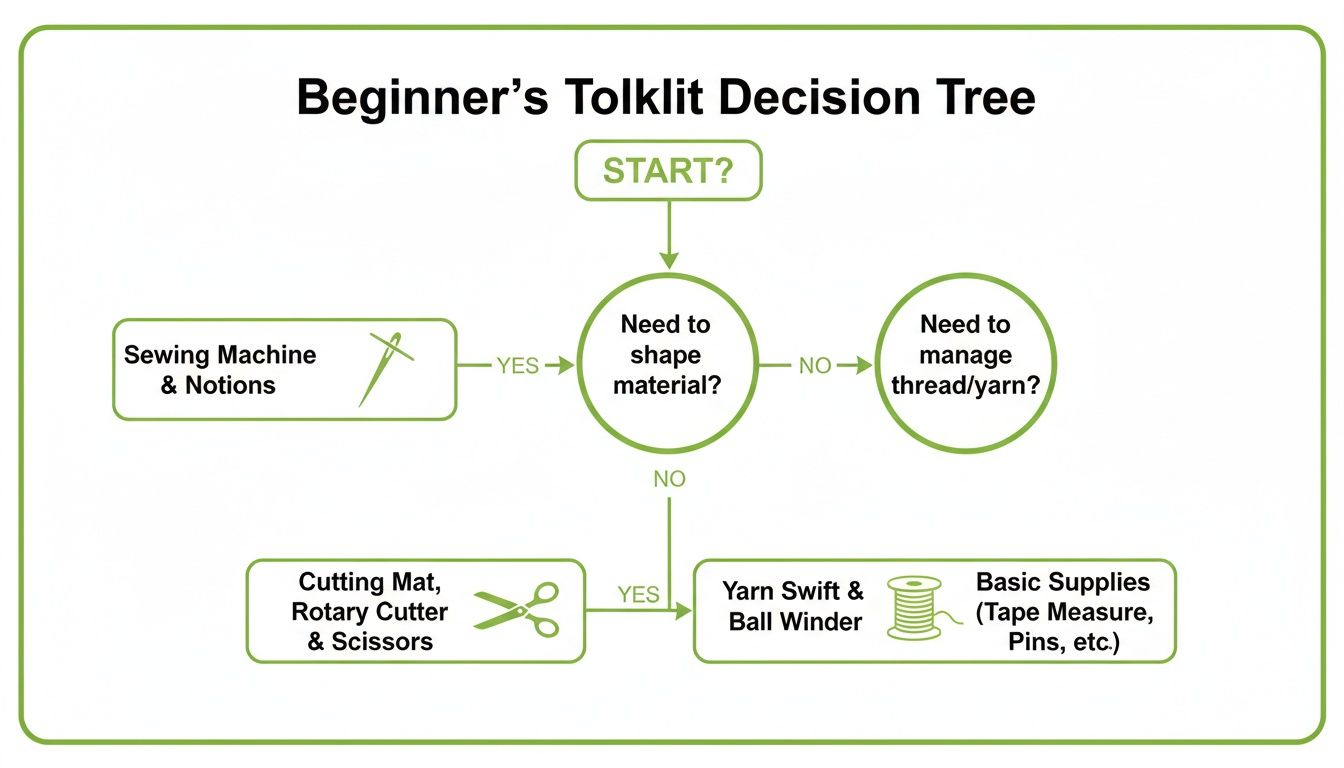
It really shows that every project, big or small, starts with these three basic steps. Mastering them from day one is the key to success!
Your Sewing Journey Starts Here with B-Sew Inn
Once you’ve picked your machine, your journey is just getting started—and we’re here for you every step of the way. We’re passionate about empowering makers through our custom machine designs, extensive online classes, and a welcoming community that’s always ready to cheer you on.
Your first machine isn't just a purchase; it’s the start of a rewarding relationship with a new skill. With B-Sew Inn, you're never sewing alone.
Ready to take that next step? Check out our handpicked collection of beginner-friendly machines or get in touch with our experts for some one-on-one advice. Your creative adventure is waiting.
Common Questions from New Sewers
Diving into the world of sewing is exciting, but choosing that first machine can feel a little daunting. We get it! To help you feel completely confident, we’ve put together answers to some of the questions we hear most often from folks just starting out.
How Much Should I Budget for My First Sewing Machine?
You’ll find that a really solid, dependable beginner machine usually falls in the $200 to $500 range. It’s so tempting to just grab the cheapest model you can find, but trust us on this one—investing a little more in a quality machine from a brand you can trust will save you a world of headaches later on.
Here at B-Sew Inn, we want to make sure you get a great machine without breaking the bank. That's why we offer financing options and even have certified pre-owned models. You can get the quality and features you need to actually enjoy learning to sew.
Do I Really Need All Those Fancy Stitches?
Nope, not at all! Seeing a machine with hundreds of stitches can be mesmerizing, but the reality is, you'll spend almost all your time using just a handful of them. Your go-to stitches will be the straight stitch, the zigzag stitch, and a good buttonhole stitch.
What really matters is the quality of those essential stitches, not the sheer quantity. A machine that nails these basics is far more valuable than one packed with decorative stitches you might never touch. Our team can point you toward models that have a practical, useful stitch package perfect for a beginner.
The most common mistake is buying a machine without considering future support. A machine is more than a one-time purchase; it's an investment in your creativity. Beginners often overlook the importance of classes, maintenance services, and expert help.
Can I Just Teach Myself to Sew on a New Machine?
You absolutely can, and many people do! But having an expert guide can make the learning process so much faster and way more fun. This is a huge reason why we at B-Sew Inn are so passionate about offering a full library of online classes and tutorials.
When you learn from an instructor, you build a solid foundation right from the start, sidestep those common beginner mistakes, and build your confidence much quicker than with trial and error.
When you buy from a dedicated sewing shop like B-Sew Inn, you're not just getting a machine in a box. You're getting a partner—someone you can turn to for training, technical support, and a whole community to help you grow.
Your creative journey is just beginning, and B-Sew Inn is here to support you every step of the way with the best machines, accessories, and education. Explore our collection and start your adventure at https://www.bsewinn.com.

