

If you ask ten different quilters what the "best" thread is, you'll probably get ten different answers. But if I had to give a quick recommendation, I'd say a good quality, 50 wt, 100% cotton thread is a fantastic workhorse for most projects. It sinks beautifully into the fabric and gives you that classic, matte finish we all love.
But what if you want your quilting to pop a little? That's when a 40 wt polyester thread comes in handy. It offers a bit more strength and a lovely, subtle sheen. The truth is, the "best" thread really comes down to the quilt you're working on right now—the fabric, the design, and the final look you're dreaming of.
Your Guide to Choosing the Right Quilting Thread
Picking out your thread is one of those small decisions that makes a huge impact on your finished quilt. It’s what separates stitches that stand out as a bold design choice from those that create soft, gorgeous texture. Using a quality thread means your quilt will stand the test of time, while a cheap spool can lead to endless headaches with fraying and breaking.
This guide is here to cut through all the noise about materials, weights, and colors. At bsewinn.com, we are deeply committed to empowering crafters like you. We don't just provide custom sewing machine designs; we offer the support you need to bring your vision to life. Through our extensive online classes, training, and resources, we're here to help you master every technique, from selecting the perfect thread to executing complex quilting patterns.
Think of this as your personal roadmap. We're going to demystify the language of thread so you understand that the "best thread for machine quilting" isn't one specific product, but the one that’s perfect for your project.
Why Your Thread Choice Matters
The thread you choose is doing more than just holding your quilt sandwich together; it's a key artistic element. The right thread can take your work to the next level, but the wrong one can cause a world of frustration before you've even finished a single block.
Here’s what’s really at stake when you pick up that spool:
- Durability and Longevity: Your thread has to be tough enough to handle the speed and friction of machine quilting without snapping. More importantly, it needs to hold up through years of cuddles and wash cycles.
- Aesthetic and Finish: Do you want your stitches to be the star of the show, or do you want them to blend in seamlessly? The material and thickness of your thread will make that decision for you.
- Machine Performance: The wrong thread can make your machine pretty unhappy. Using the right thread for your needle and project is the secret to avoiding skipped stitches, tension nightmares, and frustrating lint buildup.
Making a smart choice from the start saves so much time and prevents those annoying "why is this happening?!" moments. It’s all about making sure your creative vision comes to life exactly how you pictured it.
For anyone just starting out, getting a handle on the basic tools is the first step. For a complete rundown, check out our guide on essential quilting supplies for beginners. It'll set the stage perfectly for diving deeper and choosing that perfect spool of thread with total confidence.
Decoding Thread Materials: Cotton vs. Polyester
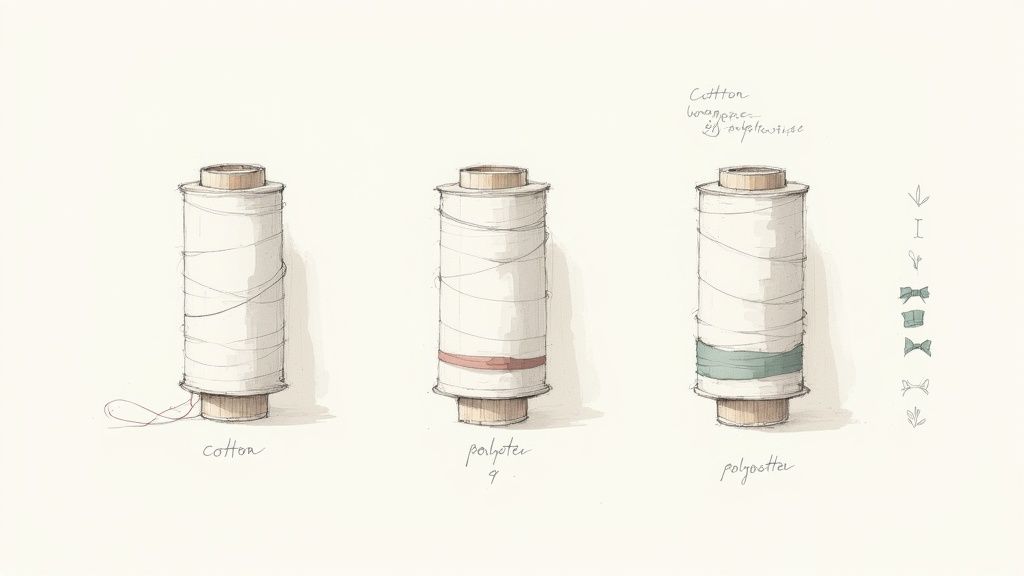
Picking the right thread is a lot like choosing the perfect fabric for an outfit. You wouldn't make a rugged hiking jacket from delicate silk, right? The same gut check applies to quilting. The thread's fiber content—usually cotton or polyester—is the foundation that defines how your stitches will look, feel, and hold up over time.
Getting a handle on what makes each thread type tick is one of those core skills that takes your quilting from good to great. This one decision impacts everything from the final texture of your quilt to how well it will stand up to years of love and washing.
The Classic Choice: 100% Cotton Thread
Cotton thread is the tried-and-true traditionalist of the quilting world. It's a natural fiber with a lovely matte finish that almost melts into the fabric. Think of it like your favorite pair of jeans—it's comfy, reliable, and just gets better with age.
The real magic happens when you pair cotton thread with cotton fabric. They shrink and wear at the same rate, which gives your quilt that beautifully crinkled, authentic heirloom feel after the first wash.
Because it has very little stretch and almost no sheen, cotton is your go-to when you want the texture of your quilting to be the main event, not the thread itself. It's my first choice for traditional patterns, cozy baby quilts, or any project where I want the stitches to blend in seamlessly.
A good-quality cotton thread will also be low-lint, which is a lifesaver for keeping your machine happy. Look for extra-long staple (ELS) cotton if you can; those longer fibers create a thread that's smoother, stronger, and way less fuzzy.
Pro Tip: Use 100% cotton thread when you want your stitches to become one with the fabric, creating a soft, traditional finish that lets your quilting pattern shine.
The Durable Workhorse: Polyester Thread
If cotton is classic denim, polyester is the high-performance athletic wear of thread. It’s literally engineered for strength and durability. Polyester is incredibly strong and has a slight stretch, which makes it a champion at handling the tension and speed of machine quilting without snapping.
Polyester often has a subtle, attractive sheen that makes quilting designs really pop. This is why it's a fantastic choice for modern quilts or any project where you want your quilting lines to stand out as a bold design element.
Being a synthetic fiber, it’s also resistant to things like mildew and UV fading. This makes it a powerhouse for quilts that will get a ton of use and washing, like bedspreads and tote bags.
The Best of Both Worlds: Cotton-Wrapped Poly
Can't decide between the two? You don't have to! Cotton-wrapped polyester thread is a brilliant hybrid that gives you the best of both. It’s built with a strong polyester core that's wrapped in a soft cotton outer layer.
This clever design gives you the strength and low-lint nature of polyester, but with the softer look and feel of cotton. It’s an awesome all-purpose thread that performs beautifully for both piecing and quilting, bridging the gap perfectly.
Understanding fiber properties is a rabbit hole you can really go down. For instance, looking at a guide comparing bamboo and cotton materials for things like bedding can give you some great insights into how different fibers behave in terms of strength and feel. Many of those same principles apply here in the world of thread.
Machine Quilting Thread Material Comparison
To make it even simpler, here's a quick cheat sheet to help you decide which thread is right for your next project.
| Thread Material | Key Characteristics | Best For | Pro Tip |
|---|---|---|---|
| 100% Cotton | Soft, matte finish, no stretch. Blends into fabric. | Traditional quilts, heirloom projects, baby quilts, when quilting texture is the focus. | Choose an extra-long staple (ELS) cotton for less lint and a smoother stitch. |
| Polyester | Strong, durable, slight stretch, and has a subtle sheen. | High-use items (bed quilts, bags), modern designs, decorative topstitching. | The sheen helps your quilting lines stand out as a design element. Perfect for modern quilts! |
| Cotton-Wrapped Poly | Strong polyester core with a soft cotton exterior. Low lint. | All-purpose use for both piecing and quilting. A great "do-it-all" thread. | When in doubt, this hybrid is a safe and reliable bet for nearly any machine quilting project. |
Ultimately, there's no single "best" thread—only the best thread for the specific quilt you're making. Don't be afraid to experiment! Keeping a few spools of each type in your stash means you'll always have the perfect option ready to go.
Once you've picked your thread material, the next big decision is its weight. The whole idea of thread weight, often written as "wt," can feel a little intimidating at first, but it's much simpler than it looks. The easiest way to think about it is like changing the font size on a document—it’s all about how bold or how subtle you want your stitches to look on your finished quilt.
Getting a handle on this one number gives you a massive amount of creative control. It’s the difference between quilting stitches that make a bold statement versus ones that create a delicate, blended texture.
Decoding the Numbers: What "Weight" Really Means
Here’s the single most important thing to remember about thread weight: the lower the number, the thicker the thread. It feels backward, I know, but it’s a leftover from an old measurement system that stuck around.
A 30 wt thread is like a bold headline; it creates thick, prominent stitches that are meant to be seen. On the flip side, a 50 wt or 60 wt thread is like the fine print—perfect for delicate stitches that seem to melt right into the fabric. Your choice here completely changes the visual impact of your quilting. Do you want your quilting pattern to be a star of the show? Go for a lower weight. Or do you want your piecing to shine, with the quilting adding just a whisper of texture? A higher weight is your best friend.
At bsewinn.com, we believe creative freedom is non-negotiable. Our custom sewing machines are built to handle a huge range of thread weights without fuss, so you can experiment and find your unique quilting voice without your equipment holding you back.
The Most Common Thread Weights for Quilting
While you can find thread in all sorts of sizes, a few key weights are the real workhorses in any quilter's studio. Get to know these, and you'll be set for about 90% of your projects.
- 50 wt Thread: This is the undisputed champion of versatility. It’s my go-to for piecing quilt tops because it’s fine enough to keep seams from getting bulky, but it's plenty strong for the actual quilting, too. If you’re just starting your thread collection, start with 50 wt. You can't go wrong.
- 40 wt Thread: A little thicker than its 50 wt cousin, 40 wt thread is a fantastic all-purpose choice for quilting. It shows up just a bit more, giving your stitches lovely definition without being overpowering. It’s strong, reliable, and runs beautifully for both straight-line and free-motion quilting.
- 30 wt Thread: When you really want your stitches to pop, 30 wt is the thread to grab. This thicker thread is amazing for decorative topstitching, machine embroidery, and any bold quilting design where the thread itself is a major design feature. It lays down a beautiful, chunky stitch that adds incredible texture.
If you want to get into the nitty-gritty of how these numbers are calculated, our comprehensive sewing thread size guide breaks down all the technical details.
Visualizing the Impact of Thread Weight
To really see the difference, let’s imagine quilting a simple block with a lot of open space.
- Quilting it with a 50 wt thread in a matching color would give you a subtle, elegant texture. From a few feet away, you’d see the lovely dimension the stitches create, but the thread itself would blend right in.
- Using a 40 wt thread would make that same quilting pattern more defined. The stitch lines would be clearer, adding a nice, balanced layer of detail that complements your piecing.
- Stitching with a 30 wt thread in a contrasting color? Now the quilting becomes a bold, graphic element. Those thick stitches will command attention, turning into a focal point of the whole design.
Honestly, playing around with different weights is one of the most fun parts of quilting. It lets you dial the emphasis up or down, turning a simple pattern into something that is completely you. Choosing the best thread for machine quilting is all about matching the weight to your creative vision for the project.
Matching Your Thread, Needle, and Tension
Once you’ve landed on the perfect thread for your quilt, the next big step is making sure it plays nicely with your machine. This is where the magic trio of thread, needle, and tension comes in. I like to think of them as a team—if one isn't doing its part, the whole project can start to unravel. Getting these three to work together is the real secret to those smooth, professional stitches we all crave.
Imagine your thread is a key and the eye of the needle is the lock. It’s a simple concept, right? If the key is too thick, it’s not going to fit. Forcing it will just cause damage. It's the exact same idea in quilting. Trying to jam a thick thread through a tiny needle eye will shred, fray, and break it, which is enough to make anyone want to throw in the towel. The goal is to give your thread a smooth, easy ride.
Choosing the Right Needle for Your Thread
The needle is literally the bridge between your sewing machine and your quilt top. Using the wrong one is probably the number one reason for skipped stitches and snapped threads. The golden rule is refreshingly simple: thicker threads need a larger needle, and finer threads need a smaller one. The bigger needle has a larger eye, giving that beefier thread plenty of room to glide through without getting roughed up by friction.
Here are a few go-to pairings that I use all the time:
- For 50 wt Thread: A size 80/12 Universal or Quilting needle is your best friend. This is the perfect all-around setup for both piecing and general quilting.
- For 40 wt Thread: Time to move up to a 90/14 Quilting or Topstitch needle. I’m a huge fan of Topstitch needles for this because they have an even larger eye and a deeper groove to protect the thread as it works its way into the stitch.
- For 30 wt Thread: You’ll definitely want a size 100/16 Topstitch needle. That extra-large eye is non-negotiable for this thicker decorative thread. It’s what prevents it from shredding.
Getting this pairing right from the start saves so much headache later. If you really want to get into the weeds on needle shapes and points, our guide on the types of sewing machine needles is a great resource.
This little infographic is a handy cheat sheet for remembering which thread weights are best for showing off (decorative), getting the job done (all-purpose), or disappearing into the background (blending).
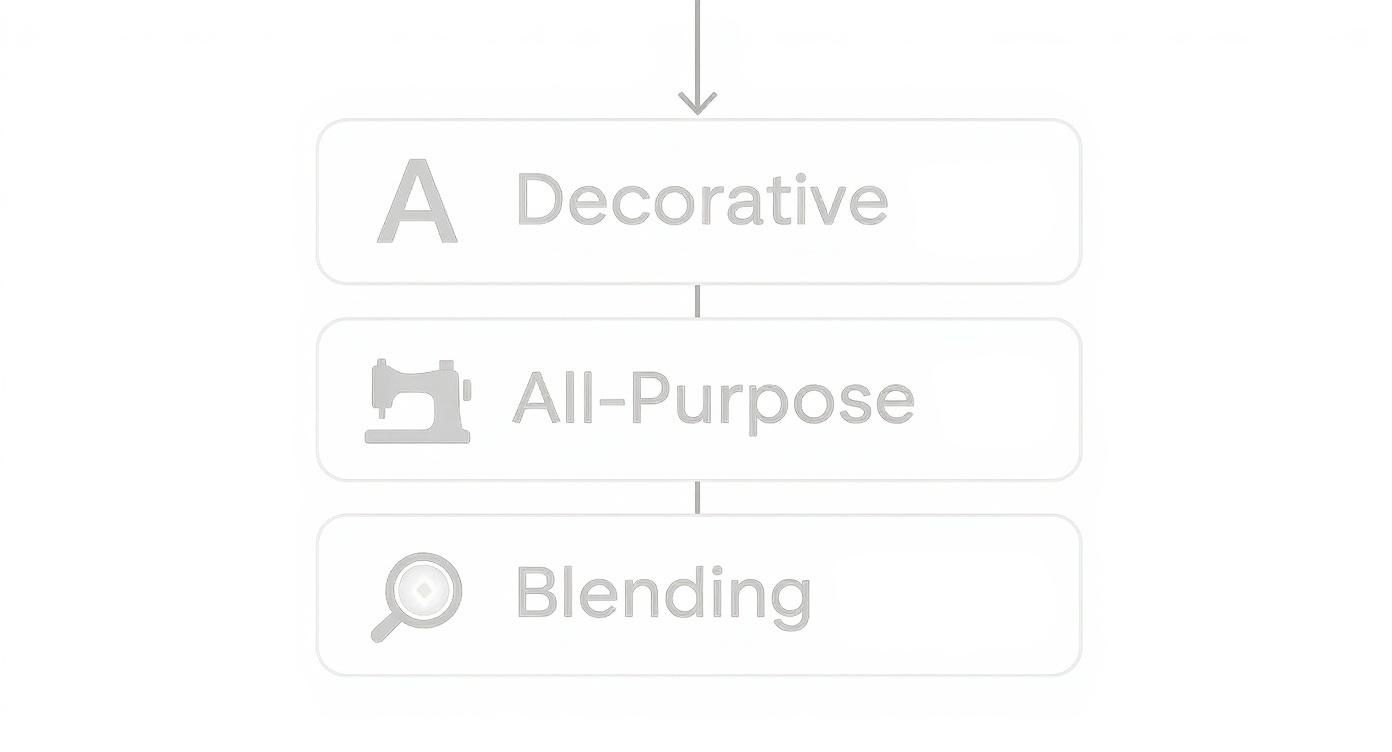
It’s a great visual shortcut for matching your thread to your project’s goal—whether you’re going for bold, functional, or subtle.
Demystifying Machine Tension
Tension sounds intimidating, but it’s just the amount of pull on your thread as it zips through the machine. What you're aiming for is a perfectly balanced stitch, where the top thread and bobbin thread meet right in the middle of your fabric layers, locked in a neat little handshake. When the tension is off, you’ll see ugly loops on either the top or bottom of your quilt.
The best way to check your tension is to grab a small scrap of your quilt sandwich.
- Use two different colors for your top and bobbin threads. This makes it way easier to see what’s going on.
- Stitch a few inches, then stop and take a close look at both sides.
- See little dots of bobbin thread on the top? Your top tension is too tight.
- See loops of your top thread hanging out on the bottom? Your top tension is too loose.
At bsewinn.com, we really believe that mastering your machine is the key to unlocking your creative joy. Our custom sewing machine designs and extensive online classes are built to turn confusing puzzles like tension into simple, solvable problems, empowering you to quilt with total confidence.
It’s amazing how sophisticated modern sewing machines have become, and it’s great news for us quilters. The sewing machine components market was valued at about USD 2.7 billion in 2025 and is on track to nearly double to USD 5 billion by 2035. This growth spurt includes those advanced parts that help our machines handle finer, high-quality threads without a single snap—a total game-changer for dense and intricate quilting designs.
Putting It All Together with Project Examples
Okay, we've talked a lot about the theory, but let's be honest—it doesn't really click until you see it happen on a real quilt. This is where all those concepts about thread weight, fiber, and finish finally make sense. This "how-to" section showcases tangible examples that you can replicate, turning theory into practice.
So, let's stop talking about the "what" and "why" and dive into the "how" with a few projects you could start today. I'll walk you through three completely different quilts to show you exactly how these thread choices play out in the real world.
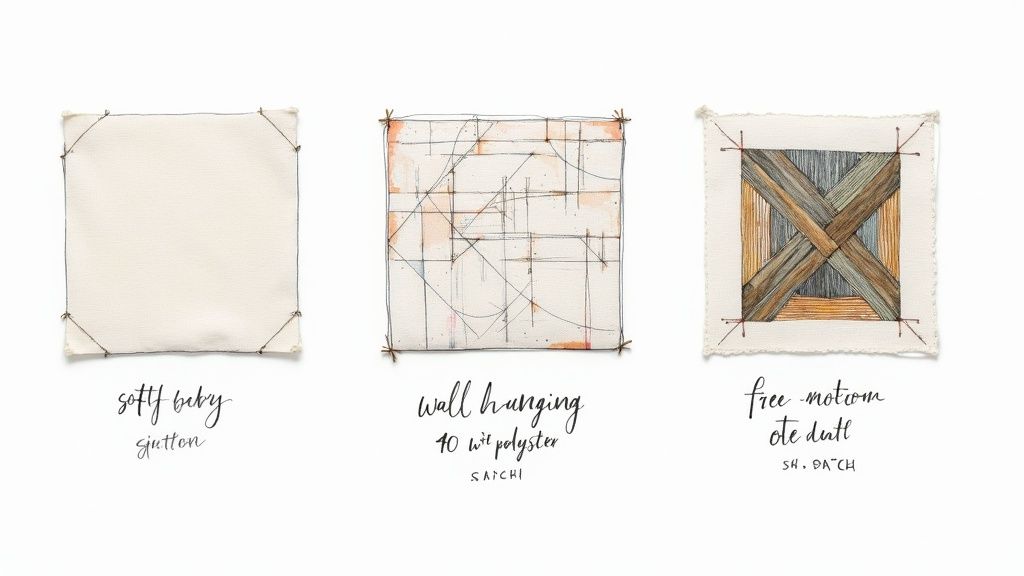
Project One: A Traditional Baby Quilt
When you’re making a classic baby quilt with soft, dreamy cottons, your goals are pretty clear: make it cozy, make it durable, and make it timeless. The quilting needs to add that lovely texture and hold everything together without feeling scratchy or stealing the show from your piecing.
- Thread Choice: This is the perfect job for a high-quality 50 wt 100% cotton thread. It’s fine enough to sink right into the fabric, creating a soft, subtle texture that’s beautiful to the touch. The matte finish of cotton just belongs on a traditional quilt—it blends in perfectly instead of screaming for attention.
- Needle and Settings: Grab an 80/12 Quilting needle. This size is the sweet spot for piecing and quilting standard cottons, giving you a clean stitch without leaving big holes. Your machine’s default tension will probably be just fine, but I always, always recommend stitching on a little practice quilt sandwich first.
- The 'Why': With this setup, the star of the show is your patchwork. The thread is the unsung hero, securing the layers and giving you that gorgeous, crinkly texture after the first wash that screams "heirloom."
Project Two: A Modern Graphic Wall Hanging
Think bold geometric shapes, lots of negative space, and crisp, clean lines. For a modern quilt, the quilting isn't just functional; it's a huge part of the design. You want people to see and admire those stitches.
- Thread Choice: I’d reach for a 40 wt polyester thread. It’s a little thicker than your standard 50 wt, so the stitches have more presence. Plus, that little bit of sheen that polyester has? It catches the light beautifully, making those geometric lines pop right off the fabric.
- Needle and Settings: You'll want to size up to a 90/14 Topstitch needle. A Topstitch needle has a bigger eye and a deeper groove down the front, which is exactly what a slightly thicker thread needs to travel smoothly without fraying or breaking.
- The 'Why': The whole point here is for the quilting to make a statement. The strength and visual punch of a 40 wt polyester give your design the definition it needs to look sharp, graphic, and intentional.
It’s no surprise that quilters are seeking out more specialized threads. The global sewing thread market was valued at around USD 3.56 billion in 2023 and is expected to grow to USD 4.63 billion by 2033. Thanks to online shops, it’s never been easier to find the perfect thread for whatever wild idea you dream up next.
Project Three: A Free-Motion Art Quilt
Art quilts are where you get to break all the rules. It's all about playing with color, texture, and pure creative expression. This is your chance to pull out those fun, decorative threads that have been sitting in your stash.
- Thread Choice: Have some fun with it! A variegated thread is amazing for adding flowing color to your quilting without having to stop and change spools every five minutes. And for a little bit of magic, nothing beats a high-quality metallic thread. It can add stunning highlights that take your piece to a whole new level.
- Needle and Settings: This part is non-negotiable: use a 100/16 Topstitch or a dedicated Metallic needle. These needles have a massive, polished eye that prevents delicate threads from shredding. You'll also want to drop your top tension a bit and slow your stitching way down. Be gentle with these threads, and they’ll reward you.
- The 'Why': Here, your thread is no longer just holding things together—it's part of the art itself. You're basically painting with your sewing machine, adding details and textures that turn a quilt into a true work of art.
Once you get the hang of pairing the right thread with the right project, a whole new world of creativity opens up. If you're looking to take those skills beyond quilts, learning how to create custom lined curtains is a fantastic way to apply what you know to beautiful home decor. At the end of the day, choosing the best thread for machine quilting is all about matching the tool to your creative vision.
Common Questions About Machine Quilting Thread
Diving into the world of machine quilting can feel like learning a new language, especially when it comes to thread. You're not alone! Here are some of the most common questions I hear from quilters, with straightforward answers to get you stitching smoothly.
Can I Use All-Purpose Thread for Quilting?
In a pinch, you can, but I really wouldn't recommend it for the long haul. Think of it like this: all-purpose thread is a jack-of-all-trades, but a master of none.
Quilting thread, on the other hand, is specifically engineered for the job. It’s stronger and has a smoother finish to handle the high speeds and friction of your machine. Making the switch means you'll see a lot less frustrating thread breakage and annoying lint buildup.
How Do I Choose the Right Bobbin Thread?
This is a great question, and you have a couple of solid options. The easiest route is to simply use the same thread in your bobbin that you're using on top. This is my go-to for a perfectly balanced stitch every time.
Another popular trick, especially for dense quilting, is to use a finer thread in the bobbin. A 60 wt thread in a neutral color is perfect for this. It keeps the back of your quilt from getting too bulky and lets your top thread be the star of the show.
Why Does My Quilting Thread Keep Breaking?
Oh, the dreaded thread snap! It’s one of the most common headaches in quilting, but it’s usually caused by just a few culprits.
Before you get too frustrated, run through this quick checklist:
- Check your needle: Is it old, bent, or the wrong size for your thread? A fresh needle is often the quickest fix.
- Look at your tension: Are the top and bottom threads playing nicely? You may need to make a small adjustment.
- Examine your thread: Not all threads are created equal. Low-quality thread is notorious for shredding and breaking.
- Clear the path: Make sure the thread is flowing freely from the spool all the way to the needle without catching on anything.
Your sewing machine is a finely tuned instrument, and mastering its nuances is key. At bsewinn.com, our extensive resources and online training are designed to help you solve these common issues, turning frustration into confident creativity.
How Should I Store My Thread?
You've invested in beautiful thread, so you want to protect it! The biggest enemies of thread are sunlight and dust. Over time, they can make the fibers brittle and weak.
Tucking your spools away in a closed container or a dedicated drawer is a fantastic solution. A wall-mounted thread rack is great too, as long as it’s not in a spot that gets direct sunlight. Proper storage keeps your thread strong and ready for your next masterpiece.
Ready to put this knowledge into action? At B-Sew Inn, we provide the machines, accessories, and expert guidance you need to create with confidence. Explore our selection and join our community of passionate crafters today at https://www.bsewinn.com.

