
I've heard it a million times: "What's the best thread for sewing?" The truth is, there isn't one magic spool that rules them all. It’s really about finding the right thread for the job at hand.
Sure, a good 40-50 wt all-purpose polyester is a fantastic workhorse for most general sewing. But if you’re creating a custom-embroidered quilt or a tailored silk blouse using one of B-Sew Inn's unique sewing machine designs, reaching for that same polyester spool might not give you the beautiful, lasting finish you want. This guide is a how-to for breaking down the essentials so you can pick the perfect thread for any design you can imagine, every single time.
Your Guide to Choosing the Best Sewing Threads
Let me tell you, selecting the right thread is one of those foundational skills that can truly take your sewing from "good" to "great." The perfect thread does more than just hold fabric together; it becomes part of the fabric, ensuring your seams are strong, durable, and practically invisible (unless you want them to pop!). At B-Sew Inn, we're committed to empowering crafters like you to create stunning projects. Our custom sewing machine designs are supported by extensive resources, training, and online B-Creative classes designed to help you succeed.
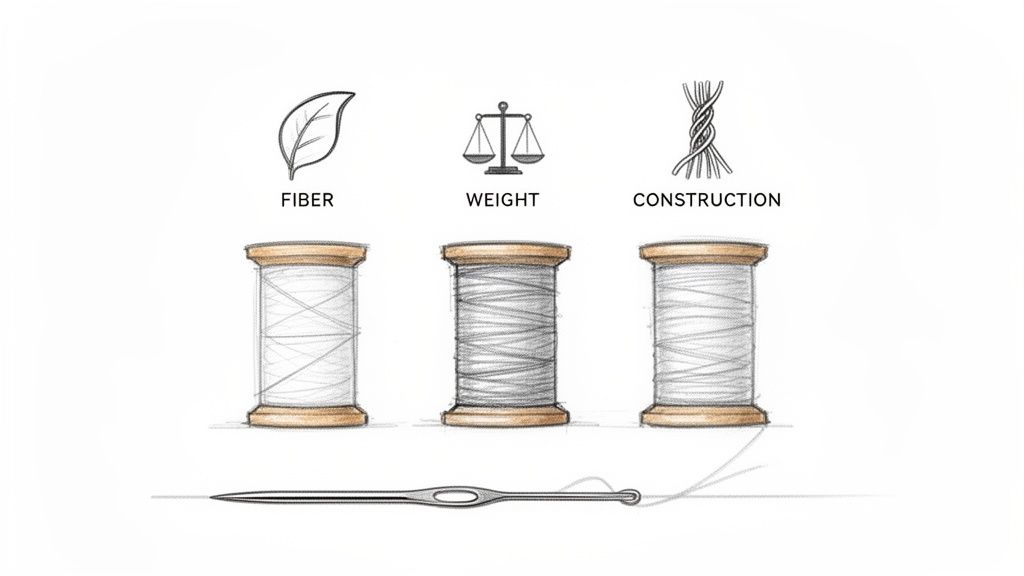
To really get a handle on thread, you just need to understand three core things: its fiber, its weight, and its construction. Once you get these down, you'll be able to walk up to any thread rack and know exactly what you need for your next creation.
- Fiber: This is simply what the thread is made of—cotton, polyester, silk, you name it. A good rule of thumb I’ve always followed is to try and match your thread fiber to your fabric fiber. Sewing cotton fabric with cotton thread just makes sense.
- Weight: This one can be a little confusing at first. Weight tells you the thread's thickness, but the numbering system is backward. A higher number (like 60 wt) means a finer thread, while a lower number (like 30 wt) means a much heavier, thicker thread.
- Construction: This describes how the individual fibers are spun and twisted together. You might see terms like 2-ply or 3-ply. This affects the thread's overall strength and how smoothly it glides through your machine.
Quick Guide to Common Sewing Threads and Their Uses
To help you get started, I've put together a little cheat sheet. This table gives you a quick overview of the most common threads you'll find and what they're best used for. Think of it as your starting point before we dive into the nitty-gritty details of how to replicate professional designs.
| Thread Type | Primary Use Case | Best For These Fabrics | Recommended Needle Size |
|---|---|---|---|
| All-Purpose Polyester | General construction, seams | Cottons, synthetics, knits | 80/12 Universal |
| 100% Cotton | Quilting, piecing, garments | Natural fibers (cotton, linen) | 75/11 or 80/12 Quilting |
| Silk Thread | Fine fabrics, tailoring, basting | Silk, wool, delicate synthetics | 60/8 or 70/10 Microtex |
| Heavy-Duty Thread | Upholstery, denim, canvas | Heavyweight wovens, vinyl | 100/16 or 110/18 Jeans |
This chart is a great way to quickly match a thread to your project, but remember that these are just guidelines. The more you sew, the more you'll develop a feel for what works best for you and your machine.
A little piece of timeless sewing wisdom: choose a thread that is slightly stronger and a shade darker than your fabric. The darker color tends to blend right into the seam, and that extra bit of strength ensures your project holds up beautifully to wear and washing.
It's no surprise that sewing is a massive industry. The global sewing thread market was valued at a whopping USD 3.66 billion in 2024 and is expected to grow to USD 4.91 billion by 2035, largely thanks to the apparel and footwear industries. What that means for home sewists like us is better access to an amazing variety of high-quality, professional-grade threads that make our garment and quilting projects even better. You can read more about the industry trends over on Spherical Insights.
Comparing Thread Fibers: Natural vs. Synthetic
Choosing between a natural or synthetic thread is one of the first big decisions you'll make for any project, and it really matters. Each type has its own personality and behaves differently with your fabric. This choice single-handedly affects the look, feel, and lifespan of your creation. Let's ditch the generic lists and talk about real-world sewing, where one fiber is the clear winner over the other for specific designs.
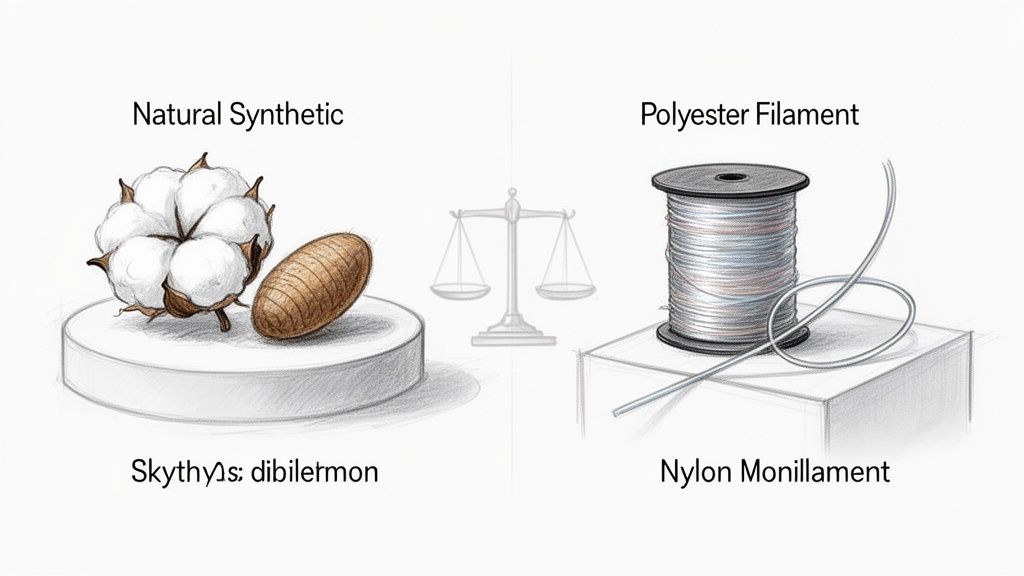
Think of it as creating harmony between your materials. When your thread acts like its fabric partner, you get seams that age gracefully and stitches that won't give up.
The Case for Natural Fibers: Cotton and Silk
Natural fibers are the classics of the sewing world, loved for their distinct character and how beautifully they work with natural fabrics. They're often the first choice for projects where you're aiming for that authentic, traditional feel.
Cotton Thread: The Quilter's Gold Standard
If you're a quilter creating an heirloom quilt design with 100% cotton fabrics, a quality cotton thread is almost always your best bet. Why? Because the thread and fabric are made of the same stuff, they'll wear, wash, and shrink at a similar rate. This simple fact prevents the dreaded puckering you see when a tough synthetic thread outlives the softer cotton fabric around it.
It also has this beautiful, soft matte finish that just melts into the fabric, making it a dream for piecing. While it does create a bit more lint than polyester, today's long-staple cotton threads are designed to minimize this, so they run smoothly through your machine.
Silk Thread: For Tailoring and Delicate Fabrics
Don't let its delicate reputation fool you; silk thread is incredibly strong for how fine it is. It has a natural elasticity that makes it perfect for tailoring wool or sewing on whisper-thin silk fabrics. You get strong, flexible seams that won't leave an impression after you press them.
Its super-smooth finish glides through fabric with hardly any friction, which also makes it the go-to for hand-basting stitches you plan to remove later without a trace.
The Strength of Synthetic Fibers: Polyester and Nylon
Synthetic threads were born from a need for strength, resilience, and pure versatility. They are the workhorses in modern sewing, especially when your project needs to stand up to heavy use and frequent washing.
In fact, synthetics are now the top choice in the sewing world. They’re projected to grab a massive 80% market share by 2025 thanks to their incredible durability and resistance to chemicals and abrasion—perfect for the high-speed machines we all love at B-Sew Inn. Apparel is still the biggest user, making up 58% of thread consumption, which shows just how reliable these threads are for making clothes. If you're a data nerd, you can dig into more stats over at Proficient Market Insights.
Polyester Thread: The Versatile Powerhouse
Polyester is the ultimate all-rounder. It's exceptionally strong, has very little stretch, and resists UV rays and mildew, so your stitches won’t weaken or fade over time. This makes it the best thread for sewing activewear, kids' clothes, and outdoor gear—basically, anything that takes a beating in the wash or on the playground.
It has a slight sheen that gives seams a crisp, professional look, and it’s completely colorfast, so your thread color stays true wash after wash. For those of us using our custom B-Sew Inn machine designs for serging and coverstitching at full tilt, the low friction and high tensile strength of polyester make it a lifesaver, preventing frustrating thread breaks.
Nylon Thread: For Unmatched Strength and Stretch
When you need serious muscle with a bit of give, nylon is what you reach for. It’s even stronger than polyester and has more stretch, making it the perfect match for heavyweight materials like canvas, vinyl, and leather. That bit of elasticity allows seams to flex right along with the material, preventing popped stitches on things like backpacks, luggage, and outdoor upholstery.
A core principle for lasting results: Always aim to match your thread fiber to your fabric fiber. A cotton thread on cotton fabric ensures they age together, while a strong polyester thread provides the necessary resilience for durable synthetic activewear. This simple rule prevents many common seam issues down the line.
Ultimately, the best thread is the one that serves your project. Once you understand these distinct personalities, you can make a confident choice every time, ensuring every stitch helps create something beautiful and built to last.
Decoding Thread Weight and Construction
Once you’ve picked your fiber, the next puzzle to solve is thread weight and construction. All those numbers on a spool might look like a foreign language, but they’re actually your secret weapon for getting the perfect finish—from seams that disappear to stitches that pop. Getting a handle on these basics is one of the biggest leaps you can make in your sewing journey.
Think of thread weight like you would a pen. A super-fine pen gives you delicate, precise lines, while a thick marker makes a bold statement. Thread is exactly the same, but the numbering system can feel a little backward at first.
- A higher weight number (like 60 wt or 80 wt) means a finer, thinner thread.
- A lower weight number (like 30 wt or 12 wt) means a heavier, thicker thread.
This one little detail makes a huge difference in your project. That whisper-thin 60 wt thread? It’s perfect for English paper piecing or sewing delicate silk because it won’t add any bulk to your seams. On the other hand, a chunky 30 wt thread is just what you need for a bold topstitching design on a denim jacket, where the stitch itself is part of the style.
Understanding Thread Ply and Strength
Now, let’s talk construction, which really comes down to ply. Picture a single strand of fiber—it’s not very strong on its own. But if you twist two or three of those strands together into a tiny rope, it becomes dramatically stronger. That’s exactly how thread is made.
The "ply" is simply the number of individual strands twisted together to form the final thread. Most of what you’ll see on the shelf is either 2-ply or 3-ply.
- 2-Ply Thread: This is made of two strands twisted together. It tends to be a bit finer and creates flatter seams, which is fantastic for piecing quilt blocks where you’re trying to minimize bulk at every intersection.
- 3-Ply Thread: Built from three strands, this thread is rounder, stronger, and more durable. It's my go-to for general garment construction, machine quilting, and any project that’s going to see a lot of wear and tear.
It's important to remember that a 50 wt, 3-ply thread will be a smidge thicker and stronger than a 50 wt, 2-ply thread, even though they share the same weight number. Knowing this lets you make smarter choices for your project. If you want to really get into the weeds on how these numbers work across different brands, check out our comprehensive sewing thread size guide for more detailed charts.
Core-Spun: The Best of Both Worlds
You’ll also run into a construction called core-spun thread. This stuff is pretty ingenious. It’s made with a strong, continuous filament polyester core that’s then wrapped up in a cozy layer of spun cotton or polyester.
So what’s the big deal? You get the amazing strength and stretch-resistance of the polyester core, but with the soft feel and beautiful stitchability of the cotton or spun poly wrap. This clever combination makes core-spun polyester one of the most reliable, all-purpose threads out there for just about everything.
The secret to a professional finish often lies in the details. Choosing a 3-ply thread for machine quilting provides the durability needed for long-lasting stitches, while a finer 2-ply thread ensures your quilt blocks lay perfectly flat at the seams.
Learning to read the info on a spool shifts you from just buying thread to truly understanding it. You can start picking thread based not just on color, but on its actual properties, making sure it’s the perfect match for your fabric and your vision. It’s this kind of foundational knowledge that gives you the confidence to tackle any sewing challenge that comes your way.
Matching the Right Thread to Your Sewing Project
Once you have a feel for thread fibers, weights, and construction, the real fun begins: putting that knowledge to work on your actual projects. There's no single "best" thread for every situation; the magic is in picking the right one for the job at hand. Whether you're sewing a flowy dress, piecing a quilt, or running a complex embroidery design, your thread choice is a cornerstone of your project's quality and durability.
This is where all that theory becomes practical. Picking the right thread means your seams will hold up, your topstitching will look crisp, and your decorative work will truly stand out. It’s what separates a project that’s just "done" from one that looks and feels professionally made.
A great starting point is always your fabric. As this simple guide shows, the weight of your fabric is the first clue to finding the perfect thread.

As you can see, your fabric choice naturally leads you down the path, pointing you toward either a fine, delicate thread or a more robust, heavy-duty option.
Best Threads for Garment Sewing
When you’re making clothes, you need seams that can handle real life—stretching, moving, and lots of trips through the laundry. Your thread has to be just as tough as the fabric it’s holding together.
Example Project: Replicating a Durable Toddler Jumpsuit. For a project like this, sewn from sturdy cotton twill, you can't go wrong with a high-quality core-spun polyester or a standard all-purpose polyester thread. A 50 wt is the sweet spot. It has fantastic strength and just enough give to keep seams from popping when you move.
If you're sewing with knits or any kind of performance fabric for a sportswear design, polyester thread is basically a requirement. Its strength ensures it won’t snap when the fabric stretches. For anything that’s going to get a lot of wear and tear, like kids' clothes or activewear, polyester is the most reliable choice you can make. If you really want to get into the weeds on what makes some threads tougher than others, check out our guide on finding the strongest sewing thread.
Best Threads for Quilting
Quilting has two main phases—piecing and quilting—and each one has its own thread preferences. This is where the classic cotton versus polyester debate really heats up.
For piecing the blocks, many quilters are purists and will only use 100% cotton thread in a 50 wt. It makes perfect sense: since most quilting fabric is cotton, the thread and fabric will behave the same way over time, shrinking and wearing at a similar rate. A 2-ply cotton is especially loved for creating super flat seams, which is a lifesaver where multiple points come together.
When you get to the actual quilting—stitching through the top, batting, and backing—your options open up. A 3-ply, 50 wt cotton gives a lovely, soft definition that blends right into the fabric. If you want your stitches to be a design element, a heavier 40 wt or even a 30 wt cotton works beautifully for straight-line or walking-foot quilting.
For quilting with batiks or other high-thread-count fabrics, a finer thread is your best friend. A 50 wt, 2-ply cotton or even a 60 wt thread can pierce through the dense weave more easily, giving you smoother stitches without distorting the fabric.
Polyester is also a fantastic choice for machine quilting, especially if you’re using a long-arm machine. Its strength can handle the high speeds and tension without shredding, and it produces very little lint, which helps keep your machine running clean. In the end, it really comes down to the look you’re going for and what you enjoy sewing with.
Best Threads for Machine Embroidery
Machine embroidery is all about two things: looks and performance. You need a thread with a gorgeous sheen to make the design pop, but it also has to be strong enough to handle the incredible speed and constant direction changes of an embroidery machine.
The two heavyweights in the embroidery ring are rayon and polyester.
Rayon Embroidery Thread
For years, rayon was the king of embroidery thread because of its brilliant, silky shine. It reflects light beautifully, giving designs a rich, high-end look. It’s also soft and drapes well, and it comes in a dizzying array of colors.
The downside? It's not as colorfast as polyester and can fade over time with lots of washing or sun exposure. It’s also a little less durable, making it a better fit for decorative items that won't see intense laundering, like wall art or embellished guest towels.
Polyester Embroidery Thread
Polyester has stormed the embroidery scene because of its incredible strength and colorfastness. It can handle high-speed stitching on multi-needle machines without breaking a sweat, and it stands up to bleach and hot water washes like a champ.
While early versions of polyester thread didn't have the same luster as rayon, technology has come a long way. Modern trilobal polyester threads have a vibrant sheen that gives rayon a serious run for its money. This makes polyester the clear winner for anything that needs to be durable, like logos on work uniforms, kids' clothes, or any item that will be washed frequently.
Navigating these choices can feel like a lot, but breaking it down by project makes it much more manageable. Here’s a quick-reference table to help you match the right thread to your next creation.
Thread Recommendations by Project Type
| Project Type | Top Thread Choice | Why It Works Best | Alternative Option | When to Use the Alternative |
|---|---|---|---|---|
| Garment Sewing | 50 wt Core-Spun Polyester | Strong, durable, and has slight give. Perfect for seams on both wovens and knits that need to withstand wear and washing. | 50 wt 100% Cotton | For lightweight, 100% natural fiber garments (like cotton voile or linen) where you want the thread to have the exact same characteristics as the fabric. |
| Quilt Piecing | 50 wt 100% Cotton (2-ply) | Creates very flat, non-bulky seams. It wears and shrinks at the same rate as standard quilting cottons, preserving the quilt's integrity over time. | 60 wt Polyester | When working with batiks or high-density fabrics. The finer thread passes through the tight weave easily and reduces bulk at intersection points. |
| Machine Quilting | 40 or 50 wt 100% Cotton | Blends beautifully into cotton fabrics for a traditional look. Heavier weights (like 40 wt) can be used to make the quilting stitches a design feature. | 40 wt Trilobal Polyester | For high-speed long-arm quilting. It's strong, lint-free, and offers a beautiful sheen that can highlight the quilting design, especially on modern quilts. |
| Machine Embroidery | 40 wt Polyester | Exceptionally strong and colorfast. It's the best choice for items that will be laundered frequently, like children's clothing, towels, or workwear logos. | 40 wt Rayon | When you want the absolute highest, most brilliant sheen for a decorative piece that won't see heavy wear, such as a wall hanging or decorative pillow. |
| Serging/Overlocking | Polyester Serger Thread | Strong enough to withstand high speeds and creates minimal lint. It's economical for the large quantities required for serging. | Woolly Nylon | For serging seams on swimwear, activewear, or lingerie. It offers excellent stretch and recovery, and it feels very soft against the skin. |
Ultimately, choosing the right thread is a skill that grows with experience. Don't be afraid to experiment! The more you sew, the more you'll develop an instinct for what works best for your projects and your machine.
Troubleshooting Common Thread Issues
Even with the very best thread, we all have those days when the machine just doesn't want to play nice. It's frustrating when you run into constant shredding, breaking, or puckering, but these problems are almost always a symptom of a simple imbalance in your setup—not a flaw in the thread itself. Getting a handle on the relationship between your needle, thread, and tension is the secret to solving these issues and getting back to that perfect stitch.
Nine times out of ten, thread problems trace back to one of three things: the wrong needle, incorrect tension, or a wonky thread path. A small tweak is usually all it takes to get back to smooth, happy sewing. Think of it as a quick diagnostic check you run before diving into a new project.
This kind of hands-on troubleshooting is a cornerstone of what we teach in our B-Creative classes. We want to empower every sewer to solve problems on their own and sew with more confidence. Here at B-Sew Inn, we truly believe that education and support are just as important as the high-quality materials and custom sewing machine designs we provide.
Diagnosing Shredding and Breaking Thread
There's nothing more aggravating than thread that just keeps snapping. Before you toss the spool across the room, let's walk through the most common culprits and how to fix them.
- Check Your Needle: A dull, bent, or wrong-sized needle is the #1 cause of shredding. That thread zips through the needle's eye dozens of times to form a single stitch, and any damage to the eye acts like a tiny razor blade. My rule of thumb? Always start a new project with a fresh needle.
- Match Needle Size to Thread Weight: If you run a fine thread through a giant needle eye, it can rattle around, creating friction that leads to breakage. On the flip side, forcing a thick thread through a too-small eye is a guaranteed recipe for shredding. Make sure your needle size is a good match for your thread weight.
- Rethread Your Machine: I know, I know—it sounds too simple. But a tiny mistake in the threading path can cause a world of headaches. Take a deep breath, unthread your machine completely, and carefully rethread it from scratch. Don't forget to lift the presser foot to open up those tension discs!
The global sewing thread market is a huge industry. In fact, the Asia-Pacific region, with textile powerhouses like China and India, accounts for a whopping 75% of the market revenue. For our B-Sew Inn customers, this scale means the threads we carry are made to meet incredibly high global standards, ensuring they perform beautifully in everything from vintage mechanicals to the most advanced computerized machines.
Solving Puckered Fabric and Uneven Stitches
Puckered seams happen when the top thread and bobbin thread are in a tug-of-war, pulling with unequal force and gathering the fabric. This is almost always a tension issue.
A beautifully balanced stitch should look exactly the same on the top and bottom of your fabric, with the threads locking perfectly between the layers. If you see little loops on the bottom, your top tension is too loose. If you see the bobbin thread peeking through on top, your top tension is too tight.
Here's a quick test that can save you hours with a seam ripper: Sew a few inches on a scrap of your project fabric, then give the seam a gentle tug. If it snaps easily, your tension is probably too tight. A well-balanced stitch will be strong yet flexible.
The fix is usually just a small adjustment to your machine's tension dial. B-Sew Inn offers extensive resources and training to help you find that perfect balance for any thread and fabric combo you throw at it.
Your Top Sewing Thread Questions, Answered
Even after you’ve learned the basics, it’s normal to have questions when you’re standing in front of that giant wall of thread, trying to pick the perfect spool. Let's tackle some of the most common things we hear from fellow sewists. Think of this as your go-to cheat sheet to help you sew with total confidence.
Here at B-Sew Inn, we want to be your partner in creativity. That means empowering you with not just the best tools and custom sewing machine designs, but also the know-how to use them, whether it's through our online guides, extensive resources, or our hands-on classes.
Can I Use All-Purpose Polyester Thread for Everything?
While all-purpose polyester thread is an absolute workhorse and a must-have for any sewing kit, it isn’t always the perfect choice for every single project. It’s fantastic for things like garment construction and everyday repairs, where you need strong seams that can handle a lot of wear and washing.
But for those special projects, swapping to a more specific thread can take your results from good to truly professional. For instance, if you're quilting with 100% cotton fabrics, using a matching cotton thread is a game-changer. It ensures the whole quilt ages, wears, and shrinks at the same pace, which means no weird puckering down the line and a beautifully soft, traditional finish.
The same goes for machine embroidery. You really need a thread designed for that job. Specialized embroidery threads, like rayon or trilobal polyester, are made to have a gorgeous sheen and stand up to the high-speed, multi-directional stitching that would shred a standard all-purpose thread.
Here's the bottom line: All-purpose thread is a solid, reliable default. But taking a moment to choose a project-specific thread is what gives your work that polished, long-lasting quality. If you're ever unsure, our team at B-Sew Inn is always here to help you find the perfect match.
How Do I Know What Thread Weight to Use?
Choosing the right thread weight sounds technical, but it’s actually pretty straightforward. Just remember this simple rule: match your thread weight to your fabric weight. Lighter fabrics need a finer thread, which confusingly, has a higher weight number.
Here's a quick breakdown to keep in your back pocket:
- For fine or delicate fabrics like silk, voile, or chiffon, grab a fine 50 wt or 60 wt thread. This keeps your seams from looking bulky and overpowering the fabric.
- For medium-weight fabrics like quilting cottons, linen, and poplin, a standard 40 wt or 50 wt thread is your sweet spot. It's strong enough for solid construction but fine enough to blend right in.
- For heavy-duty fabrics like denim, canvas, or upholstery, you'll need a tough 30 wt thread. This will give you stitches strong enough to hold thick layers together without snapping.
And don't forget to pair your thread with the right needle! A fresh, correctly sized needle is just as critical as the thread for getting that perfect stitch.
Does the Quality of Sewing Thread Really Matter?
Oh, absolutely. Investing in good-quality thread is one of the single best things you can do for your craft. It’s so tempting to grab that budget spool to save a few dollars, but cheap thread is often the secret villain behind so many sewing headaches.
Lower-quality threads are usually spun from shorter fibers, which makes them weaker and fuzzier. This creates a ton of lint that clogs up your machine’s bobbin case and tension discs, leading to all sorts of frustrations like skipped stitches, wonky tension, and constant thread breaks.
When you stick with reputable brands, you’re getting a smooth, strong, and consistent thread that glides through your machine. It forms beautiful, balanced stitches and creates durable seams that last. It’s a small upgrade that makes a massive difference in your sewing experience and the final product.
How Should I Store My Thread to Keep It in Good Condition?
Good storage is your best defense for protecting your thread collection. The two biggest enemies of thread are direct sunlight and dust.
Sunlight not only fades colors but, more importantly, it breaks down the fibers over time, making them brittle and likely to snap while you're sewing. Dust is a sneakier problem; it gets wound into the spool and then carried right into your machine, adding to lint buildup and causing tension issues.
To keep your thread happy and healthy:
- Store it in a closed container. A specialized thread box or even a clear plastic bin with a lid works perfectly to protect it from dust and pet hair.
- Keep those containers out of the sun. A closet, drawer, or cabinet is the ideal home for your thread stash.
- If you use thread racks, try to keep them inside a cabinet. This way, you get the organization without the exposure.
Taking these simple steps ensures that whenever inspiration strikes, your thread is clean, strong, and ready to go.
At B-Sew Inn, we’re here to fuel your creativity with the best materials and support. From helping you pick the perfect thread for one of our custom sewing machine designs to teaching you advanced techniques, we want to guide you every step of the way. Come explore our huge collection of premium threads and see what a difference quality can make in your next project.

