
So, you're ready to start sewing? Fantastic! The first big question on every new sewist's mind is, "Which machine should I buy?" It can feel like a massive decision, but I promise it's not as scary as it looks. The real goal is finding a creative partner—a machine that's reliable, easy to figure out, and won't hold you back as your skills take off.
When you're just starting, it's easy to get bogged down by long lists of features and technical jargon. Let's push all that aside for a moment. For a beginner, the choice really boils down to two main camps: mechanical machines and computerized ones.
Your First Machine: Mechanical vs. Computerized
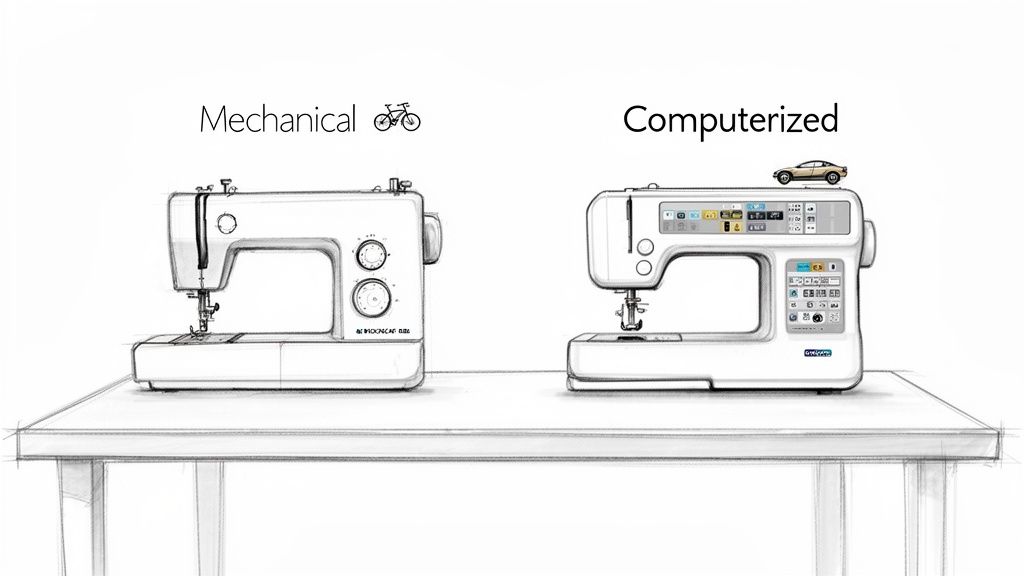
Think of it like choosing between a classic, manual car and a modern one with an automatic transmission. Both will get you where you're going, but the experience is totally different. One gives you direct, hands-on control, while the other automates some of the tricky parts to make the ride smoother.
- Mechanical Machines: These are the trusty workhorses of the sewing world. You control everything by turning physical dials and knobs. They're built like tanks, are incredibly straightforward, and they really force you to learn the fundamentals of things like stitch tension and length. They're perfect if you love a hands-on, tactile experience.
- Computerized Machines: These are the smart, modern cousins. Instead of dials, you get push-button stitch selection, an LCD screen, and helpful automated functions like needle up/down or automatic tie-offs. They can seriously cut down on beginner frustration by taking care of the small adjustments for you.
To help you see the differences side-by-side, here’s a quick breakdown.
Beginner Sewing Machine Types at a Glance
| Feature | Mechanical Machines | Computerized Machines |
|---|---|---|
| Controls | Manual dials and knobs | Push buttons and an LCD screen |
| Best For | Learning sewing fundamentals, durability | Ease of use, preventing common errors |
| Stitch Selection | Turning a dial to choose | Selecting from a digital menu |
| Key Advantage | Simple, rugged, and budget-friendly | Automated features, precision, wider stitch variety |
| Potential Drawback | Limited features, more manual adjustments | Higher price point, more complex to learn all features |
Ultimately, there's no single "best" choice—just the best choice for you.
Finding Your Perfect Creative Partner
Your first machine should be a confidence-builder, not a patience-tester. The good news is that modern sewing machines for beginner sewists are designed to eliminate the very problems that used to trip people up, like impossible needle threading and constant thread nests. With the right machine, you can jump right into the fun part: creating tangible projects you can replicate.
The most important quality in a beginner's sewing machine isn't the number of stitches it has. It’s the ability to create a perfect, consistent stitch, every single time. Reliability is everything.
The interest in sewing and DIY projects has absolutely exploded, and machine technology has raced to keep up. The global sewing machine market, valued at USD 6.8 billion in 2025, is expected to climb past USD 11 billion by 2033. This boom is all about making powerful, user-friendly computerized models more accessible than ever before.
More Than Just a Box
Here at bsewinn.com, we know that the right machine is just the start. Real success comes from pairing great tools with great support. We don't just sell you a box and send you on your way; we are committed to empowering crafters through our custom sewing machine designs, emphasizing the support offered via online classes, training, and extensive resources.
For a deeper dive into making your choice, be sure to check out our complete guide on how to choose a sewing machine. Your new hobby is waiting, and we can't wait to help you get started on the right foot.
Understanding Different Machine Types
Your sewing journey will almost certainly kick off with a standard machine—either mechanical or computerized. But it helps to know that the sewing world is full of specialized tools for specific jobs. I like to think of it like a kitchen. You start with a great chef's knife that can handle most things, but as you get more adventurous, you might add a bread knife or a paring knife. The same idea applies here.
Learning about these other machines isn't about running out and buying them all at once. It's about seeing the possibilities that open up as your skills grow. It gives you an appreciation for what your first machine can do and helps you dream about where your craft might take you.
The Everyday Workhorse: The Standard Sewing Machine
This is your starting point, the most versatile tool you'll own. Whether you go with a mechanical or a computerized model, a standard machine is built for construction—piecing fabric together with straight stitches, finishing edges with a zigzag, and tackling essentials like hemming pants or making buttonholes. It’s the jack-of-all-trades that will handle 90% of your early projects, from your first tote bag to your first handmade garment.
If you want to get into the nitty-gritty, we have a full guide that breaks down the pros and cons of computerized versus mechanical sewing machines for new sewists.
The Specialist for Professional Finishes: The Serger
Ever peeked inside a t-shirt you bought at the store and seen that neat, loopy seam edge? That beautiful finish is the work of a serger, sometimes called an overlocker. A serger isn't a replacement for your regular sewing machine; think of it as its best friend.
Its main job is to trim the raw edge of the fabric and wrap it in a thread casing, all in one super-fast step. This creates a durable, stretchy, and fray-proof finish that's a game-changer when you start working with knit fabrics like jersey or spandex.
- What it does best: Finishing seams on clothes, especially stretchy ones, to give them a polished, professional look.
- A real-world example: Sewing a pair of leggings or a comfy knit dress where you need the seams to stretch right along with the fabric without popping.
A serger is the secret weapon for making homemade clothes look truly store-bought. It takes your garment construction to a whole new level of quality and durability.
The Artist’s Tool: The Embroidery Machine
If you're dreaming of adding custom logos, intricate floral designs, or personalized monograms to your projects, an embroidery machine is what you’re picturing. These are highly specialized, computerized machines that use a hoop to hold the fabric perfectly still while the machine automatically stitches a digital design you’ve programmed.
Some standard sewing machines come with embroidery functions (we often call them "combo" machines), but dedicated embroidery units offer much larger design areas and more advanced features. For a beginner, just knowing this machine exists opens up a world of personalization for future projects like custom towels, embellished jackets, or unique quilt blocks.
The Quilter’s Dream: The Long-Arm Quilting Machine
Finally, for those who get bitten by the quilting bug, the long-arm quilting machine is the ultimate goal. A standard machine has a limited amount of space between the needle and the body of the machine (we call this the "throat space"), which makes wrestling a big, bulky quilt a real challenge. A long-arm solves this with a massive throat space and a frame that holds all the quilt layers together for you.
Instead of moving the quilt, you move the machine's head over the stationary fabric, basically drawing with thread. This makes it possible to create intricate, free-motion designs across a king-sized quilt with total ease. It’s definitely an advanced piece of equipment, but it’s something many passionate quilters aspire to own. Understanding what it does helps you appreciate the quilting features you'll find on many of the beginner-friendly machines at bsewinn.com, which are the perfect starting point for your quilting journey.
Must-Have Features for a Fun Experience
When you first start looking at sewing machines, it's so easy to get mesmerized by the ones boasting hundreds of stitches and a sea of buttons. But let me tell you a little secret: the key to a happy start isn't about having the most features. It’s about having the right ones—the ones that stop frustration in its tracks and make creating feel smooth and, well, fun!
Think of it like this: a professional chef would much rather have one perfectly balanced knife than a clunky multi-tool with 50 attachments they’ll never touch. The same idea applies here. You want a machine that feels like an extension of your hands, one that works with you, not against you.
Quality Over Quantity for Stitches
First things first, let's talk about stitches. A machine with 200+ decorative stitches might look impressive on the box, but as a beginner, you'll find yourself using just a handful for nearly every single project. It’s far better to have a machine that does those few stitches perfectly than one that does hundreds of them poorly.
Honestly, you only need three core stitches to get started on the right foot:
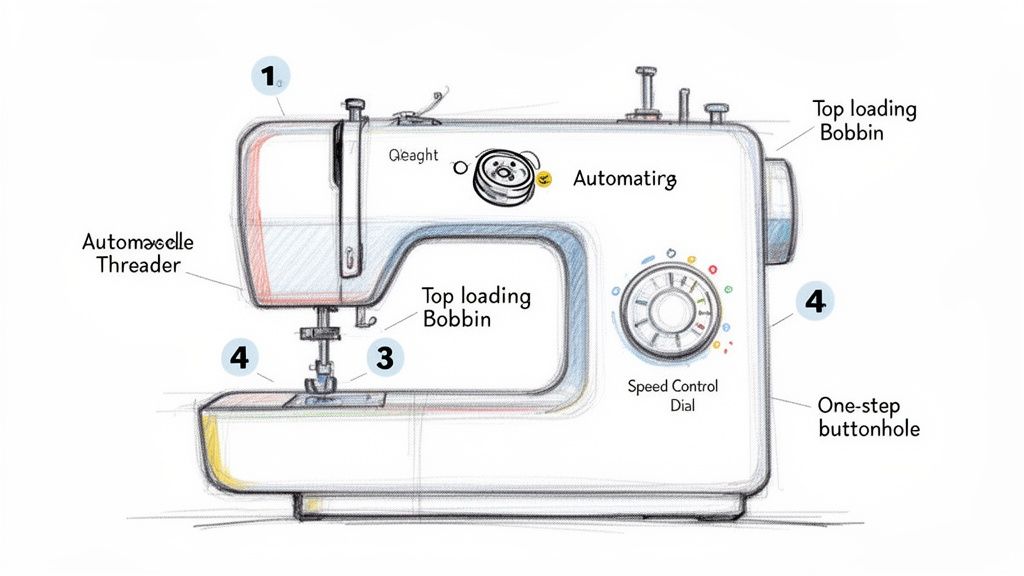
- Straight Stitch: This is your bread and butter. It's the foundation of everything, used for seams, hems, and topstitching. A quality machine will give you a straight, even, and balanced stitch every single time, which makes all the difference.
- Zigzag Stitch: This is your go-to for finishing raw fabric edges to keep them from fraying. It’s also a must-have for sewing with stretchy knit fabrics, since the zigzag shape lets the seam stretch right along with the material.
- One-Step Buttonhole: Trust me, this feature is a game-changer. It automatically creates a perfect, consistently sized buttonhole in one easy step. It saves you from what used to be a multi-step, headache-inducing process.
The real measure of a great beginner machine isn't the stitch count, but the stitch quality. A flawless straight stitch is the single most important feature to look for—it’s the backbone of everything you'll ever create.
Features That Eliminate Frustration
Beyond the stitches, a few key features are what I'd consider non-negotiable for a modern, beginner-friendly machine. These are the tools that tackle the most common pain points for new sewists, turning potential roadblocks into minor speed bumps.
Automatic Needle Threader
Picture this: you're leaning in, squinting, trying to poke a flimsy piece of thread through a microscopic hole for the tenth time. Now, imagine just pulling down a lever and watching the machine do it for you in a second. That's an automatic needle threader. It's not a luxury; it’s an essential that will save your eyesight and your sanity.
Top-Loading (Drop-In) Bobbin
Older machines often have front-loading bobbins hidden away in a clunky, hard-to-reach compartment. A top-loading, or "drop-in," bobbin is so much simpler. You just pop off a small clear plate on the sewing surface, drop the bobbin in, and you’re good to go. The clear cover is a lifesaver, too, because you can see how much thread is left and avoid running out mid-seam.
Taking Control of Your Sewing
Finally, a couple of features give you crucial control over the sewing process, helping you build confidence and precision right from your very first project.
Adjustable Speed Control
A speed control slider lets you set a maximum sewing speed, no matter how hard you press the foot pedal. Think of it like putting a car in first gear to navigate a tricky parking spot. You can floor the pedal, but the machine will only sew at the comfortable, slower pace you’ve set. It's perfect for handling curves or detailed corners without losing control.
Needle Up/Down Function
This feature, usually found on computerized models, lets you program the needle to always stop in the "down" position (piercing the fabric) when you lift your foot off the pedal. This is incredibly helpful for pivoting at corners. The needle acts like a little anchor, holding your fabric perfectly in place while you lift the presser foot to turn your work.
These user-friendly features are becoming standard, and for good reason. Research has shown that while over 70% of new sewers used to quit within a year out of sheer frustration, modern machines with these kinds of helpful functions have slashed that number to under 30%. If you want to dive deeper, you can find more insights on the growth of sewing and how technology is shaping the craft.
How to Set a Realistic Budget
Okay, let's talk about the dollars and cents of buying your first sewing machine. Setting a budget isn't just about finding the cheapest machine on the shelf. It’s about making a smart investment in your creativity. Think of it this way: a solid, reliable machine will save you a world of frustration and repair headaches down the road.
Sure, you could grab a cheap model from a big-box store, but many of them are packed with plastic internal parts that just don't hold up. After a few frustrating projects, that machine often ends up collecting dust. Spending a little more upfront with a reputable dealer like bsewinn.com gets you a quality machine that's built to last and can actually grow with you as your skills take off.
Understanding Price Tiers
The market for sewing machines for beginner sewists basically breaks down into three camps. Figuring out where you fit helps you line up your budget with your goals and find a machine that just feels right.
-
Entry-Level (Under $300): These are your mechanical or very basic computerized machines. They’ll give you the essentials, like a straight stitch and a zigzag, and are a perfectly fine place to start learning the ropes. The catch? Build quality can be all over the place, so sticking with a trusted brand is key.
-
Mid-Range Hobbyist ($300 - $700): Honestly, this is the sweet spot for most new sewists. Here you'll find sturdy computerized machines with great build quality and features that make life so much easier—think automatic needle threaders, speed control, and one-step buttonholes. These machines can handle a much wider range of fabrics and projects without a fuss.
-
Advanced or Specialty ($700+): When you get into this price range, you're looking at machines with more bells and whistles, like a larger throat space for quilting or even some introductory embroidery functions. You definitely don't need this as a beginner, but if you know you're diving into quilting or more complex garment making, it gives you incredible room to grow.
Making a Great Machine More Accessible
We genuinely believe that a quality machine shouldn't be out of reach for anyone. That's why at bsewinn.com, we have a few ways to make the investment feel a lot more manageable, so you can get the right tool for the job from day one.
The right machine isn't just about the initial price—it's about the total value. Consider the support, education, and long-term reliability that come with your purchase. That's where the real savings are found.
Our flexible financing options, for example, let you spread out the cost. This can make a fantastic mid-range machine much more attainable, so you don't have to settle for a basic model you'll outgrow in six months.
We also have a great trade-in program. When you're eventually ready to upgrade, your first machine holds its value and can be put toward your next creative partner. Plus, keep an eye out for our special events and sales on pre-owned machines! They're a fantastic way to snag a professionally serviced, high-quality machine for a lot less.
Getting Started with Your New Machine
The moment is finally here. The box is on your table, and that creative itch you’ve had is about to get scratched. Unboxing your first sewing machine is a thrill, but let's be honest, it can also feel a little overwhelming. Don't worry—we'll walk through these first few steps together, turning that box into your new creative sidekick.
First thing's first, take everything out of the box and just get familiar with the main parts. You'll see the handwheel (it moves the needle up and down manually), the presser foot (this holds your fabric in place), and the bobbin winder. Just taking a minute to identify these key players makes everything else feel a lot more intuitive.
Your First Steps to Sewing
Before you can lay down that first perfect stitch, you need to get the hang of two fundamental skills: winding a bobbin and threading the machine. Think of it like learning to tie your shoes—it feels clumsy at first, but after a few tries, it becomes pure muscle memory.
Most modern sewing machines for beginner sewists are designed to make this easy, with numbered guides printed right on the machine to show you exactly where the thread goes.
- Winding the Bobbin: This is just the process of filling the small spool (the bobbin) that creates the bottom half of your stitch. You’ll just follow the guides to wrap thread from your main spool onto the empty bobbin.
- Threading the Machine: Next, you'll take the thread from that same main spool and guide it through the machine's path, all the way down to the needle. This is where a feature like an automatic needle threader feels like a complete game-changer.
If you’re a visual learner and want to see it done, our post on sewing machine basics for beginners has great step-by-step photos that will get you set up in no time.
Fun and Easy First Projects
Okay, your machine is threaded and ready to go. Now for the really fun part! The best first projects are the simple, satisfying ones that let you get comfortable sewing in a straight line. You don't need a complicated pattern to make something you’ll be proud of. This guide will help you create various sewing machine designs, showcasing tangible examples that you can replicate.
Here are a couple of my favorite starter projects:
- Simple Pillowcase: This is almost all straight seams. It's a fantastic way to practice guiding fabric, pivoting at corners, and finishing edges without any pressure.
- Basic Tote Bag: A tote is another wonderful project that relies on straight stitching. You’ll learn some basic construction and end up with something you can actually show off and use.
These kinds of projects teach you the foundational skills without throwing too much at you at once. The goal is to enjoy yourself and see a finished item quickly—it’s a huge motivation boost!
Success in your first sewing project isn’t about perfection; it’s about understanding the process and building the confidence to try again. Each stitch is a step forward.
To help you see the bigger picture, this chart breaks down how machine features tend to grow as you move through different budget tiers.
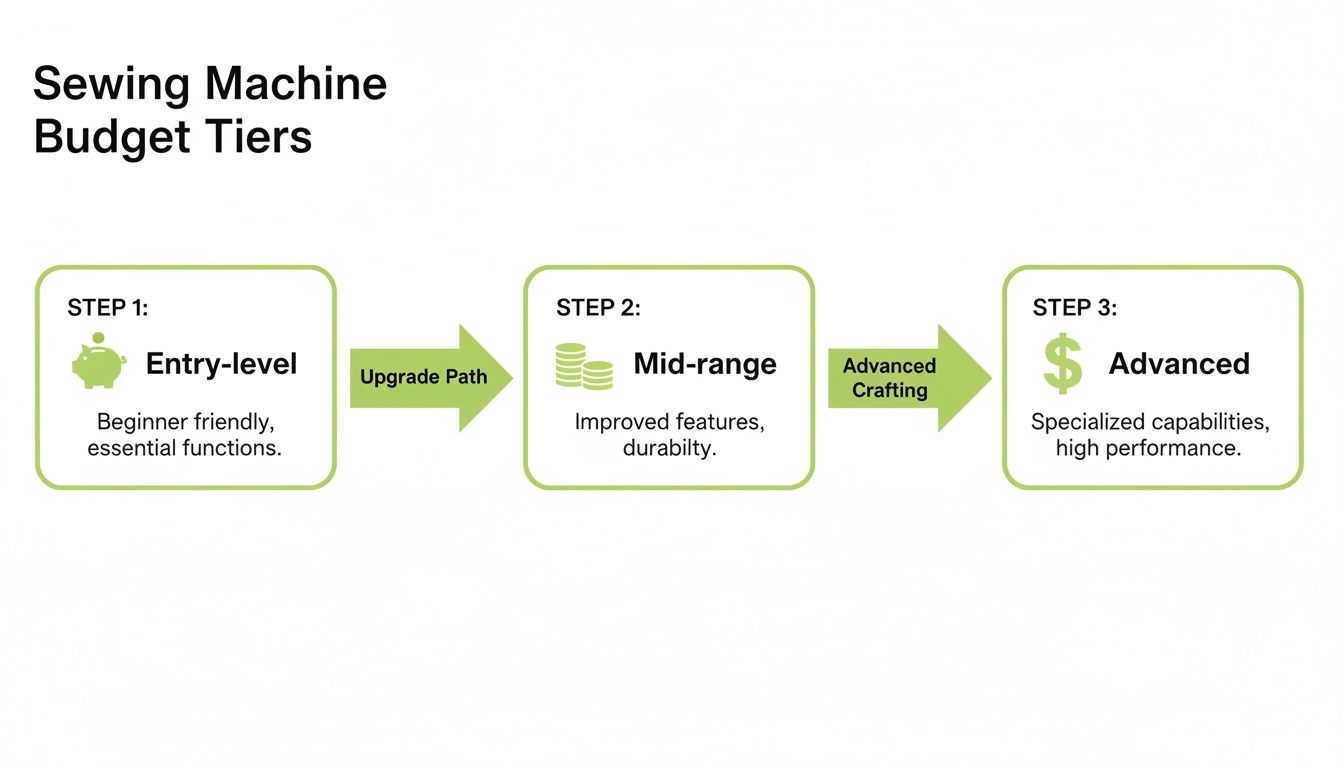
It’s a great visual for understanding the journey from a solid starter machine to the more advanced models you might grow into down the road.
Beyond the First Stitch with B-Sew Inn
Here at bsewinn.com, we truly believe that your sewing education is just as important as the machine you buy. Our whole mission is to empower crafters, which means you’re never on your own. Through our online tutorials and our B-Creative classes, we give you the ongoing support and extensive resources you need to tackle any project with confidence. We’re here to make sure your first sewing experience is a great one, and hopefully, the start of a lifelong passion.
Empowering Your Craft Beyond the Purchase
Choosing your first sewing machine is just the beginning of a wonderful creative journey. The real magic, though? That happens long after you've unboxed your new machine, when you have a real partner to help you grow your skills. At bsewinn.com, we are committed to empowering crafters through custom sewing machine designs and support. The purchase is the starting line, not the finish.
We're not just a store that sells equipment. Think of us as a community built around your creative growth. Our whole goal is to give you the tools, know-how, and confidence to fall in love with sewing and stay in love with it for years.
Education That Grows with You
One of the biggest hurdles for anyone with a new sewing machine for beginner skills is that "what now?" feeling. That’s exactly why we’ve built out an entire world of education to guide you, from threading your first needle to tackling tangible projects you've only dreamed of replicating.
Our online classes and in-person training events are designed for every skill level. You can learn the absolute basics of how your machine works in one class, and then dive into garment-making or quilting techniques in the next. We've set it up to build your skills step-by-step, so you feel accomplished, not overwhelmed.
The goal isn't just to teach you how to use a machine. It's to build the confidence that lets you see a piece of fabric and imagine all the possibilities. That's what creativity is all about.
A Community of Support and Inspiration
Sewing might seem like a solo hobby, but it truly comes alive within a community. Our B-Creative membership connects you with a whole network of fellow crafters and experts who get just as excited about this stuff as you do. This membership is your key to exclusive tutorials, project ideas, and events that keep the inspiration flowing.
Imagine having a library of resources at your fingertips anytime you feel stuck or just need a new idea. That’s what we want to be for you—a constant source of support to fuel your craft. Once you're comfortable, you might get ambitious with bigger projects like making your own lined curtains, and our community will be right there to cheer you on.
And finally, we stand behind every single machine we sell with solid warranties and service. It’s all about giving you peace of mind so you can focus on creating. We're here to make sure your machine runs beautifully, so you can bring your unique designs to life without a hitch.
Got Questions? We've Got Answers.
Diving into the world of sewing is exciting, but let's be honest—it can bring up a lot of questions. If you're feeling a little uncertain as you pick out your first machine, that's completely normal! We've been there.
Think of this section as a chat with a seasoned sewing friend. We've gathered the most common questions that pop up for just about every beginner to help you feel confident and ready to start making things you love.
Mechanical or Computerized: What's the Real Difference?
For a beginner, the choice between a mechanical and a computerized machine really comes down to one thing: control versus convenience.
A mechanical machine is all about that hands-on, tactile experience. You'll turn physical dials to pick your stitches and adjust the tension. It's a fantastic way to learn the nuts and bolts of how a sewing machine actually works, forcing you to understand the "why" behind every adjustment.
On the other hand, a computerized machine is your convenient, tech-savvy friend. It takes care of a lot of the tiny tweaks that can sometimes frustrate a new sewist. With simple push-buttons and an LCD screen showing you the way, you get super consistent, perfect stitches without the guesswork. This can be a huge confidence booster right out of the gate!
How Many Stitches Do I Actually Need?
It's easy to get wide-eyed looking at a machine that boasts hundreds of stitches, but here's a little secret: you don't need them. At least, not yet. In fact, over 90% of your first projects will probably only use two or three basic stitches.
A machine that sews a perfect straight stitch and a solid, reliable zigzag is worth its weight in gold. Those two are the absolute foundation for everything from building garments to hemming pants and finishing seams. The next most valuable player? A good one-step buttonhole.
Seriously, a quality machine that masters these essentials will serve you far better than a lower-quality one packed with decorative stitches you might never even touch.
Can I Learn to Quilt on a Regular Sewing Machine?
Absolutely! You do not need a giant, specialized long-arm quilting machine to start your quilting journey. Many standard sewing machines for beginners are more than capable of handling small-to-medium quilts like baby blankets, wall hangings, or cozy lap throws.
The main thing you'll want to look for is decent "throat space"—that's the open area to the right of your needle. A little extra room there makes maneuvering your project so much easier. You can start with simple techniques like "stitching in the ditch" (sewing right in the existing seam lines) and add a walking foot to your machine down the line. A walking foot is an amazing accessory that helps feed all the layers of your quilt through evenly, preventing puckers.
What Basic Maintenance Does My New Machine Require?
Keeping your new machine happy is way simpler than you might think, but it makes a world of difference in how well it sews. Think of it like a car—a little regular upkeep keeps it running smoothly for years. The single most important job? Keeping it clean.
Lint and dust are the natural enemies of a sewing machine. So, after every few projects, just take a few minutes to give it a quick spa treatment:
- First, always unplug your machine. Safety first!
- Take off the needle plate (that little metal plate your needle goes through).
- Use a small brush to gently sweep out any lint that's built up around the bobbin area and the feed dogs (the little teeth that pull your fabric).
That's it! This simple habit will prevent so many headaches like thread jams and wonky stitches, and it will seriously extend the life of your machine.
At bsewinn.com, our job doesn't end when you buy a machine. We're here for your whole creative journey, providing the classes, support, and encouragement you need to have an amazing sewing experience from the very first stitch. Come find your perfect creative partner with us at https://www.bsewinn.com.

