

Before you even think about buying a sewing machine, I want you to ask yourself one simple question: What do I actually want to make?
It sounds obvious, I know. But this is the single most important step, and it's the one most people skip. They get dazzled by features and brand names, only to end up with a machine that's completely wrong for them. A fantastic quilting machine might be a total pain for making clothes, and a heavy-duty workhorse will be overkill if you just want to mend a few things.
Figuring this out before you shop is the secret to making a smart purchase you won't regret.
Matching Your Crafting Goals to the Right Machine
Walking into a sewing machine shop (or browsing online) can feel overwhelming. There are so many models, all promising the world. The best way to cut through that noise is to get crystal clear on your own creative vision first.
Are you dreaming of sewing sturdy denim jackets and canvas tote bags? Or maybe you're picturing yourself piecing together a beautiful, intricate quilt? Perhaps you're excited to create stretchy, comfortable knit t-shirts and dresses that move with you.
Each of those dreams requires a different set of tools. Getting specific now stops you from buying a machine that's too basic for your big plans or, just as bad, one that’s so complicated you never take it out of the box. At bsewinn.com, we believe that the right machine is the one that empowers you to bring your tangible design ideas to life.
What Are Your Main Projects?
Let's get specific. Don't just think "I want to sew." Think about the finished items you're excited to hold in your hands.
-
Garment Sewing: If a handmade wardrobe is your goal, you'll need a machine that's a versatile all-rounder. Look for one that can handle everything from floaty silks to sturdy cottons without a fuss. A good blind hem stitch, a simple one-step buttonhole function, and the ability to cleanly sew curved seams will be your best friends.
-
Quilting: For all you quilters out there, it's all about space and control. A machine with a generous "throat space" (that's the open area to the right of the needle) is a non-negotiable for wrestling with big quilts. You’ll also want to look for a walking foot to keep your quilt layers from shifting and a "needle-down" feature, which is a lifesaver for pivoting on sharp corners.
-
Heavy-Duty Crafts: If you're drawn to making bags, reupholstering furniture, or working with tough stuff like canvas, vinyl, or leather, then power is everything. You need a machine with a beefy motor and a solid, all-metal frame. A flimsy plastic machine will just vibrate and skip stitches when you try to punch through thick layers.
A great machine should feel like a creative partner, not a frustrating roadblock. When you match the machine's strengths to your goals, you're setting yourself up for success from the very first stitch.
Taking this time upfront makes all the difference. The global sewing machine market is huge—valued at around USD 4.56 billion in 2024—because there's a growing demand for machines that do specific jobs well. You can see more about these market trends on cognitivemarketresearch.com.
Here at bsewinn.com, we know this first step is absolutely key. We're not just here to sell you a box; we're here to empower crafters with custom sewing machine designs and the support to master them. Our extensive resources, including online classes and hands-on training, are designed to help you replicate tangible examples and build your skills with confidence.
Understanding the Main Types of Sewing Machines
Okay, once you have a good idea of what you want to make, it's time to dive into the different kinds of machines out there. The lingo can feel a bit overwhelming at first, but each machine is really just a tool built for a specific job.
Think of it this way: you wouldn't use a paring knife to chop a butternut squash. Same idea here. Matching your creative goals to the right machine type is probably the most important decision you'll make. Let's walk through the most common options so you can see where you fit.
Mechanical Sewing Machines: The Reliable Workhorse
Mechanical machines are the classics. They're the ones with manual knobs and dials you physically turn to pick your stitch, adjust tension, and set your stitch length. No screens, no menus—just pure, straightforward mechanics.
Because they're built with fewer complex parts, these machines are absolute tanks. They're known for their durability and are generally easier and cheaper to service. I always recommend them for true beginners who want to master the fundamentals of sewing without getting distracted by a million buttons. If you see yourself doing basic garment construction, mending, or simple home decor projects, a solid mechanical machine is a fantastic, budget-friendly partner.
Computerized Sewing Machines: Precision and Possibilities
This is where things get exciting. Computerized machines are a huge leap forward in convenience and creative features. They’re run by a small internal computer and usually have an LCD screen and push-button controls to access a huge library of built-in stitches.
You'll find some real game-changing features on these machines:
- Automatic Needle Threader: A tiny little hook that saves you an incredible amount of time and eye strain. Seriously, you'll wonder how you ever lived without it.
- One-Step Buttonholes: This feature alone is worth the upgrade for anyone sewing clothes. It makes perfect, identical buttonholes every single time.
- Speed Control: A simple slider lets you cap the machine's top speed. It's a lifesaver for tackling tricky curves or for helping new sewists build confidence without the machine running away from them.
- Needle Up/Down: This lets you decide if the needle stops in the fabric or out of it. Stopping with the needle down is essential for pivoting perfectly at corners without your fabric shifting.
These machines really do streamline the whole process, taking a lot of the guesswork out of sewing and opening the door to more creative projects. While they have a higher price tag, their efficiency makes them a go-to for hobbyists at every level. If you're on the fence, we have a guide that digs deeper into computerized vs. mechanical sewing machines to help you sort it out.
Sometimes, a simple visual can help you figure out where to start.
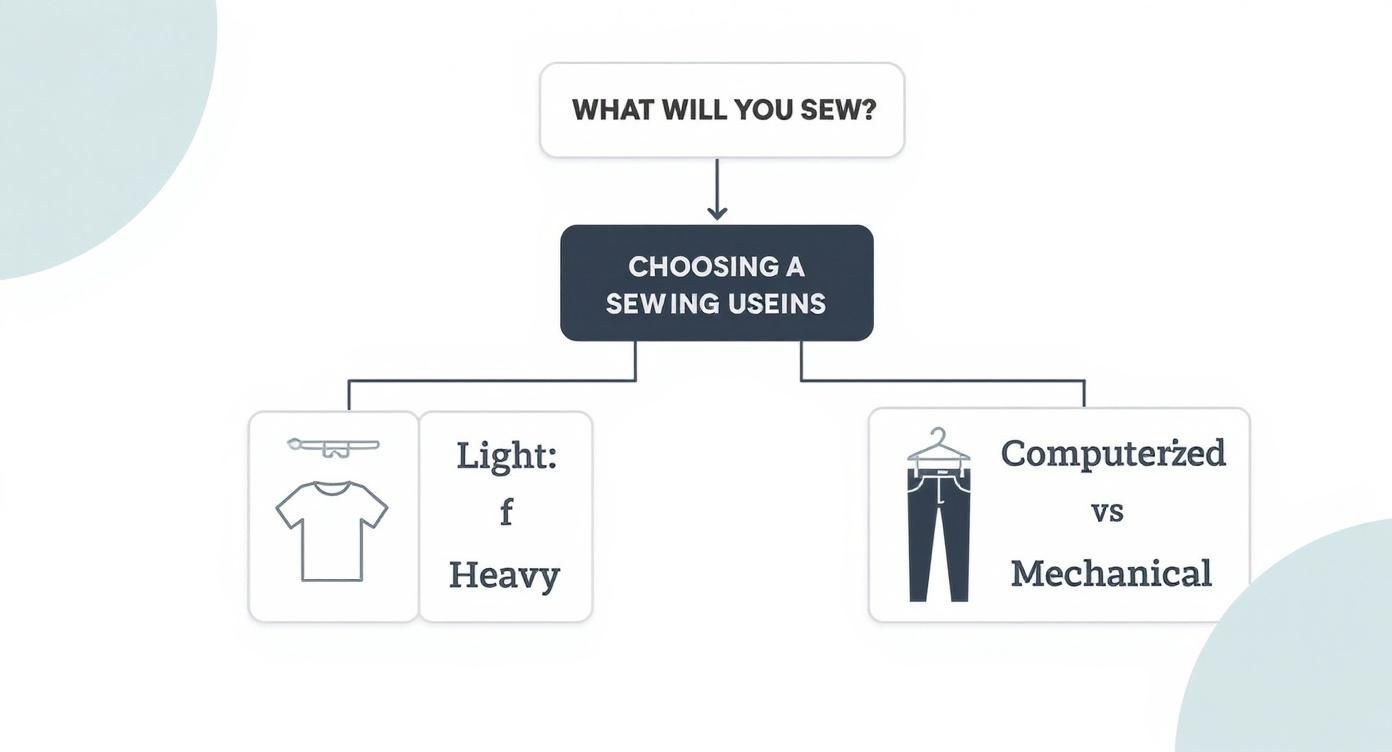
This flowchart shows how the type of fabric you'll be working with can point you toward the right machine.
Specialized Machines for That Professional Polish
Once you get hooked on sewing, you might find yourself wanting a machine that does one specific thing really well. These aren't usually your first machine, but they're amazing additions to your sewing space as your skills grow.
To help you get a quick sense of the landscape, here’s a simple breakdown of the most common machine types.
Sewing Machine Types At a Glance
| Machine Type | Best For | Key Features | Ideal Skill Level |
|---|---|---|---|
| Mechanical | General sewing, mending, simple projects, learning the basics | Manual dials, heavy-duty build, basic utility stitches | Beginner |
| Computerized | Garment making, quilting, decorative stitching, crafting | LCD screen, push-button controls, vast stitch library, automatic features | Beginner to Advanced |
| Serger (Overlocker) | Finishing seams on knits and wovens, creating rolled hems | 3-4 threads, trims & finishes edges in one pass, differential feed | Intermediate |
| Coverstitch | Hemming knits (like t-shirts), activewear, decorative topstitching | 2-3 needles, creates a stretchy, professional hem | Intermediate to Advanced |
| Embroidery | Monogramming, creating patches, embellishing projects with designs | Hoop-based, automated stitching from digital files | All Levels |
| Long-Arm | Finishing large quilts | Large throat space, mounted on a frame, machine head moves over fabric | Advanced |
Each of these machines offers a unique way to elevate your projects from "homemade" to "handmade." Whether it's the clean, stretchable seams from a serger or the perfect hems from a coverstitch, having the right tool makes all the difference.
Focusing on Features That Actually Matter
Walking into the world of sewing machine features can feel like trying to read another language. Spec sheets throw dozens, sometimes hundreds, of options at you, and it’s easy to get lost in the noise. The real secret? Shift your focus from the quantity of features to the quality and real-world usefulness of a handful that will actually make your sewing life better.
Let's be honest for a second. Many machines will boast about having 500+ stitch options, but the truth is that most of us use the same core stitches for 95% of our projects. A machine that delivers a flawless straight stitch, a perfect zigzag, and a clean buttonhole is infinitely more valuable than one packed with decorative stitches you'll never even try.
This is where the bsewinn.com philosophy really shines. We believe a machine's power isn’t just in its spec sheet, but in what you can do with it. Our commitment is to empower crafters by providing the training and support—through online classes and dedicated resources—so you can truly master every feature your machine offers and confidently replicate any design.
The Heart of the Machine: A Powerful Motor
Before we even get to stitches or screens, let's talk about the engine. A machine's motor is the single most important part that determines what it can truly handle. A weak motor will whine and struggle when you ask it to sew through multiple layers of fabric, resulting in skipped stitches, snapped needles, and a whole lot of frustration.
Picture yourself tackling a denim jacket or a heavy canvas tote bag. A machine with a beefy motor will glide through those thick seams without a second thought. It provides the consistent piercing power needed for heavyweight materials like leather, upholstery fabric, or dense quilt sandwiches. This isn't just a "nice-to-have" feature; for many projects, it's an absolute deal-breaker.
A strong motor means reliability and longevity. It's the difference between a machine that enables your creative ambitions and one that constantly holds you back.
Convenience Features That Save Time and Sanity
Beyond raw power, a few specific features are absolute game-changers for your workflow. These aren't just flashy extras; they’re practical innovations designed to eliminate common sewing headaches so you can spend more time actually creating.
Here are a few I always recommend looking for:
- Automatic Needle Threader: This tiny little hook is a lifesaver. It saves an incredible amount of time and eye strain by pulling the thread through the needle's eye for you. Once you've used one, you'll never want to go back.
- Top-Loading (Drop-In) Bobbin: These systems are so much easier to manage than the old front-loading style. You just drop the bobbin in from the top, and a clear cover lets you see exactly how much thread you have left. No more running out of bobbin thread in the middle of a crucial seam!
- Adjustable Presser Foot Pressure: This gives you control over how firmly the presser foot holds the fabric down. You can lighten the pressure for delicate fabrics like chiffon to prevent marking, or increase it to get a better grip on bulky quilt layers or fleece.
"Mastering a few key features that streamline your process is far more impactful than having access to a hundred you never use. Focus on the tools that remove friction from your creativity."
These thoughtful additions are what separate a good machine from a truly great one, making your entire sewing experience smoother from the get-go.
Understanding Your Workspace: Hoop Size and More
If you're drawn to embroidery or quilting, the physical size of the machine suddenly becomes a huge factor. You can have the most incredible software, but if your machine doesn't have the physical space to handle your project, you're going to feel boxed in.
For machine embroidery, hoop size is everything. It literally dictates the maximum size of a design you can stitch at one time. A small 4x4 inch hoop is fine for monogramming towels or adding a small logo to a shirt. But if you’re dreaming of stitching large, detailed designs on the back of a jacket, you'll need a machine that can handle a much larger hoop, like an 8x12 inch or even bigger.
For quilters, the key measurement is throat space—the open area to the right of the needle. A generous throat space is what makes it possible to maneuver a big, bulky quilt without feeling like you're in a wrestling match.
These physical specs directly impact the scale of your creative work. It's vital to think about the projects you want to make down the road and choose a machine with the workspace to match. The right accessories can also expand what your machine can do. To see how much of a difference the right add-on can make, check out our detailed sewing machine feet guide.
How to Properly Test Drive a Sewing Machine
You wouldn't buy a car without taking it for a spin first, right? The same exact logic applies when you're choosing a sewing machine. Reading reviews and comparing spec sheets online is a fantastic start, but nothing—and I mean nothing—beats the hands-on experience of sitting down and actually sewing with it.
This "test drive" is your golden opportunity to see if a machine feels right in your hands, sounds healthy, and handles the way you expect. It's the only real way to know if it will become your trusted creative partner instead of a constant source of frustration.
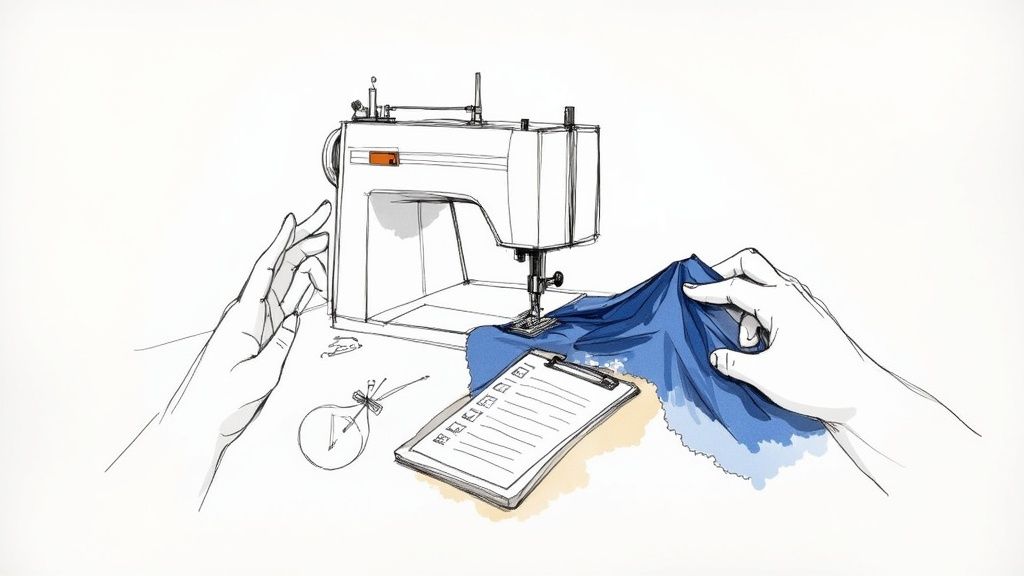
Come Prepared with Your Fabric Toolkit
If you walk into a store empty-handed, you'll end up testing the machine on their perfectly starched, easy-to-sew sample fabrics. That's not going to tell you much. To get a true sense of a machine's power and finesse, you need to challenge it with the materials you actually plan to use.
So, put together a small test kit with a variety of fabric scraps. This is the secret to understanding how the machine’s motor and feed system really perform under different conditions.
I recommend bringing:
- Something slippery and lightweight like silk, charmeuse, or chiffon to see if it causes puckers.
- A stretchy knit fabric like a jersey to check if the machine creates wavy, stretched-out seams.
- Something sturdy and thick like a few layers of denim or canvas to really test its piercing power.
- A basic quilting cotton to get a feel for its baseline performance on an everyday material.
Bringing your own fabrics lets you simulate real-world sewing projects, giving you a much clearer picture of how that machine will behave in your own craft room.
The Hands-On Sewing Checklist
Okay, you're sitting at the machine with your fabric kit. Now what? It's time to put it through its paces. Don't just sew a few random lines. You want to perform specific tasks that mimic the techniques you'll use day-in and day-out.
Your mission is to assess its precision, power, and overall ease of use. This is where you feel for weird vibrations, listen for strange noises, and see the stitch quality with your own eyes.
Your Test-Drive To-Do List:
- Sew a perfectly straight line. Does the machine pull the fabric to one side, or does it feed through smoothly and evenly?
- Stitch a gentle curve. See how well you can control the machine around flowing lines. This is also a great way to check the visibility around the needle area.
- Vary your speed. Use the foot pedal and go from a super slow crawl to full speed. A good machine will give you smooth acceleration, not a jerky, uncontrollable lurch.
- Make a one-step buttonhole. Is the process intuitive? More importantly, is the final buttonhole well-formed, dense, and consistent?
- Try the reverse stitch. The stitches should land directly on top of the forward stitches, locking them securely without making a tangled mess.
Take a moment to just listen. A well-built machine should have a smooth, consistent hum. Any loud clanking, grinding, or rattling can be a huge red flag for internal issues or a weak motor that's struggling.
Questions to Ask Before You Buy
Your test drive isn't just about the machine itself; it's also about the support that comes with it. The relationship doesn't end when you swipe your card. Here at bsewinn.com, we are committed to empowering crafters, and that means our post-purchase support, training, and extensive resources are what really help sewists thrive.
Be sure to ask the salesperson these crucial questions to understand the long-term value you're getting:
- What accessories come in the box, and which ones will I need to buy separately?
- What, specifically, does the warranty cover, and for how long?
- Do you offer any training or introductory classes after I buy the machine?
- Who services the machines, and where is that work done?
Feeling confident in your purchase is everything. For more foundational knowledge, you can always check out our complete guide on sewing machine basics for beginners. Taking the time to properly test a machine ensures it will feel like a natural extension of your hands for many years to come.
Building Your Toolkit With Essential Accessories
Picking out the perfect sewing machine is a huge win, but honestly, it’s just the starting line. The real magic begins when you pair that machine with the right tools for the job and get into a good maintenance rhythm. This is how you protect your new investment, sidestep a ton of frustration, and take your sewing from "homemade" to "wow, you made that?"
Think of it like this: your machine is the engine, but accessories are the specialized attachments that let you tackle any project with confidence. You don't need to buy every gadget under the sun, but a handful of key items will totally transform what your machine can do.
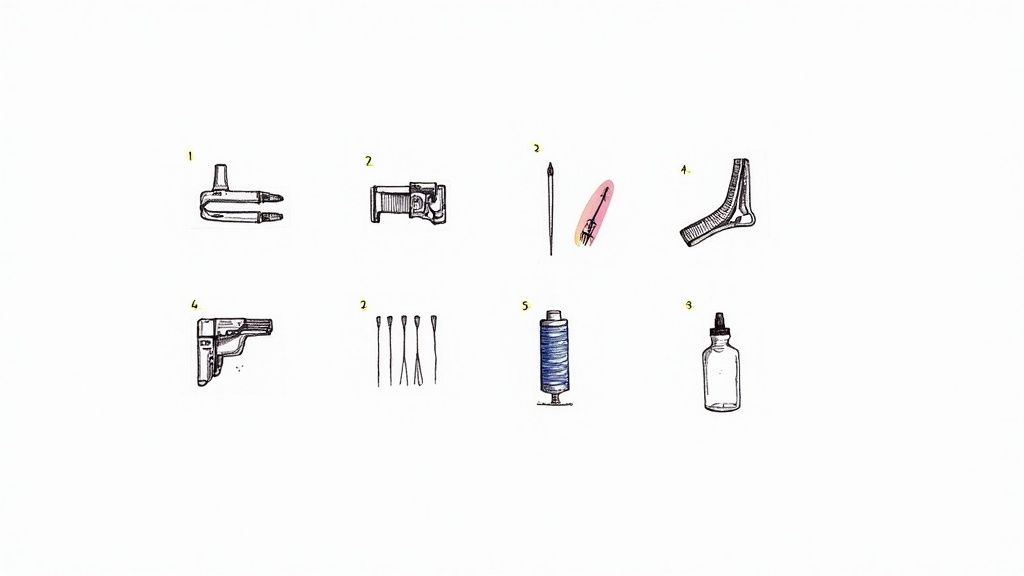
Must-Have Presser Feet
Sure, your machine came with a standard all-purpose foot, but the real power is unlocked with specialty feet. These aren't just frivolous extras; they make tricky techniques practically foolproof.
Here are the ones I absolutely can't live without:
- Zipper Foot: Its narrow shape lets you stitch right up against zipper teeth for a super clean finish. No more bunched-up fabric or wavy zippers.
- One-Step Buttonhole Foot: If you plan on making any clothes, this is non-negotiable. It creates perfectly sized, consistent buttonholes every single time, taking all the stress out of a notoriously fussy task.
- Walking Foot: This is a complete game-changer for quilters or anyone sewing slippery fabrics like rayon, velvet, or knits. It has its own set of feed dogs on top that work with the machine's feed dogs to move all layers of fabric through at the same time. Say goodbye to shifting and puckering.
Adding just these three feet will open up a whole new world of projects and give your work that polished, professional look.
The Unsung Heroes: Needles and Thread
It’s so easy to overlook the small stuff, but I’m telling you, the wrong needle or thread is the secret culprit behind 90% of common sewing headaches. Skipped stitches, shredded thread, puckered seams—it almost always comes back to this.
Think of your needle and thread as a team. A fine needle paired with thick thread will cause constant breakage, while a thick needle on delicate fabric will leave permanent holes. The goal is a perfect partnership.
As a rule of thumb, always match your needle to your fabric. Use a "jeans" needle for denim, a "ballpoint" for knits—you get the idea. Just as important, swap out your needle after every 8-10 hours of sewing. A dull needle causes all sorts of chaos, and it’s such an easy thing to fix.
Keeping Your Machine Happy
A little bit of basic maintenance isn't optional; it's the secret to keeping your machine running smoothly for years. Dust and lint are the enemy. They build up in the bobbin area and under the needle plate, throwing off your tension and causing all sorts of jams.
Just take five minutes after every few projects to do a quick clean-up. Use that little brush that came with your machine to gently sweep out the lint around the bobbin case and feed dogs. This simple habit prevents that lint from getting packed down into a dense clog that only a technician can remove.
At bsewinn.com, we know that mastering your machine goes way beyond the day you buy it. Our commitment to empowering crafters is why we've built a huge library of online classes, training, and extensive resources. We want to give you the skills to not only create amazing things but also to care for your machine properly, ensuring it's always ready for your next big idea.
A Few Common Questions We Get Asked All The Time
Choosing a new sewing machine is a big decision, and it’s totally normal to have a few lingering questions as you narrow down the options. Let's walk through some of the most common things we hear from sewists who are right where you are now.
My goal here is to give you straight, honest answers based on years of experience helping people find their perfect machine. At bsewinn.com, our commitment is to empower every crafter. It's why we pour so much into our extensive resources, from online classes to hands-on training—we want you to feel completely confident in your choice and ready to tackle any project.
How Much Should I Really Budget for My First Machine?
If you're just starting out, plan on spending somewhere between $200 and $400. This is the sweet spot where you get a truly reliable, well-built machine without breaking the bank. In this range, you'll find sturdy mechanical models and easy-to-use electronic machines that have all the core stitches you'll actually need.
It's tempting to grab one of those sub-$150 machines you see at big box stores, but I'd caution against it. They often have plastic internal parts that just can't handle consistent use, and their motors really struggle with anything heavier than a single layer of cotton. Spending a little more now will save you a world of frustration and give you a machine you can grow with, not out of.
Do I Really Need a Machine with Hundreds of Stitches?
Honestly? No. It's so easy to get dazzled by a machine that boasts a giant library of decorative stitches, but here's the truth: quality over quantity is everything.
Think about it—most of your sewing will be done with just a handful of stitches: a straight stitch, a zigzag, maybe a blind hem and a buttonhole. A machine that does those few stitches perfectly is infinitely more valuable than one with 200 fancy stitches that are weak or poorly formed. For the vast majority of sewists, a machine with 15-30 well-executed, built-in stitches is more than enough to handle almost any project you can dream up.
What's the Single Most Important Feature for a Quilter?
If you're a quilter, one thing matters more than almost anything else: throat space. This is the distance from the needle to the inside arm of the machine.
You'll want a machine with at least 9 inches of throat space, if not more. This is the real estate you need to maneuver a big, bulky quilt without feeling like you're in a wrestling match.
Sure, other features are great for quilting—a walking foot and a "needle down" function are game-changers. But if you can't even fit your quilt under the arm of the machine, those other features don't matter much. The workspace itself is what will make or break your quilting experience.
How Do I Know It's Time to Upgrade My Machine?
You'll know it's time when your machine starts holding you back. It’s less about how long you've had it and more about whether your creative ideas have outgrown what your machine can do.
Here are a few tell-tale signs:
- You find yourself constantly fighting to sew through fabrics you love, like denim, leather, or canvas.
- You're getting frustrated by the lack of a specific feature you know would make your life easier, like an automatic thread cutter or a knee lift.
- You want to try new things your current machine just can't handle, like free-motion quilting or embroidery.
- You're spending more time fixing tension issues and clearing jams than you are actually sewing.
The moment your machine feels more like an obstacle than a creative partner, that’s your cue. It’s time to find a machine that can keep up with your vision.
Ready to find the machine that will bring your creative ideas to life? At bsewinn.com, we offer a curated selection of machines for every skill level and crafting goal, backed by unparalleled support and education. Explore our collection and start your next sewing adventure today.

