

A stabilizer roll often starts its life neatly packaged, then ends up leaning beside the machine, folded under fabric, or compressed in a plastic tote. The trouble appears later: a tearaway tears unpredictably, a water-soluble film feels tacky, or a fusible sheet leaves residue on a project that deserved better. Stabilizer storage embroidery requires more than keeping supplies out of sight. The material needs protection from climate, pressure, light, and the particular behavior of its coating or fiber structure.
For a broader explanation of how backing supports stitches, see this guide to what stabilizer does for embroidery. Storage decisions become much easier once the stabilizer's job and chemistry are clear.
Table of Contents
- Why Standard Storage Advice Fails Embroidery Supplies
- Setting Up a Climate-Controlled Storage Space
- Organizing Rolls and Sheets Without Mechanical Damage
- Special Handling for Fusible and Water-Soluble Types
- Building a Smart Scrap Management System
- Upgrading Your Studio and Equipment
Why Standard Storage Advice Fails Embroidery Supplies
“Keep it cool and dry” sounds sensible, but it doesn't tell an embroiderer what to measure, where to place a cabinet, or how to treat a wash-away film differently from a cutaway mesh. Stabilizer isn't generic craft paper. It may contain synthetic fibers, cellulose, adhesive, silicone, or water-soluble components, and each can react differently to heat, moisture, compression, and handling.
Textile-conservation guidance offers a useful professional baseline. The National Park Service recommends textile storage at 65–75°F, with relative humidity as close to 50% as possible, and warns that high temperature can embrittle textiles while high humidity supports biological activity. Relative humidity below 35% can also contribute to embrittlement. The National Park Service textile-conservation guidance applies to collections rather than every commercial stabilizer, but it gives a defensible starting point for a home studio.
The Western Australian Museum recommends 15–25°C and 45–55% relative humidity, with daily variation limited to 4°C and 5% RH respectively. It identifies 70% RH or higher as a risk for mold growth, insects, and chemical degradation, while 40% RH or lower increases desiccation and brittleness. Those competing risks explain why a damp basement and an aggressively dried storage box can both damage supplies.
Practical rule: Stable conditions matter more than chasing the driest possible air.
A tearaway may become brittle or lose predictable tear lines after poor storage. A wash-away can absorb moisture and turn tacky or partially dissolve. Adhesive-backed products may lose tack or transfer residue when exposed to heat and pressure. Light, dust, solvents, and contaminated surfaces add further problems, especially when the material will sit directly against fabric and pass through a machine.
The history of stabilizer reinforces the point. Specialized nonwoven materials became commercially significant in the late 1970s, including a 1.5-ounce cutaway stabilizer made through a wet-laid process by International Paper. It incorporated silicone to improve needle glide and was first developed for pocket welts before its embroidery suitability became clear. Later products established the familiar distinction between cutaway, tearaway, and low-visibility mesh materials, as described in the evolution of embroidery stabilizers.
Setting Up a Climate-Controlled Storage Space
A reliable storage area doesn't require a dedicated archive room. A clean interior closet, cabinet, or drawer can work when the environment is measured and the supplies stay away from heat, sunlight, dust, and rapid climate changes.
Build the environment before filling it
Use these steps in order:
- Choose an interior location. Keep the cabinet away from exterior walls, heating vents, radiators, direct sunlight, attics, garages, basements, and floors that may transmit dampness or cold.
- Install a digital hygrometer. Place it near the stored supplies rather than across the room. Temperature and relative humidity can differ inside a cabinet.
- Log readings for at least one week. Record the readings at consistent times and watch for repeated excursions, not just one unusual day.
- Target a moderate range. A practical textile-storage target is 15–25°C and 45–55% RH, with daily changes limited to about 4°C and 5% RH, based on Western Australian Museum storage guidance.
- Adjust the room, not just the container. Relocate stock if readings repeatedly exceed the limits. A dehumidifier may help a small studio, but it shouldn't create an excessively dry microclimate.
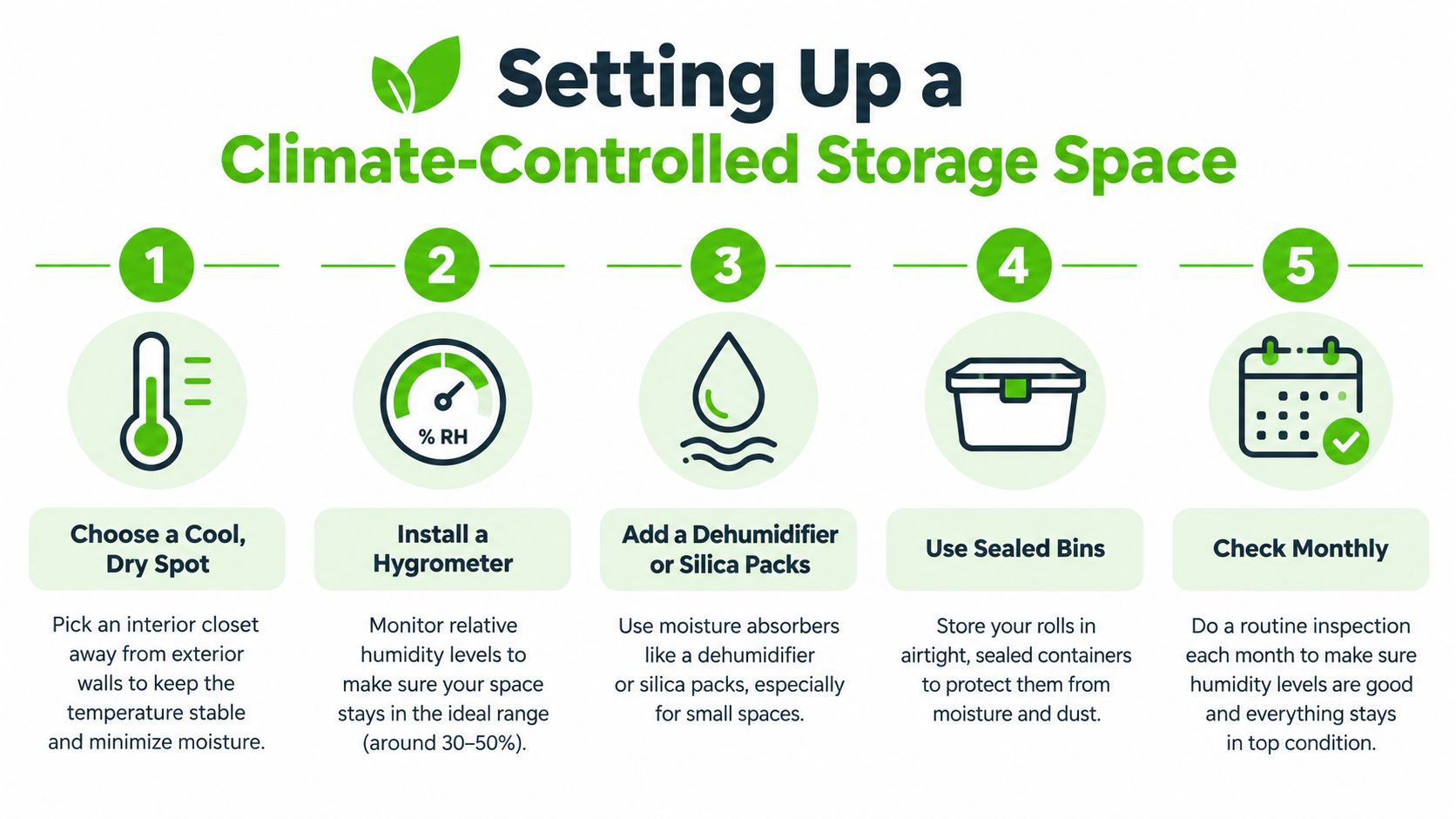
The National Archives recommends low temperature with moderate humidity because chemical, biological, and physical deterioration increase as both rise. Its conservation benchmark for textiles and stable acrylic materials is 50–65°F and 30–50% RH, a range that should be treated as a conservative archival reference rather than a universal manufacturer requirement. The National Archives preservation guidance also supports keeping supplies away from sunlight and heat-producing equipment.
Use containers with climate awareness
Closed cabinets and archival boxes help limit dust and environmental swings. However, airtight plastic bins can trap residual moisture, especially when supplies enter the bin during humid weather. That trapped moisture may create a small environment where mold develops even though the surrounding room seems acceptable.
For readers evaluating durable storage furniture or containers, this secure storage container buyer's guide provides useful context about container construction and protection. The embroidery-specific decision still depends on the material. Don't seal damp stock, and don't place a heat-sensitive fusible product in a container that sits beside a press or heater.
Fabric and stabilizer benefit from the same basic discipline, but they shouldn't be packed together without labels or separation. A practical fabric storage method can help organize the surrounding studio while stabilizer remains grouped by type and behavior.
Organizing Rolls and Sheets Without Mechanical Damage
Climate won't rescue stabilizer that has been crushed, sharply folded, or allowed to develop edge distortion. Rolls and sheets need different physical treatment, and the right choice depends on format, available space, and how often the material is accessed.
Rolls need support, not pressure
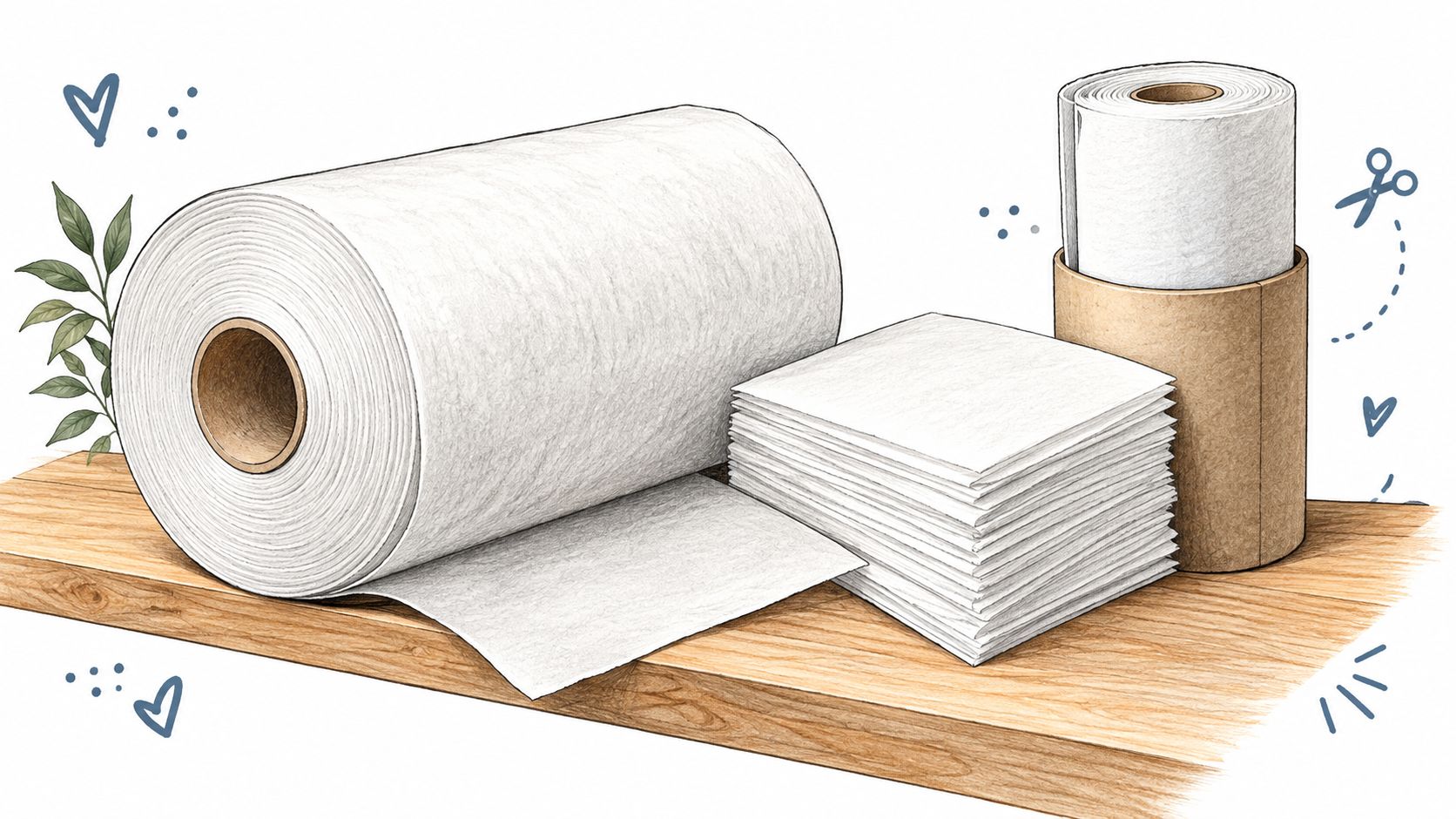
A roll should stay on a sufficiently large-diameter, acid-free core. Align it so the edges are supported and don't develop sharp folds. Upright storage can save floor space, but a heavy roll standing on one edge may distort that edge over time. Flat or loosely rolled storage is safer when the roll can rest without compression.
Avoid stacking heavy supplies on top of rolls. A crushed edge can make cutting awkward and may produce an uneven surface during hooping. Rolls should also remain off the floor, away from exterior walls, and separated from materials that shed lint or carry dust.
Sheets need flat, clean separation
Store precut sheets flat in acid-free drawers or boxes. Interleave layers with acid-free tissue so adhesive surfaces, coatings, and delicate films don't rub against one another. Folding creates a crease that may remain visible or weaken the support exactly where a hoop needs a smooth, stable layer.
A compact organizer can make type separation easier. B-Sew Inn offers the Easy Access Stabilizer Rack, which is designed for keeping stabilizer accessible and identified rather than buried in a mixed stack. For broader shelving decisions, the Labs USA selection guide offers useful principles about load support, shelf layout, and access, even though its setting is not embroidery.
Label every package with the stabilizer type, weight, color, adhesive behavior, purchase date, and opened date. A first-in, first-out rotation keeps older stock visible. Annual inspection should look for dampness, odor, mold, insects, curling, edge crushing, and contamination before any material reaches fabric or a machine.
Special Handling for Fusible and Water-Soluble Types
A cutaway mesh can tolerate handling that would ruin a water-soluble film. Treating every stabilizer the same way creates avoidable failures because the material's chemistry determines what storage protection matters most.
| Stabilizer type | Main storage concern | Practical approach |
|---|---|---|
| Water-soluble film or wash-away | Humidity can make the surface tacky or partially dissolve it | Keep clean, cool, and protected from moisture. Use a closed package only when the material is fully dry and the container won't trap condensation |
| Fusible stabilizer | Heat and pressure can activate adhesive or alter the coating | Store away from irons, presses, heaters, and sun. Prevent compression between stacked supplies |
| Adhesive-backed stabilizer | Heat may reduce tack or encourage adhesive migration | Keep the release surface intact and inspect for residue or changed tack before use |
| Tearaway | Humidity, age, and folding can affect predictable tearing | Store flat or neatly rolled, without sharp creases or edge pressure |
| Cutaway and mesh | Compression, curling, and distortion can affect hooping | Support the roll or sheets and keep clean pieces separated by weight and type |
Water-soluble products deserve special caution in humid climates. A sealed container with an appropriate moisture-control method can protect a dry film, but the container shouldn't be filled while the material, tissue, or interior is damp. Excessive desiccation isn't automatically safer either. Archival guidance from the Society of American Archivists on storage environments explains that high humidity encourages mold and pests, while low humidity can increase physical damage during handling.
Fusible sheets need distance from heat sources and pressure. A cabinet beside an iron or pressing station may seem efficient, but incidental heat can soften adhesive or create transfer between stacked layers. Before a delicate appliqué, lace, or freestanding design, test a small piece for curl, brittleness, tack, odor, uneven coating, or unexpected dissolving.
The practical guide to using water-soluble stabilizer for embroidery can help match the material to the project. Storage remains part of that selection process, not an afterthought.
Building a Smart Scrap Management System
Throwing every remnant away wastes usable material, but saving every scrap creates a drawer full of unknown backing and false confidence. A better system classifies pieces before storing them.
Keep separate envelopes or shallow boxes for cutaway, tearaway, mesh, fusible, adhesive-backed, and water-soluble remnants. Label each group with the material type and approximate size. Clean, uncreased cutaway pieces may suit small hoops, stitch tests, or low-risk samples. A scrap with an intact adhesive surface may work for a small test, but it shouldn't be trusted automatically for a valuable garment.
Use clear discard rules:
- Discard curled pieces that won't lie flat in the hoop.
- Discard heat-damaged scraps showing shiny areas, softened coating, or adhesive migration.
- Discard contaminated pieces with dust, oil, mold, insects, or unknown residue.
- Quarantine partially dissolved or tacky film until its behavior has been evaluated.
- Reserve clean remnants for testing tension, registration, thread color, and design density.
Reuse should match the intended job. A small remnant can support a sample, but dimensions alone don't prove that it can handle a dense design. If the project matters, test the scrap with the same fabric, hoop, needle, thread, and stitch conditions.
A labeled, visible system prevents duplicate buying and makes older stock easier to use first. The same approach extends to the wider studio through organized craft-supply storage, where categories remain visible instead of disappearing into opaque containers.
Upgrading Your Studio and Equipment
Good stabilizer storage removes one source of inconsistency, but the machine, hooping method, needle, thread, and design still have to work together. A correctly stored backing gives the fabric reliable support, allowing the machine to form stitches without compensating for curled edges, weakened fibers, or unpredictable adhesive.
A machine upgrade makes most sense when it solves a real workflow problem. A single-needle embroidery machine may suit a hobbyist who wants straightforward hooping and design transfer. A more advanced Baby Lock, Bernina, or Brother embroidery setup may offer features that help with larger projects, repeated designs, or more demanding stitch work. The correct choice depends on hoop sizes, interface preferences, available space, service needs, and the types of projects the embroiderer makes.
Storage should influence the studio layout as well. Stabilizer belongs close enough to the machine for efficient selection, but not so close that vibration, heat, lint, or direct light affects it. Rolls need clearance and support, sheets need flat drawers, and scraps need labels. A desk or cabinet with thoughtful access can reduce the temptation to fold supplies or leave them on the floor. This buyer's guide for desks with storage offers general ideas for combining work surfaces with organized storage.
B-Sew Inn is an authorized sewing, quilting, and embroidery machine dealer with retail stores in Tulsa, Oklahoma City, Springfield, Humble, and Fayetteville, plus an online store. The business sells and services Baby Lock, Bernina, Bernette, Brother, and Janome machines, along with stabilizer, thread, notions, cabinets, cutting tables, embroidery designs, sergers, and longarm quilting machines. Readers can see and test machines in person, ask about service and repair, attend in-person classes, use machine mastery sessions, and discuss trade-ins before committing to an upgrade.
A practical next step is to sort the current stabilizer supply by type, inspect the oldest pieces, and choose storage that matches the material rather than forcing every product into one container. Browse the stabilizer and embroidery collections, then visit a B-Sew Inn location to try Baby Lock, Bernina, Bernette, Brother, or Janome machines with knowledgeable guidance, or shop online through B-Sew Inn for supplies, classes, service, and equipment support.

