

Adjustable differential feed and a thread range that matches the projects matter most when buying a serger. Start with a machine built around a 1.0 neutral differential-feed setting and choose between 2-thread, 3-thread, 4-thread, and 5-thread capability according to the garments, knits, hems, and home projects it will sew. Dealer support is the under-discussed third pillar, because service, instruction, and repair access shape whether the machine earns its place years after the purchase.
A familiar scene plays out in sewing stores. A customer holds a discounted 4-thread serger in one hand and a feature-loaded 5-thread model in the other, comparing stitch diagrams while wondering whether the extra capability justifies the investment. The answer isn't found in the largest number on the brochure. It comes from matching three practical factors: fabric control, useful stitch architecture, and a dealer who can stand behind the machine.
A serger trims, stitches, and wraps fabric edges in one pass, which makes it especially valuable for garment construction, knit sewing, and clean seam finishing. It also has loopers, knives, tension controls, and several thread paths, so setup mistakes and occasional jams are part of ownership. A buyer who considers only the purchase price may overlook the more frustrating cost of downtime.
Table of Contents
- The Serger Decision Most Buyers Miss
- Differential Feed and Why It Runs the Show
- Matching Thread Count to the Projects You Actually Sew
- Stitch Length, Knife Setup, and Threading Access
- Beginner vs Pro Specs That Actually Matter
- Dealer Support, Service, and Long-Term Serviceability
- Putting It Together and Your Next Step
The Serger Decision Most Buyers Miss
A serger earns its place through years of reliable use, not through an attractive sale sign or a crowded stitch menu. Before comparing specifications, judge how easily the machine can be threaded, adjusted, tested, serviced, and repaired. Authorized local support, practical classes, and a reasonable repair turnaround can shape your satisfaction long after the purchase.
Three buying pillars
Adjustable differential feed controls how fabric moves under the presser foot. It helps manage stretching, puckering, rippling, and deliberate gathering. The serger buying guide from Seamwork places this feature at the center of evaluating machines for different fabrics. Confirm that the adjustment is easy to reach and simple to understand.
Thread and stitch capability must match the projects you sew. A Kansas State University Extension buying guide identifies serger types by thread count, including 2-thread, 3-thread, 4/2-thread, 4/3-thread, 4-thread, and 5-thread configurations. Threads Magazine recommends testing stitch groups such as 2-thread overedge and rolled hem, 3-thread flatlock, overlock and rolled hem, 4-thread overlock, and 5-thread seam options. Its serger shopping guidance is useful because it directs buyers toward stitches they can test rather than labels on a specification sheet.
Dealer support determines how ownership feels after the first difficult threading session, dull knife, or tension problem. Ask whether the dealer is authorized to service the machine, offers instruction, stocks commonly needed parts, and can explain expected repair turnaround. A Kansas State University Extension buying guide also recommends checking dealer knowledge, lessons, authorization, and repair speed. Treat those answers as purchase criteria, not afterthoughts.
Practical rule: Choose the machine that can be serviced, explained, and tested locally before choosing a more complicated model with features you may rarely use.
Test before paying. Bring the fabrics you sew most often, thread the machine yourself, adjust its controls, disengage the knife, and sew several samples. Use this guide to what a serger does to clarify the machine's role before visiting the dealer. A capable local technician and a useful class can matter more than another stitch option on the chart.
Differential Feed and Why It Runs the Show
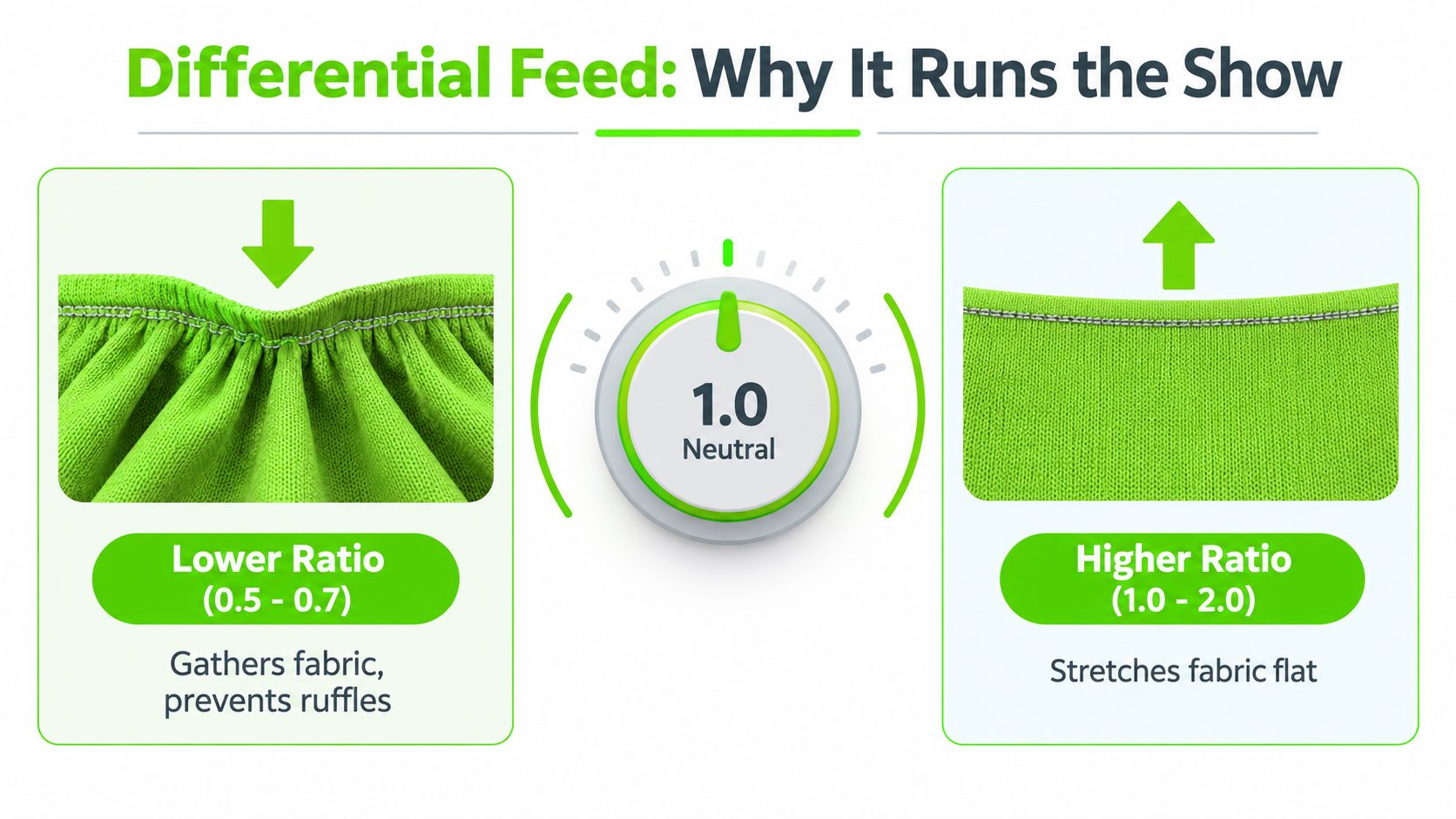
A stretchy knit can leave a wavy seam even when the thread tension is correct. Differential feed is the control that addresses that problem by changing how the front and rear feed dogs move fabric. It can stretch, stabilize, or gather the material as it enters the stitch area.
Start with 1.0, the neutral setting. A practical range commonly runs from 0.7 to 2.0, according to a budget serger comparison that covers differential-feed ranges. Settings below 1.0 intentionally stretch fabric. Settings above 1.0 can gather fabric or help a wavy seam lie flatter.
How to test the dial
Set the machine to 1.0 and sew a sample with stable woven fabric. The seam should feed evenly. Lower the setting with a stretchy knit, then inspect the edge for lengthening or a controlled lettuce effect. Raise it above neutral with a knit or lightweight woven, and check whether the seam flattens or begins to gather.
The dial should sit where you can reach it while fabric is under the presser foot. A buried control or complicated menu slows every adjustment. External access helps when a swimwear knit stretches, a t-shirt hem turns wavy, or lightweight polyester needs a deliberate lettuce edge.
A broader range gives you more control across fabrics. One guide describes roughly 0.7 to 1.5 for basic use and approximately 0.5 to 5 for greater versatility, as discussed in its differential-feed comparison. Treat those figures as a reason to inspect the adjustment, not as a substitute for testing the actual machine.
Don't overlook the presser foot
Differential feed does most of the fabric control, but the presser foot affects how material enters the stitch area. Check whether the machine accepts useful feet for gathering, elastic, blind hemming, or specialty finishing. A practical serger presser-foot guide can help match available feet to the techniques you plan to sew.
Ask the dealer to demonstrate the dial on your fabrics. Confirm that you can read and adjust it without removing a cover, and ask whether replacement feet and parts remain available through authorized service. A machine that is easy to demonstrate, maintain, and repair will serve you longer than one with a wider specification sheet that you cannot confidently set up.
Skipping adjustable differential feed limits a beginner's options. Prioritize an accessible control, clear markings, and a local dealer who can teach you how to use it before choosing extra features you may rarely touch.
Matching Thread Count to the Projects You Actually Sew
Thread count should be chosen by project, not prestige. More threads can expand the stitch menu, but unused capability adds cost and setup complexity without improving a project that only needs a simple edge finish.
The main configurations include 2-thread, 3-thread, 4-thread, and 5-thread options. Threads Magazine's stitch-testing advice supports evaluating each configuration by the actual stitch families it produces, while the U.S. Extension serger buying guide explains the broader thread-count categories available to shoppers.
Serger thread count by project type
| Thread Count | Best For | Project Examples | Fabric Weight |
|---|---|---|---|
| 2-thread | Light edge finishing and delicate hemming | Dressy fabrics, narrow finishing, lightweight edges | Lightweight |
| 3-thread | Basic overlock work and decorative edges | Lightweight knits, edge finishing, rolled hems | Lightweight to medium |
| 4-thread | Construction seams and everyday garment sewing | T-shirts, activewear, knit garments, dependable seam finishing | Medium and stretch fabrics |
| 5-thread | Stronger seam construction with a safety-seam approach | Bags, home décor, stress points, utility garments | Medium to heavier fabrics |
A 2-thread setup suits delicate finishing where a lighter edge treatment is preferred. It isn't the right reason to buy a machine for someone whose sewing centers on activewear or garment construction.
A 3-thread configuration adds useful flexibility for edge finishing, lightweight knits, and decorative effects. It can be a sensible choice for a sewist who already owns a regular sewing machine and wants the serger primarily for clean edges.
The 4-thread serger is the practical workhorse for many home garment sewists. It offers a stronger overlock seam for knitwear and everyday construction, and it gives a buyer room to grow without requiring the full complexity of a 5-thread system.
A 5-thread model earns its place when the project list includes stronger seams, bags, home décor, or areas that receive repeated stress. It adds capability, but it also asks the owner to learn more stitch arrangements and manage more thread paths.
Buy the thread count that removes workarounds from weekly projects. Don't pay for a stitch family that will remain unused.
Thread supply deserves attention too. A serger needs coordinated thread paths and dependable cones or spools, so the buyer should consider thread storage, needle compatibility, and the machine's tension behavior alongside the stitch chart. The sewing thread size guide helps connect thread selection with the fabrics and techniques planned for the machine.
Stitch Length, Knife Setup, and Threading Access
A serger feels friendly or finicky based on small mechanical details. Buyers should inspect the controls with the cover open, thread the machine themselves, and sew a sample before deciding whether the layout makes sense.
Stitch length and cutting control
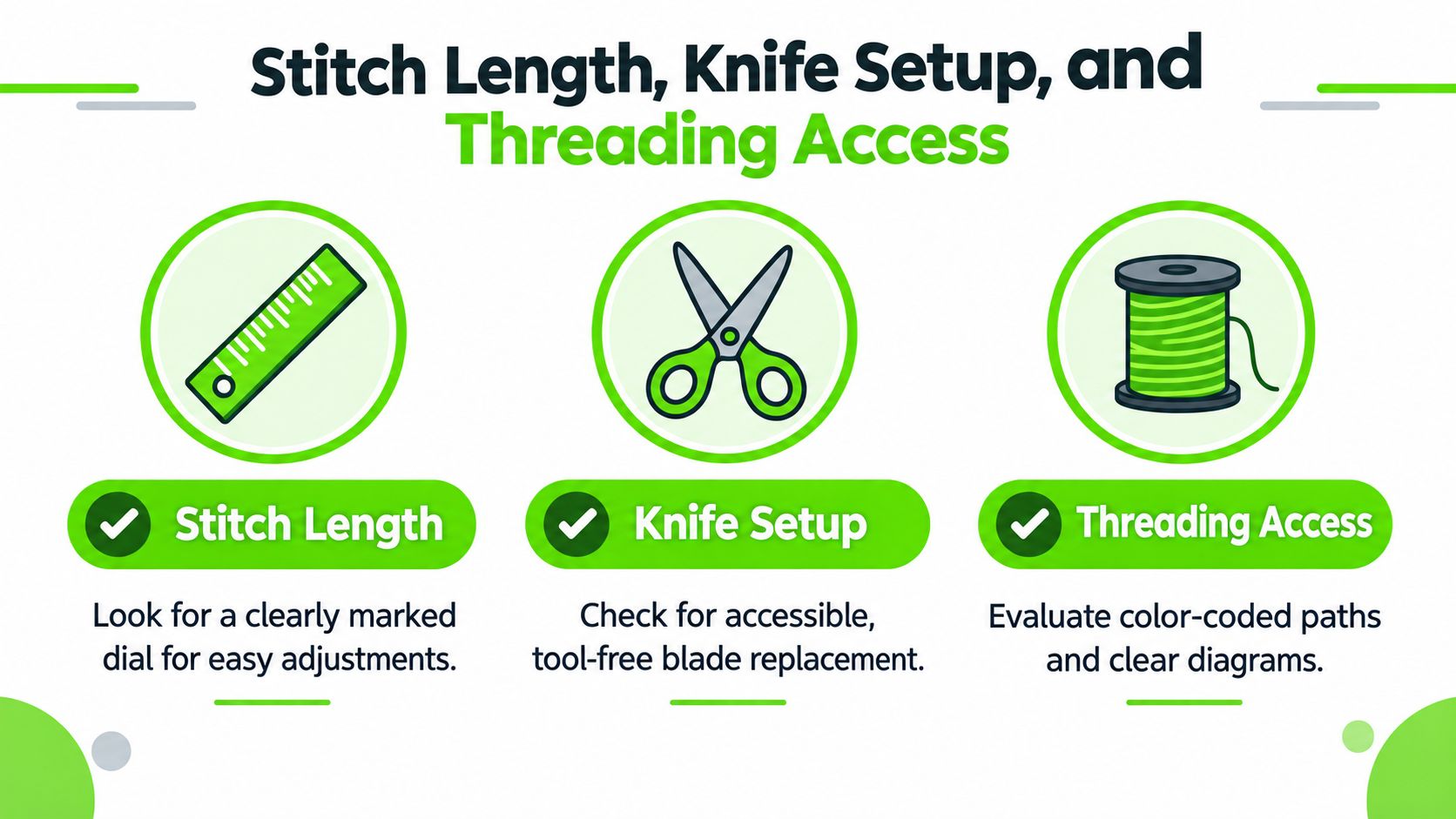
Stitch length affects both construction seams and finish work. Technical references for overlock machines commonly list stitch lengths around 2 to 4 mm, while some industrial and higher-spec machines offer approximately 0.6 to 4.5 mm, according to the overlock machine specification reference. A clearly marked dial matters more than an impressive maximum. The control should be easy to read, easy to adjust, and stable while the machine runs.
The knife deserves a hands-on inspection. A buyer should check whether the upper knife disengages cleanly for hemming or working near a pre-finished edge, whether the cutting width is accessible, and whether blade replacement follows a clear service procedure. A dull or disengaged knife appears in serger troubleshooting guidance as a common source of failure, so knife access isn't a minor convenience.
Threading access prevents daily frustration
Threading-order mistakes, tension loops appearing on the wrong side, skipped stitches on stretch fabric, and knife problems are all identified in serger repair guidance as recurring troubleshooting issues. Buyers should look for color-coded paths, clearly labeled tension controls, an accessible looper area, and a threading diagram that remains readable at the machine.
Lay-in thread paths, looper assists, swing-out covers, built-in thread cutters, and hands-free presser-foot lifts can make repeated setup less irritating. The best feature is the one the owner will use every time the machine needs a new color or a corrected thread path.
The following video can help buyers observe the threading and control layout before arranging a hands-on demonstration.
A machine that threads beautifully on a salesperson's demonstration still needs to feel manageable in the buyer's hands. The test should include removing and replacing thread, following the sequence, opening the looper cover, and correcting a deliberately interrupted path.
Beginner vs Pro Specs That Actually Matter
A beginner and a professional may look at the same specification sheet and make completely different decisions. Beginners need forgiveness and clarity. Experienced sewists often need speed, broader stitch architecture, stronger feeding, and access to adjustments that support demanding fabrics.
Beginner vs pro serger specifications
| Feature | Beginner Priority | Pro Priority |
|---|---|---|
| Thread capability | 2-, 3-, and 4-thread options for learning core stitches | 4- and 5-thread capability, including a true safety stitch |
| Threading | Color-coded paths, clear diagrams, and assisted looper threading | Fast, repeatable access for frequent rethreading |
| Differential feed | Clearly marked external dial with simple adjustment | Broad adjustment range and precise response |
| Tension | Guided or manual controls that are easy to understand | Fine manual control for varied thread and fabric combinations |
| Knife system | Safe access and simple disengagement | External cutting-width adjustment and efficient blade handling |
| Stitch architecture | Core overlock, rolled-hem, and finishing options | Construction, safety-seam, chainstitch, and specialty options |
| Frame and feeding | Stable frame that stays planted during normal sewing | Durable internal components, strong feed performance, and pressure adjustment |
| Workspace | Compact footprint with accessible controls | Knee lift, extension-table compatibility, and production-friendly layout |
A beginner shouldn't chase top speed before learning the threading sequence. Color-coded paths, a clear differential-feed dial, and approachable tension controls usually have more daily value than a crowded menu.
A professional or highly active sewist may prioritize a separate chainstitch option, external knife adjustment, industrial-style feed control, and support for denim, canvas, or technical stretch fabrics. Knee lift access and extension-table compatibility can also improve long sessions.
The right choice depends on the features touched every week. A machine can have impressive capabilities that never affect the owner's projects, while a simpler machine can become indispensable because its threading and fabric controls are easy to use.
Needle setup also belongs in the test. An independent serger manual explains that a 3-thread overlock can use the left needle for a wider seam or the right needle for a narrower seam, while its 4-thread configuration uses both needles to produce a 7.0 mm-wide stitch on that machine, as shown in the serger instruction manual. Buyers should confirm how needle position changes the finished seam on the model being tested.
Dealer Support, Service, and Long-Term Serviceability
A serger contains loopers, blades, tension discs, feed dogs, and timing that must remain coordinated. The dealer relationship determines whether a problem becomes a manageable service appointment or an extended interruption to sewing.
Questions worth asking before purchase
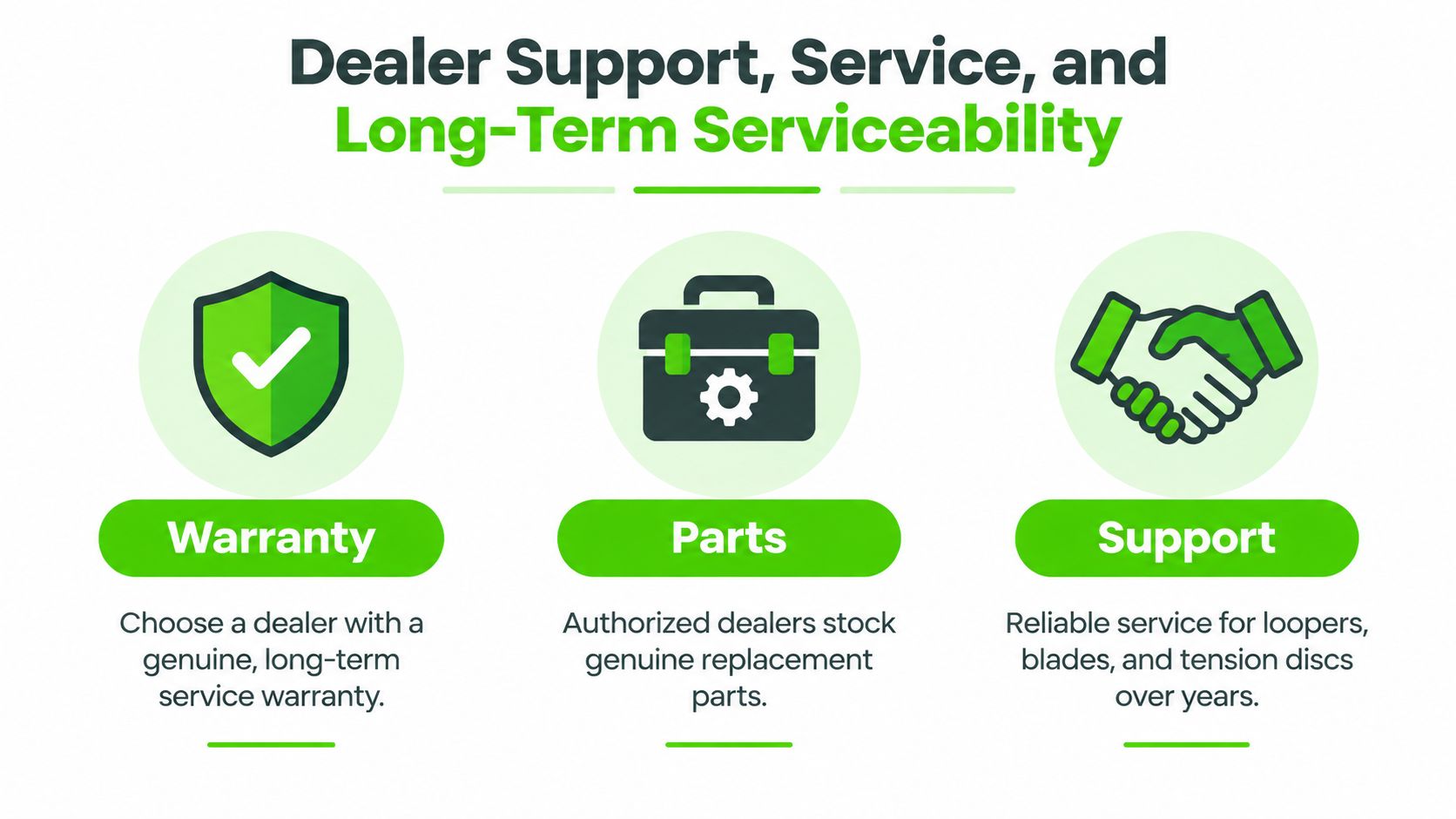
Authorization matters. A university extension buying guide recommends asking whether the dealer is authorized, whether staff understand the machines they sell, how quickly repairs are handled, and whether lessons are available. A local bench technician, genuine replacement parts, and clear warranty procedures are more useful than a vague promise that support exists somewhere.
Classes reduce ownership friction. In-person instruction can help a new owner learn threading order, differential-feed adjustments, needle selection, rolled hems, and tension troubleshooting before small mistakes become discouraging habits. Sewing.org also highlights instructional classes and on-site repair as relevant buying factors.
Repair turnaround affects real projects. A machine that sits without service access can stop a garment, class assignment, gift, or small production run. Buyers should ask whether repairs are performed locally, whether routine tune-ups are available, how parts are sourced, and what happens if the machine requires specialized work.
A strong dealer may also offer trade-ins and machine mastery sessions, which matter when the sewist's needs change. Documented service history can support a smoother upgrade conversation, while a dealer that knows the machine can often diagnose whether a problem comes from threading, a needle, tension, or mechanical adjustment.
B-Sew Inn is an authorized sewing, quilting, and embroidery machine dealer with retail stores in Tulsa, Oklahoma City, Springfield, Humble, and Fayetteville, plus an online store. It sells and services machines from Baby Lock, Bernina, Bernette, Brother, and Janome, along with sergers, thread, notions, cabinets, and cutting tables. It doesn't manufacture machines or create custom machine designs, but it does offer in-person machine support and service options.
The sewing machine service and repair information gives buyers a starting point for evaluating the after-sale side of a purchase. That conversation should happen before checkout, not after the first major jam.
Putting It Together and Your Next Step
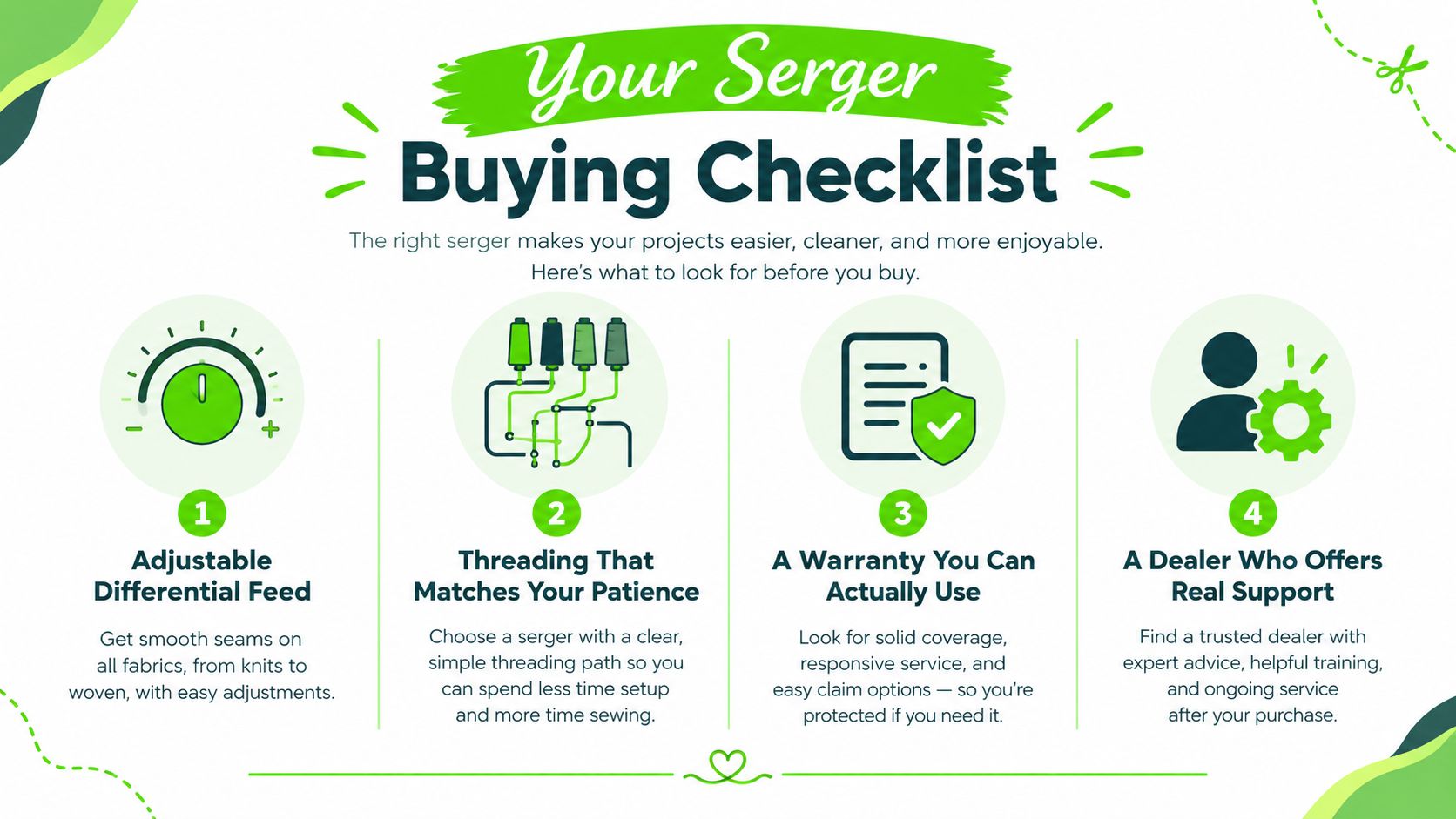
A sound serger purchase comes down to four key considerations:
- Adjustable differential feed: The dial should be accessible, clearly marked, and appropriate for the fabrics used most often.
- Threading that matches patience: Color-coded paths, looper access, and a readable diagram matter more than clever marketing language.
- A useful thread range: Choose 3- and 4-thread capability for broad garment use, then move to 5-thread when stronger seam construction or specialized projects justify it.
- A warranty and dealer relationship: Confirm authorization, repair handling, classes, service appointments, and trade-in policies before paying.
A practical showroom test
Bring a knit, a woven fabric, and a lightweight material if possible. Ask the dealer to demonstrate a construction seam, an edge finish, and a rolled hem, then take the controls yourself.
The buyer should be able to answer these questions before leaving:
- Can the machine adjust differential feed without a complicated setup?
- Can the buyer follow the threading path without relying on memory?
- Does the knife disengage or adjust in a practical way?
- Does the stitch range match the actual project list?
- Is there a local place for instruction, repair, and follow-up?
Pricing deserves the same disciplined approach. The verified buying information supports comparing machines by capability and serviceability, but it doesn't establish reliable entry-level, midrange, or professional price bands. Buyers should therefore request current pricing rather than relying on generic budget labels, then compare the complete ownership package, including accessories, instruction, warranty handling, service, and financing terms.
A lower purchase price can be sensible when the machine covers the intended projects and has dependable support. A higher purchase price can also make sense when it buys easier threading, stronger stitch architecture, better fabric control, or a service relationship the owner will use. The wrong comparison is price alone. The better comparison is capability plus support over the years the machine is expected to serve.
The guide to choosing a serger for home use can help narrow the feature list before a store visit. A hands-on demonstration remains the decisive step, because the right machine is the one that feels understandable when the buyer threads it, adjusts it, and sews the first sample.
B-Sew Inn carries and services sergers from brands including Baby Lock, Bernina, Bernette, Brother, and Janome, with in-person stores in Oklahoma, Missouri, Texas, and Arkansas where buyers can see and test machines. Visit B-Sew Inn to browse current serger options, arrange a demonstration, book an in-person class, or contact the team about service and trade-ins before making the purchase.

