

An applique pressing sheet is a reusable, heat-resistant sheet, usually PTFE-coated, placed between the iron and fusible appliqué so adhesive stays on the sheet. That sounds simple until the board tells a different story. A leaf is cut, the fusible web is trimmed, the iron comes down for a few seconds, and the piece lifts with a shiny patch on the soleplate and a sticky crescent on the cover.
The fix isn't more heat or a harder press. It's the right barrier for the adhesive in hand, used at the time and temperature that adhesive requires. Choose badly and the substitute fails in its own predictable way, either letting glue through, hiding the placement lines, or giving up after one use.
Table of Contents
- What an Applique Pressing Sheet Is and How Its Surface Works
- Pressing Sheet, Parchment and Pressing Cloth Compared
- How to Press Applique Without Adhesive Transfer
- Fixing Transfer, Shifting and Scorching Problems
- Handling Large Motifs, Repeat Use and Cleaning
- Choosing a Pressing Sheet and Taking Your Next Step
What an Applique Pressing Sheet Is and How Its Surface Works
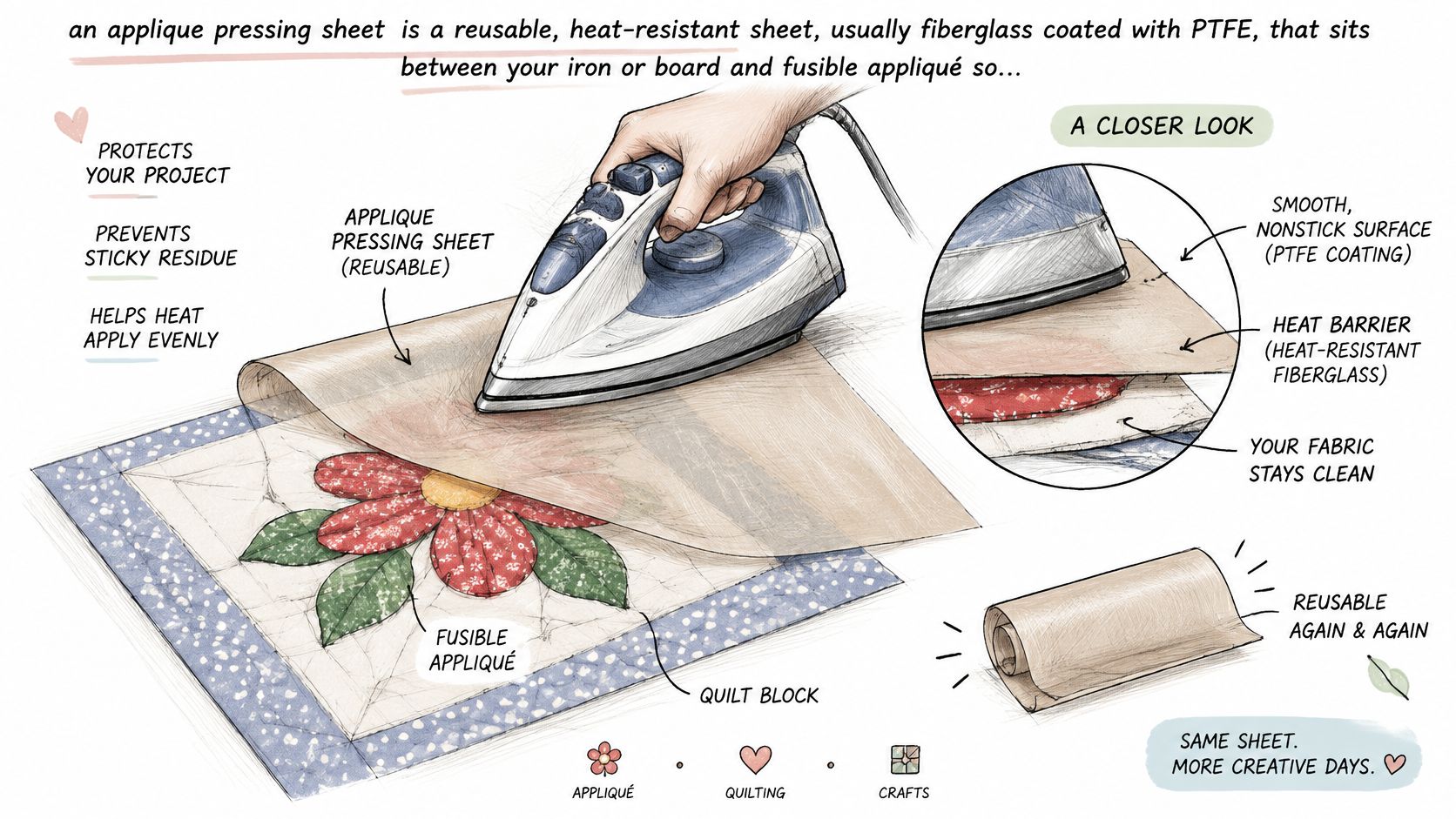
An applique pressing sheet works like a nonstick baking sheet for an iron. It's usually fiberglass coated with PTFE, or polytetrafluoroethylene, and it sits between the iron or board and fusible appliqué so melted adhesive releases from the sheet instead of bonding to equipment.
Why Adhesive Can't Grip It
PTFE has very low friction, strong resistance to chemical attack, and stability well above the temperatures ordinary fabric pressing requires. Melted fusible web spreads on contact but finds no surface texture or chemical grip to hold, so the cooled piece peels away cleanly.
The material isn't a recent craft invention. The Science Museum's account of Teflon history records PTFE's accidental discovery on April 6, 1938, its patent in 1941, the Teflon trademark in 1945, and production reaching approximately 900 tons annually by 1948, decades before quilters adopted the surface for appliqué.
Where It Earns Its Place
Say a motif has four overlapping petals, each backed with web that runs slightly larger than the fabric at one edge. Built directly on a board, the first press glues the overlap to the cover. Built on a sheet, the unit fuses to itself, cools, and lifts as one piece ready for the background.
That flat, smooth surface also stops small pieces from skating under the iron. The web controls placement; the sheet controls release. Guidance on keeping small appliqué pieces in place pairs well with sheet work because it handles the placement half of that split.
Self-check: Adhesive on the iron, residue on the board, or pieces that shifted during pressing means a sheet belongs in the setup.
Nonstick doesn't mean risk-free. The sheet protects equipment and controls the surface. Each fusible web's manufacturer chart still sets the temperature, dwell time, and pressure, and those numbers differ between adhesives.
Pressing Sheet, Parchment and Pressing Cloth Compared
Each of these four tools fails in a different place. The table below maps those failures so the choice happens before adhesive melts, not after.
Pressing sheet and alternatives compared
| Option | Reusable | Transparency | Best use |
|---|---|---|---|
| Applique pressing sheet | Yes, PTFE-coated | Often translucent | Fusible appliqué and repeat pressing |
| Teflon-coated sheet | Yes | Usually opaque | Adhesive-heavy patches and appliqués |
| Parchment paper | No, single use | Opaque | One-off pressing, cut to size for large motifs |
| Pressing cloth | Yes | Thin fabric, not nonstick | Protecting fabric from shine, not stopping adhesive transfer |
Applique Pressing Sheet and Teflon-Coated Sheet
A purpose-built applique pressing sheet is the repeat-use option. It survives block after block, wipes clean, and, in translucent versions, lets a printed pattern show through for positioning. Its weakness is size, because a sheet smaller than the motif forces repositioning mid-build.
A Teflon-coated sheet is fiberglass mesh coated with PTFE, and that construction suits adhesive-heavy patches and appliqués because stubborn glue releases cleanly off the coating. The trade-off is visibility. An opaque sheet hides alignment marks underneath, so positioning has to happen by eye or by pre-marking the fabric edges.
Parchment Paper and Pressing Cloth
Parchment is cheap, disposable, and cut from a roll to whatever length a large motif demands. That solves the size problem for a quilt-scale design. It fails on economics and handling over time, because every session consumes a fresh piece and thin paper curls at the edges under heat. A light fusible web releases from it once; a heavier adhesive saturates the sheet and the bond becomes unpredictable.
A pressing cloth does a different job entirely. It shields wool and delicate fabric from iron shine and scorching, a role covered in guidance on pressing seams without shine. For any adhesive at all, it fails outright. Melted web soaks into the weave and transfers to the next project the cloth touches.
Match the tool to adhesive weight, motif size, and reuse count, then confirm the choice against the adhesive maker's chart rather than treating one sheet as universal. A quilter fusing small motifs repeatedly should start with a translucent pressing sheet. A one-off oversized motif points to a large sheet or parchment cut to size.
How to Press Applique Without Adhesive Transfer
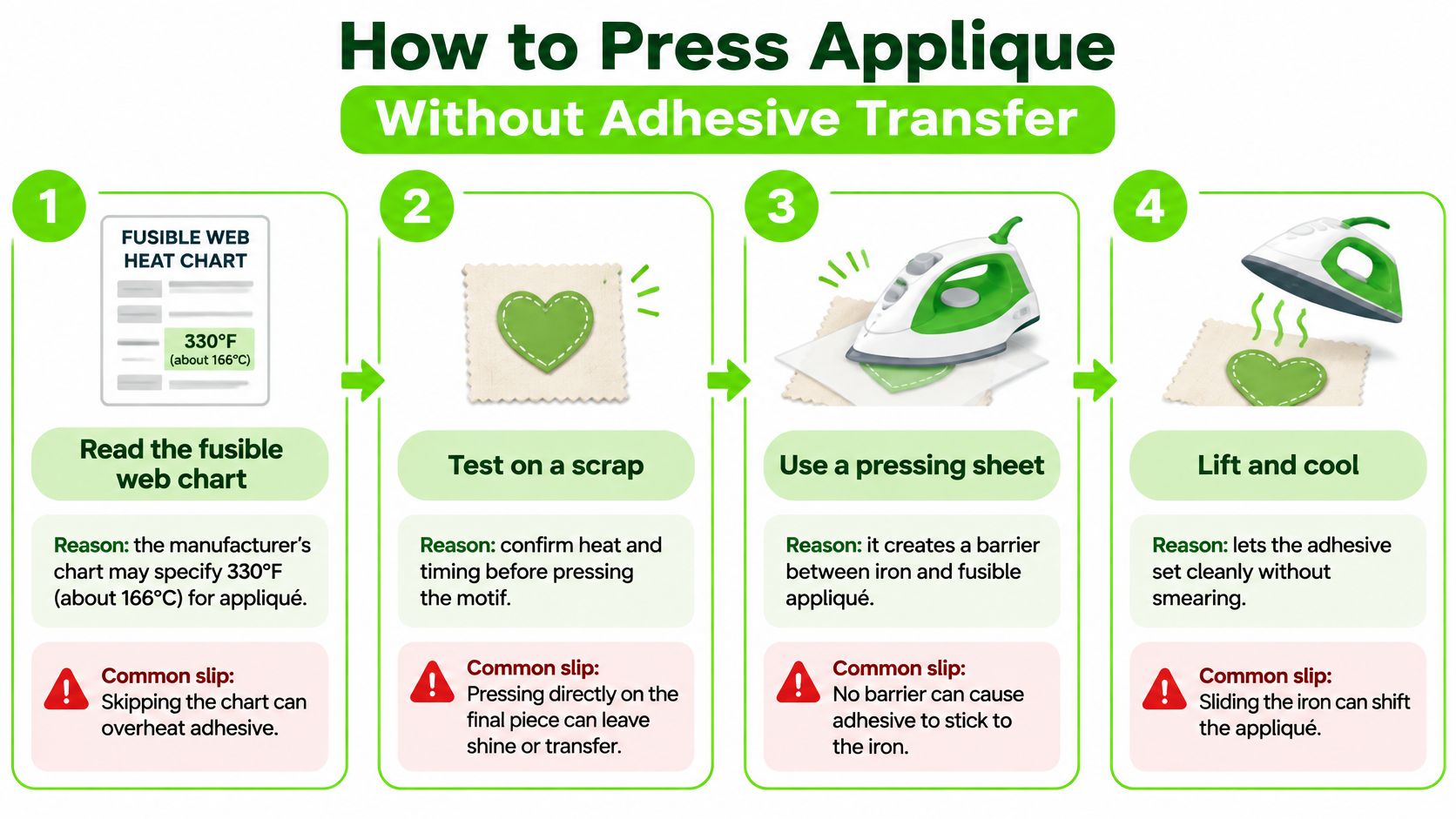
The sheet handles release. The adhesive chart handles everything else, and treating any setting as universal is where most failed bonds start.
Settings by appliqué material
| Material | Temperature | Time | Pressure |
|---|---|---|---|
| Appliqué fabric with fusible web | 330°F (about 166°C) | 10-15 seconds | Medium |
| Acrylic felt | 330°F (about 166°C) | 20 seconds | Firm |
Seven Steps, in Order
- Read the fusible web chart first. One manufacturer application chart for appliqué materials specifies 330°F (about 166°C) for appliqué fabrics at 10-15 seconds with medium pressure, states the appliqué must subsequently be sewn, and lists acrylic felt at the same temperature for 20 seconds at firm pressure. The common slip is pressing every material to one memorized setting.
- Set the iron and let it heat fully. A soleplate still climbing toward temperature melts web unevenly and leaves the bond incomplete. Wait for the ready light, then give it a few extra seconds.
- Lay the sheet flat and smooth it. Wrinkles and folds under a motif print straight through as creases in the fused unit. Run a hand across the sheet before any fabric goes down.
- Place the motif fusible side down, fabric right side up. This orientation lets overlapping pieces fuse to each other on the sheet. Reversed pieces glue themselves face down and distort when peeled.
- Press by lifting and setting down, never sliding. Sliding drags small pieces out of registration while the web is liquid. Lift, move, press again for large areas, following the same discipline used for positioning hand appliqué pieces.
- Let the piece cool flat before peeling. Warm adhesive stretches, and edges lifted hot curl or thin out. Cool pieces release with a clean pop and hold their shape.
- Test the bond at one edge. A corner that lifts easily needs a second press at the chart's full time. Forcing a weak unit onto a background only moves the failure to the stitching stage.
A finished unit shows sealed edges, no residue left on the sheet, and nothing stuck to the iron.
Insufficient heat, time, or pressure leaves the bond incomplete. Excessive heat distorts heat-sensitive fabric and drives adhesive migration beyond the motif edge. The sheet protects the iron and board, and it never overrides the chart.
Fixing Transfer, Shifting and Scorching Problems
Adhesive reaches the board despite the sheet. The cause is usually geometry, not coating failure. Fusible edges overhang a sheet that's too small, or web sits under the sheet instead of on it. Trim the web so every glued edge stays inside the sheet's borders.
Residue on the sheet won't wipe off. That sheet is past its useful life. Scrubbing with an abrasive pad scratches the coating and makes release worse, so replacement beats rescue. The same restraint applies to any temporary spray used nearby, as notes on 505 adhesive spray cleanup make clear.
Surface Marks and Heat Damage
Texture or print transfers onto the appliqué. A wrinkled or folded sheet sat under the motif during pressing. Smooth the sheet completely flat before placement and keep its edges unfolded.
Fabric scorches or turns shiny even with a sheet. The iron is set above the fabric's tolerance, and a sheet underneath can't shield the top surface. Lower the heat, place a pressing cloth over the motif, and test on scrap first. Options such as Walt's Pressing Cloth, offered in 2 variants, cover that top-side protection role.
The bond fails after washing. The chart's time or temperature was cut short, so the web never fully flowed into the fibers. Press again for the full time and cool the piece flat before stitching.
If a problem repeats, change one variable at a time and write the setting on a scrap label kept with the project.
Handling Large Motifs, Repeat Use and Cleaning
A sheet that handles a single block beautifully can become the limiting tool on a quilt-scale design. When a motif outgrows the sheet, two routes work. Tile two sheets with a small overlap so no glued edge crosses a gap, or move up to a larger sheet for that project.
Size, Alignment, and Throughput
A larger sheet keeps the whole design visible at once, which matters when a stem must meet a leaf placed several inches away. Repositioning a half-fused unit to fit a small sheet risks stretching warm edges that have already grabbed adhesive. Parchment cut from a roll remains the practical fallback for a single oversized piece, accepting disposal in exchange for coverage.
For repeated blocks, the calculation flips. A durable sheet that wipes clean between units keeps batch speed steady, while cutting fresh parchment for every block slows the line. Seasonal projects built from repeated fused units, like the appliqué tea towel project, reward that repeatability.
For complex layouts, usable area and repeatable release usually outweigh a higher heat rating.
Lifting, Storage, and Care
Cool the fused unit completely on the sheet, then lift it from one edge in a slow peel. Store partly assembled motifs flat and face up between sheets of plain paper so exposed adhesive can't grab neighboring pieces in the stack.
Wipe the cooled sheet with a soft cloth after each session. That habit removes the thin adhesive film that, left in place, bakes harder with every press until release suffers. Keep pins and scissor tips off the surface. One scratch through the coating becomes a permanent sticking point.
Stated reuse counts deserve a skeptical read. Listings for similar PTFE-coated sheets vary widely, and the figures come from each seller's own description rather than a shared test standard. They describe the coating under ideal use, not the conditions on your ironing board. Excessive heat, sharp motif edges, adhesive buildup, or folding all shorten real service life well below any printed number.
Replace a sheet when residue no longer wipes away, when the coating looks scratched or flaky, or when cooled units stop releasing cleanly. At that point the sheet creates the transfer problems it was bought to prevent.
Choosing a Pressing Sheet and Taking Your Next Step
Brand matters less than these five criteria.
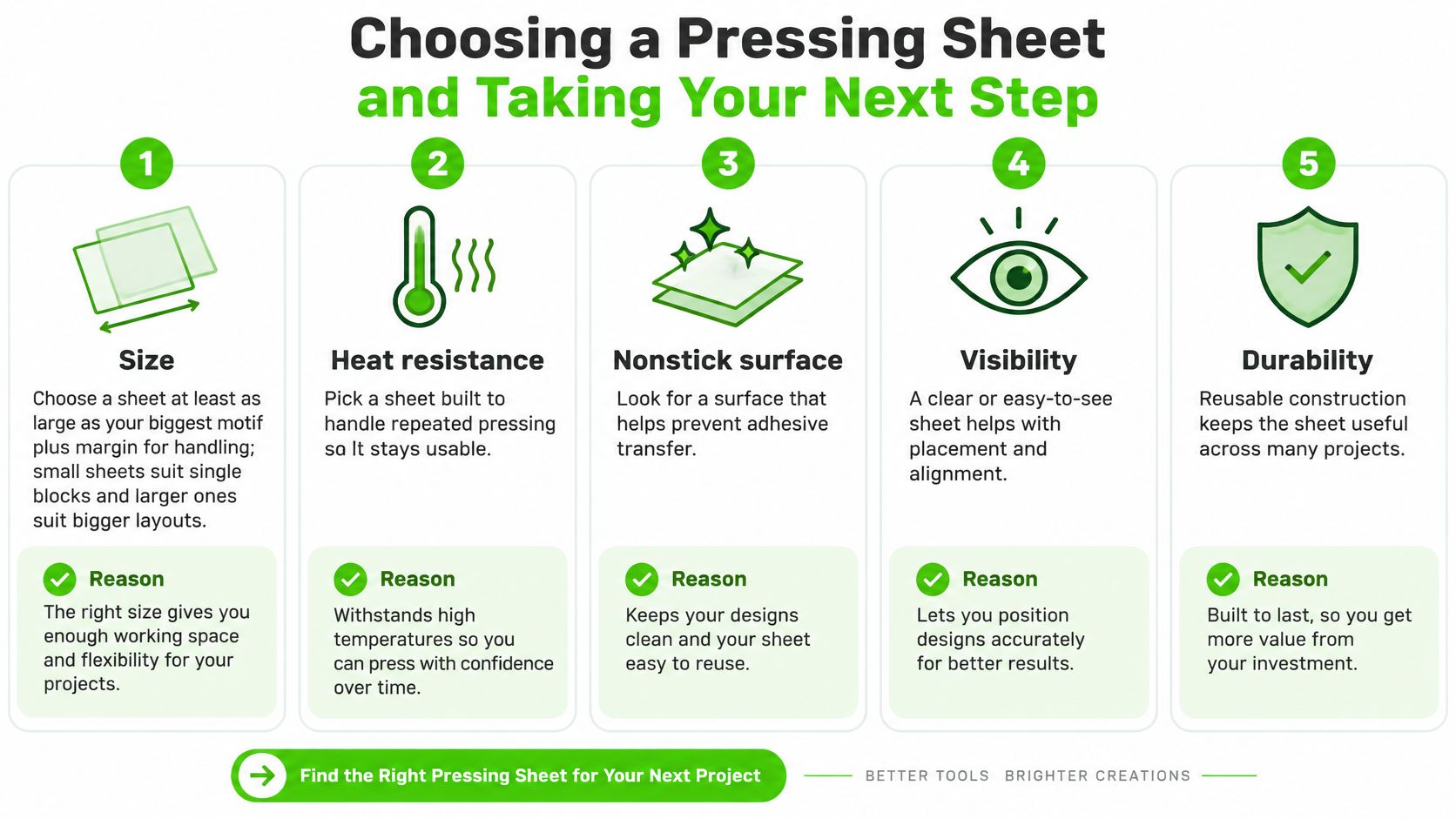
- Size: Pick a sheet at least as large as the biggest motif, plus margin for handling. Small sheets suit single blocks, and larger ones suit quilt-scale layouts.
- Heat rating: Confirm the label maximum covers both the iron setting and the adhesive chart. One PTFE fabric specification for Teflon sheet lists fiberglass coated with PTFE at -70°C to +300°C, about -94°F to 572°F, well above appliqué temperatures.
- Coating and base: PTFE-coated fiberglass is the common construction. Check whether the sheet is double-sided if both faces will see use.
- Transparency: See-through sheets help placement over a printed pattern. Opaque sheets hide alignment and suit free-form work.
- Reuse rating: Treat stated press counts as manufacturer claims for comparison only, not guarantees.
No single sheet covers every fusible. The adhesive manufacturer's chart sets the working temperature and press time, so the sheet only has to outlast that range while still releasing cleanly. A low-temperature web gives any coated sheet an easy job. A high-bond adhesive run near the top of a sheet's rating is where weak coatings fail first, and matching the sheet to that chart is what separates a clean release from a bonded mess.
Small pressing tools fill the gap a flat sheet leaves. A compact iron, like the one covered in the petite press overview, reaches seams and tight curves, while the sheet protects the adhesive face during fusing. Stock changes, so checking availability before ordering saves a wasted wait.
The practical next move is narrow. Pick one sheet sized to the largest current project, test it on scrap with the adhesive already in use, and check the bond before any stitching. I would rather sacrifice one scrap than unpick a fused motif.
Browse pressing sheets, cloths, stabilizer, and appliqué notions in the B-Sew Inn online catalog, where standard shipping is free on orders over $100 and the B-Creative membership adds classes and tutorials for the next project.

