
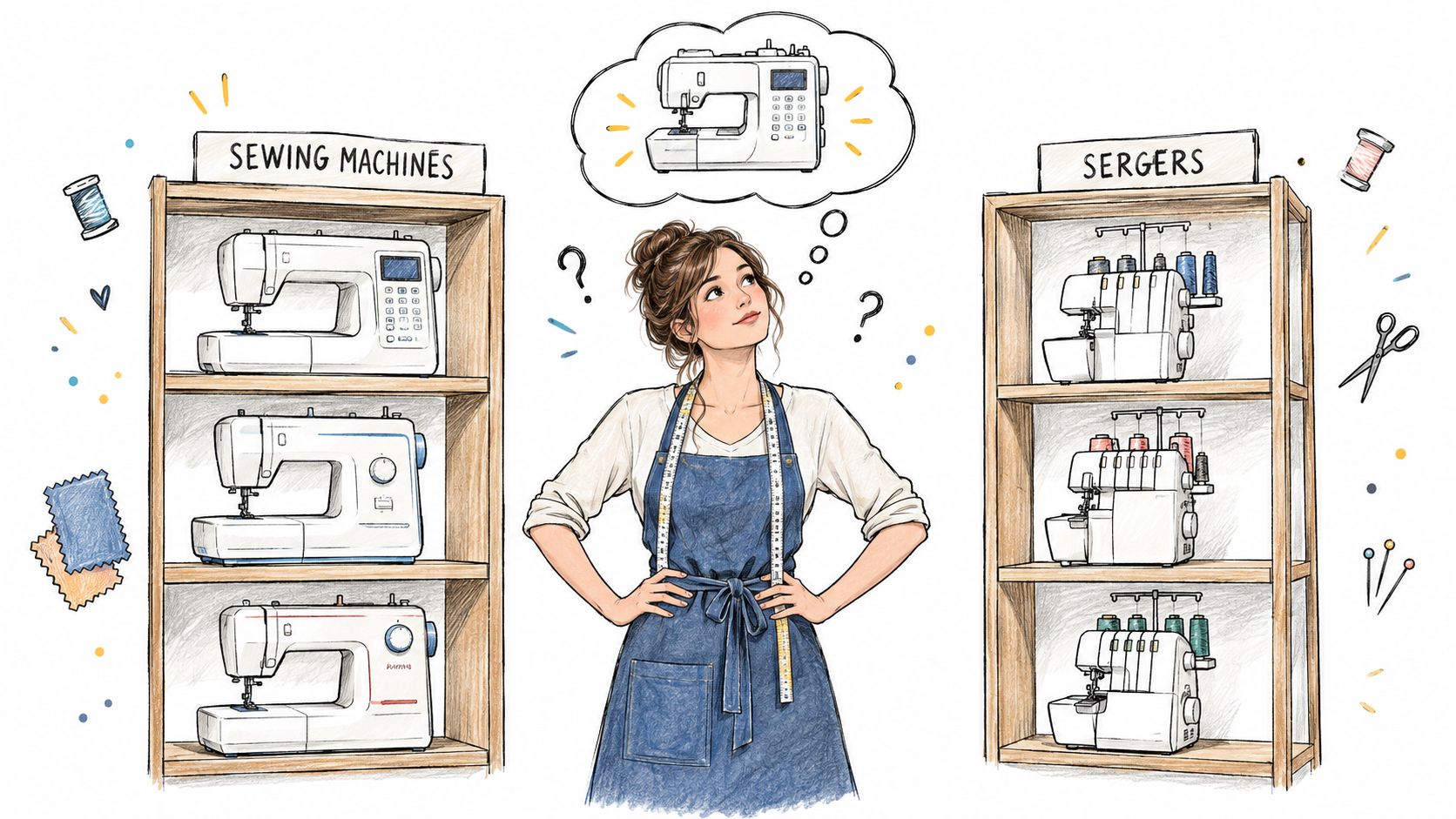
A sewist can spend an evening comparing sewing machines on one shelf and sergers on another, then still wonder whether a single sewing machine and serger combo is the smarter purchase. The answer depends less on the number of machines and more on how often the sewist changes functions, what fabrics fill the cutting table, and what happens when equipment needs service.
A combo can save table space and keep both overlock and coverstitch capabilities in one cabinet. Separate machines can make learning, troubleshooting, and production easier. The right choice comes from matching the setup to real sewing habits, not from treating “one machine” as automatically more economical.
Table of Contents
- Why a Combo Setup Is Worth Thinking Through
- How a Sewing Machine and a Serger Work Together
- The Tradeoffs of Combo Versus Separate Machines
- A Practical Workflow for Both Machines
- Features and Setup Details Worth Comparing
- Matching the Setup to Your Sewing Life
- Buying, Testing, and Getting Set Up
Why a Combo Setup Is Worth Thinking Through
A garment sewist working in a compact room may value a combo because one machine can handle overlock work and coverstitching without requiring two full-size work areas. Another sewist may find that frequent conversions interrupt the rhythm of construction, especially when a project moves repeatedly between seam finishing and hemming.
That difference matters. A combo may save space, but it can also add configuration work. Separate machines occupy more room, yet each remains ready for its specific task. The buyer needs to answer three practical questions: Does the combo reduce total ownership cost, will it fit the available sewing space, and which setup matches the weekly workload?
Space savings aren't the whole calculation
A hobbyist who brings out a machine occasionally may appreciate a unit that stores more neatly. A garment-focused sewist who works through several projects in a session may care more about avoiding rethreading and conversion steps. The more often the workflow alternates between functions, the more important that friction becomes.
The historical development of these machines supports that distinction. The conventional sewing machine evolved around precise construction seams, while serging developed around trimming, wrapping, and securing fabric edges. The two functions complement each other, but they don't perform the same job.
A buyer comparing conventional machines can use this sewing machine buying guide to clarify the construction features that matter before adding overlock or coverstitch capability.
The useful answer is personal
A combo is a sensible choice for a sewist with limited room, a strong need for coverstitching, and enough patience to learn the conversion process. Separate machines are usually the stronger choice for someone who values uninterrupted production, easier setup, or independent operation during service.
B-Sew Inn is an authorized sewing, quilting, and embroidery machine dealer with retail stores in Tulsa, Oklahoma City, Springfield, Humble, and Fayetteville. Seeing and trying machines in person gives buyers a way to judge threading paths, controls, working height, and fabric handling before committing several thousand dollars.
How a Sewing Machine and a Serger Work Together
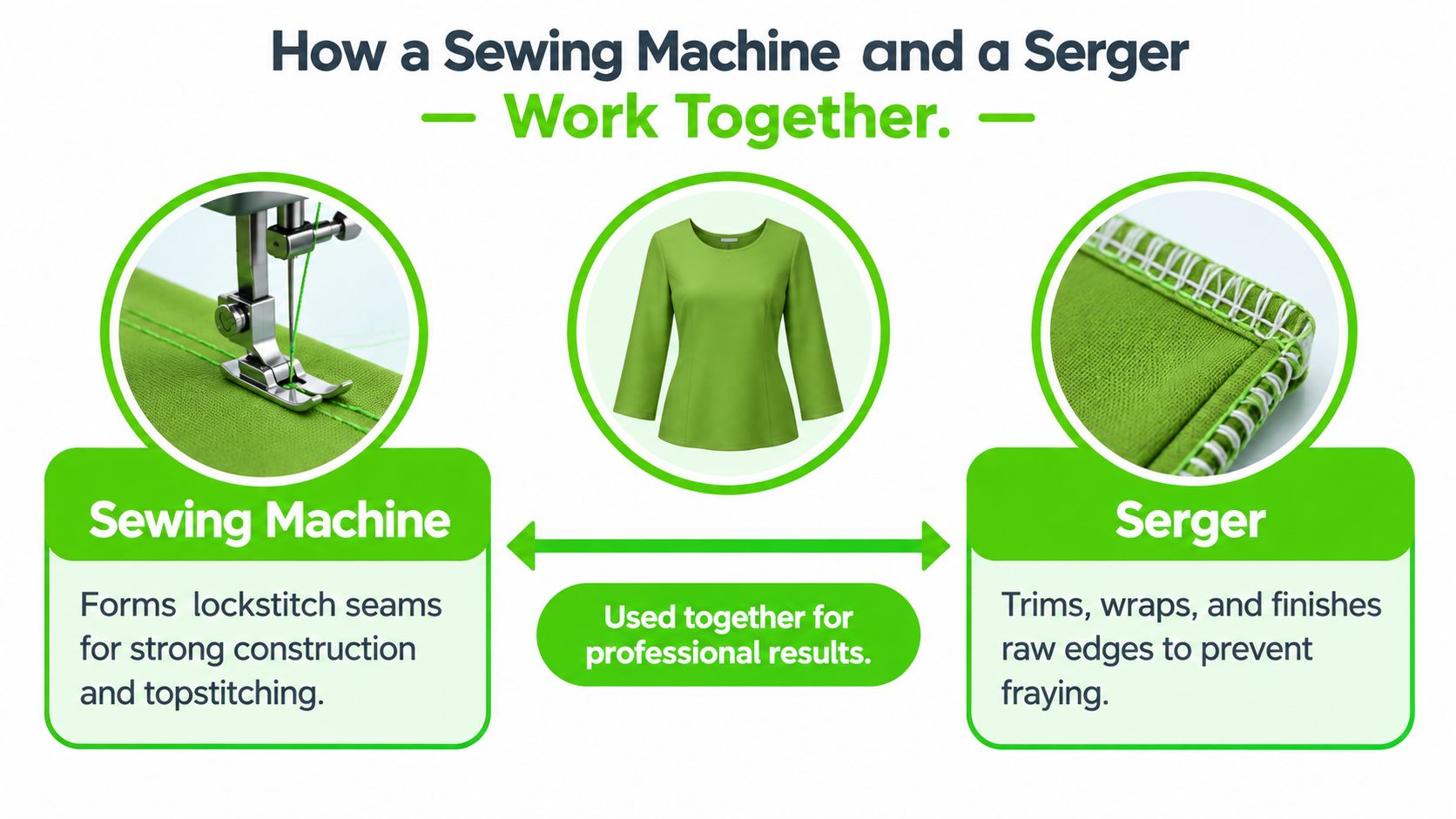
A sewing machine and a serger earn their places by handling different stages of garment construction. A conventional sewing machine forms a lockstitch, making it the primary tool for joining garment panels, sewing controlled curves, adding topstitching, inserting zippers, and making buttonholes.
A serger, also called an overlocker, trims excess seam allowance while wrapping thread around the raw edge. It can form a seam and finish that edge in one pass, which makes it especially useful for knit garments and fast edge finishing. For a fuller explanation, read our guide to what a serger machine does.
Construction and finishing are different operations
The sewing machine builds the garment by joining fabric pieces with a controlled seam. The serger handles the exposed edge, trims excess material, and helps keep the seam allowance from fraying. That division of labor explains why a combo can be useful, but it also creates a learning curve. You must understand which function your project needs and configure the machine correctly.
The machines developed around separate technical priorities. Elias Howe patented a lockstitch sewing-machine concept in 1846, while Isaac Merritt Singer received U.S. Patent No. 8,294 on August 12, 1851. Singer's design used a straight, vertically reciprocating, eye-pointed needle and a shuttle moving in a straight path, an arrangement that produced a reliable lockstitch. The Singer machine displayed at the 1853 New York Crystal Palace exhibition could produce approximately 900 stitches per minute, reported as more than three times the efficiency of Howe's model. The Smithsonian documents Singer's patent model and design development.
Serging developed around industrial edge finishing. That distinction remains practical today: the sewing machine joins fabric panels, while the serger trims and encloses the raw edge.
Choosing the right overlock configuration
A four-thread overlock uses two needle threads and two looper threads. It forms a seam while enclosing the cut edge, making it a useful general-purpose companion for garment construction.
A three-thread overlock uses one needle and two loopers. It suits lighter seam finishing when a full four-thread construction seam is unnecessary. Some sergers also offer narrow-hem, rolled-hem, and ribbon-lock options, so compare the stitch programs with the projects you regularly sew.
Judge a combo by its available stitch work, not by the label “serger.” Garment-focused sewists may prioritize four-thread overlock, while delicate edges or decorative finishes may call for a different combination. Before buying, use B-Sew Inn's in-store try-before-you-buy opportunity to test threading, controls, and fabric handling. That hands-on check reveals whether the machine's learning curve fits your working style.
The Tradeoffs of Combo Versus Separate Machines
A combo saves space, but space is only one part of ownership. Separate machines cost more room and equipment, while a combo can cost more time each time you change functions. Choose according to how often you sew, how often you switch modes, and how much downtime you can accept.
Four ownership questions matter most
Table space favors a combo. One machine leaves more counter area available, although it still needs room for thread, fabric handling, accessories, and configuration changes.
Workflow speed usually favors separate machines. One can stay threaded for overlocking while the other remains ready for coverstitching. A combo may require changed settings, extra thread-guiding steps, and further adjustment before work can continue.
Learning curve also favors separate machines for many sewists. Each dedicated machine has one main purpose to learn. A combo places more needles, loopers, guides, and controls in one interface, so you must know which setup belongs to each function. Use B-Sew Inn's in-store try-before-you-buy opportunity to test that process with real fabric before committing.
Total ownership cost depends on your habits. A combo can save money when you have limited space and use coverstitching occasionally. Separate machines may justify their higher equipment cost when you sew garments frequently or change functions throughout a project.
Practical rule: Choose a combo for compact ownership only if you will accept the time required to learn and change configurations.
Serviceability changes the economics
The purchase price does not cover every ownership cost. According to sewist-reported repair costs discussed on Reddit, routine service and timing repairs can carry significant costs, but those reports should be treated as user experiences rather than a universal market rate.
A combo problem can stop both overlocking and coverstitching at once. That matters to a small apparel business, educator, or sewist working to a deadline. With separate machines, one may remain available while the other is being serviced.
Before committing, review what to look for when buying a serger and ask about technician access, parts, diagnostic fees, turnaround time, warranty coverage, and service charges. B-Sew Inn offers machine sales, service, repairs, trade-ins, and in-person machine mastery sessions, giving buyers a place to test these questions before purchase.
A combo fits occasional use and tight space. Separate machines fit frequent production and buyers who cannot tolerate a complete stoppage.
A Practical Workflow for Both Machines
A two-machine garment workflow becomes easier when each stage has a clear assignment. The sewing machine handles controlled construction, and the serger finishes edges or assembles suitable knit seams.
A five-stage garment process
- Cut and organize the fabric. Keep pattern pieces together and identify which edges will receive overlock finishing. This prevents unnecessary conversion between operations.
- Sew construction seams. Use the sewing machine for seams that need precise placement, topstitching, zippers, buttonholes, and controlled curves. Press the seams before finishing whenever the pattern and fabric require it.
- Test the serger on project fabric. A scrap from the actual garment is more useful than a generic test cloth because fabric weight, elasticity, and thread behavior change the result.
- Finish or assemble with the serger. A four-thread overlock can join and enclose a seam. For a separate edge finish, the serger can trim and wrap the raw edge without replacing the construction work of the sewing machine.
- Complete hems and details. Coverstitching can support knit hems, while the sewing machine remains useful for detail work that the serger isn't designed to perform.
Differential feed controls fabric movement
On a serger, differential feed changes the relative travel of the front and rear feed dogs. The neutral setting is 1.0. Values below 1.0 create a stretching effect, while values above 1.0 create a gathering effect.
For lightweight woven fabrics, a practical starting range is 0.7 to 1.0 to help reduce puckering. Knits and highly elastic fabrics generally need settings from 1.0 toward 2.0 to suppress rippling. Stitch length and fabric elasticity also affect the outcome, so the test strip remains essential.
A four-thread overlock baseline can begin around 2.5 mm stitch length, 5 to 7 mm stitch width, cutting width near 2 mm, and thread tensions around 3 to 5 for each needle and looper. These are starting points, not universal settings. University extension guidance explains differential feed and serger adjustment principles.
If the looper threads extend beyond the cut edge, the stitch isn't balanced. Visible looping on the underside or needle-side edge can indicate a threading problem, incorrect tension, or unsuitable cutting width. Adjust only one tension dial by 0.5 to 1 increment, sew another test, and inspect both sides before changing another control.
For additional practical setup guidance, More Sewing's overlocker hints and tips offers useful reminders about threading, testing, and fabric handling. B-Sew Inn's serger threading guide can also help a buyer judge how much threading support a preferred machine may require.
Record the final stitch length, tensions, cutting width, differential-feed value, fabric type, needle size, and thread. That record turns a successful test into a repeatable setup instead of a lucky result.
Features and Setup Details Worth Comparing
A good buying decision starts with fabric and technique, not with the highest stitch count. The right machine should support the materials the sewist uses and provide controls that can be adjusted without guesswork.
Needles are part of the machine decision
Utah State University Extension recommends size 80 needles for most serger sewing, with sizes 70 and 90 also suitable in appropriate situations. The same guidance warns against size 100 for typical serger work. Needle condition matters just as much as size. A dull, bent, or burred needle can cause skipped stitches and fabric damage. Utah State University Extension explains serger needle sizes and points.
The needle point should match the fabric:
- Sharp points suit woven fabrics.
- Ballpoint needles suit knits and interlocks.
- Universal needles can help when joining a woven to a knit.
- Stretch needles suit spandex, highly elastic knits, and fleece.
A combo owner should plan to stock multiple needle types rather than treating one needle as suitable for every project. Thread quality, cones, tweezers, seam rippers, clips, and cleaning tools also belong in the purchase plan.
Stitch programs reveal the machine's range
A buyer should compare four-thread and three-thread overlock options, then check whether the machine supports narrow hems, rolled hems, ribbon-lock finishes, chainstitching, and coverstitch variations where needed. A garment sewist working with knits has different priorities from someone finishing woven napkins or decorative edges.
| Decision Factor | Combo Machine | Separate Machines |
|---|---|---|
| Table space | Uses less counter area | Requires space for two machines |
| Conversion | Requires switching between functions | Each machine stays configured for its role |
| Learning | One system includes multiple functions | Each machine has a narrower purpose |
| Downtime | One failure can affect both functions | One machine can remain available |
| Best fit | Limited space and occasional switching | Frequent production and minimal interruption |
B-Sew Inn carries sewing and serger categories from Baby Lock, Bernina, Bernette, Brother, and Janome, along with thread, needles, stabilizer, notions, cabinets, and cutting tables. Buyers should compare the stitch programs and included accessories available in the current collection rather than assuming every machine in a category offers the same capability.
Matching the Setup to Your Sewing Life
The strongest recommendation changes with the person using the machine.
A hobbyist with limited table space and a strong interest in knit garments may prefer a combo. That buyer gains a compact setup and access to overlock and coverstitch functions, provided the owner accepts a slower learning process and practices conversion on scrap fabric.
A quilter who rarely works with stretch fabric may not need coverstitch capability at all. A conventional sewing machine may deserve priority for piecing, accurate seam control, quilting feet, and decorative work, with a separate serger added only if edge finishing becomes a regular need.
A small-business sewist faces a different calculation. Production work rewards repeatability, fast transitions, and uptime. Separate machines often make more sense when overlocking and coverstitching happen repeatedly throughout the day because each machine can remain threaded and ready.
Confidence should influence the purchase
Only 27% of respondents in a 2025 Good Housekeeping survey said they could operate a sewing machine confidently, which makes in-store testing and in-person instruction especially valuable for anyone considering a combo setup with a steeper learning curve. The discussion reproducing that survey finding also highlights the need for practice with combo machines.
That finding doesn't mean beginners should avoid a combo. It means the support plan matters. Buyers should choose a dealer that can demonstrate threading, conversion, needle placement, stitch selection, and troubleshooting in person.
Baby Lock, Bernina, Bernette, Brother, and Janome all represent lines carried by B-Sew Inn. The correct fit depends on available stitches, fabric mix, controls, service access, and the buyer's comfort with setup. A hands-on trial can reveal whether the machine feels manageable long before a spec sheet does.
Buying, Testing, and Getting Set Up
Buyers can visit B-Sew Inn stores in Tulsa OK, Oklahoma City OK, Springfield MO, Humble TX, or Fayetteville AR to see, test, and try machines in person. An in-person machine mastery session can make the first projects less frustrating, and the service department can answer maintenance, repair, and trade-in questions. The sewing machine maintenance and repair guide is a useful preparation resource.
The starter plan should include the chosen machine, suitable needles, serger thread, stabilizer where the project requires it, and practical notions such as clips, tweezers, cleaning tools, and seam rippers. Browse the relevant current collections at bsewinn.com, then bring fabric samples when testing.
Visit B-Sew Inn to compare available sewing machines, sergers, and combination models with hands-on guidance. Test the setup, ask about an in-person class or machine mastery session, and schedule service support before choosing the system that will earn its place in the sewing room.

