

A jersey T-shirt starts innocently enough. The fabric looks soft, the pattern seems manageable, and the first seam appears straight. Then the hem begins to ripple, the shoulder seam stretches longer than the garment, and small holes appear beside the stitching after the first wash. The machine may be working perfectly. The problem is often that the fabric and the machine are asking different things from each other.
Choosing a sewing machine for knit fabrics means matching equipment to the fabric's weight, stretch, and intended finish. Lightweight jersey, stable ponte, loose sweater knit, and highly elastic activewear don't behave alike. A regular machine may be enough for one, while a serger or coverstitch machine makes a dramatic difference for another.
Table of Contents
- Why Knit Fabrics Make Sewing So Frustrating
- Which Sewing Machine Type Handles Knits Best
- Machine Setup Essentials for Sewing Knits
- Needles, Threads, and Stitch Choices That Matter
- How to Choose the Right Machine at B-Sew Inn
- Troubleshooting the Three Most Common Knit Sewing Problems
Why Knit Fabrics Make Sewing So Frustrating
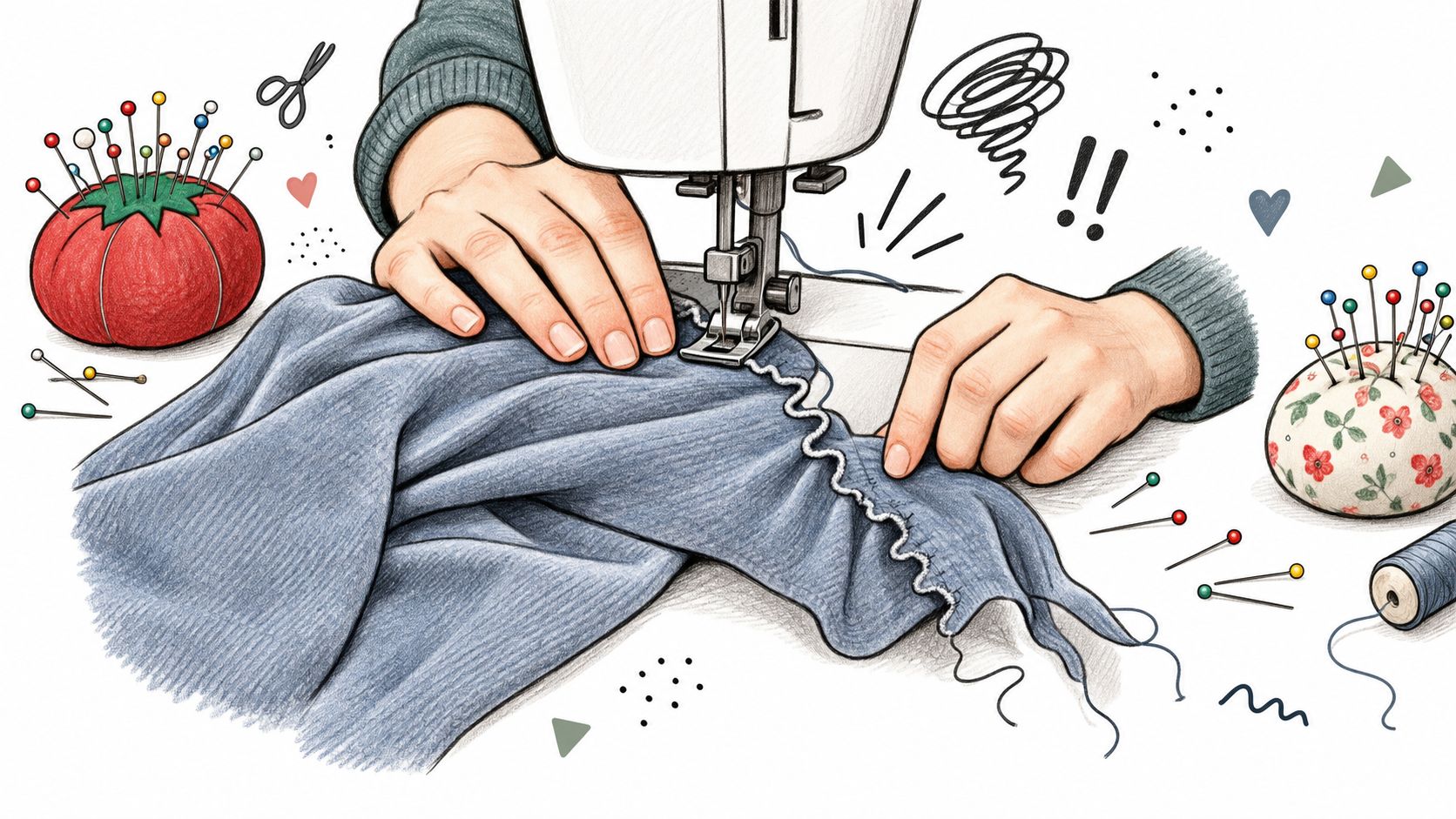
A beginner often blames thread tension after a jersey seam puckers. Tension can contribute, but the deeper problem is mechanical. Woven fabric is built from crossing threads that generally stay put. Knit fabric is made from interlocking loops, so it can stretch, recover, roll, shift, and grow longer while the presser foot moves across it.
That behavior becomes obvious when a standard machine feeds the fabric under a conventional presser foot. The feed dogs move the lower layer while the foot presses the upper layer, and the knit can stretch between those points. A seam that looked smooth while sewing may relax into ripples when released. Washing and repeated wear can reveal even more distortion.
What the loops demand from a machine
A knit seam needs two things at once. It must hold the fabric layers together, and it must extend with the garment instead of snapping when the fabric stretches. A straight stitch often fails the second test because its thread path has little room to expand. A narrow zigzag, stretch stitch, or overlock construction gives the seam more movement.
The edge creates another challenge. Knit fabric doesn't fray like a woven edge, but it can curl, ladder, or lose its shape. An overlock machine controls the edge while joining the layers, trimming excess allowance and enclosing the cut edge in one operation. That combination is why overlock stitching became important in apparel production. The Merrow Machine Company is widely credited with introducing overlock stitching in 1881, then developing an overlock machine in 1889, as documented in this history of serging and overlock development.
Industrial knitwear production adopted the approach long before home sewists had convenient access to it. Sergers entered the clothing industry in the 1920s, while the first home-market serger, the Baby Lock EF-205, appeared in 1967, according to the same historical reference. That gap explains why older home sewing advice often treats knit construction as a workaround rather than a normal garment-sewing task.
Fabric control matters before stitch selection
A machine doesn't need every decorative stitch to sew a good knit seam. It needs controlled feeding, an appropriate needle, and a stitch that can recover with the fabric. A walking foot can help on a regular machine, while differential feed on a serger gives the operator more direct control over how the fabric enters the stitch area.
Stabilizing a shoulder seam or another area that must not grow can also prevent trouble before it starts. Readers who want a focused explanation of that technique can review this guide to prevent fabric stretching with stay stitching. For a practical garment-focused walkthrough, the B-Sew Inn guide to sewing stretch fabrics connects fabric handling with the machine setup and accessories that support it.
Practical rule: A machine that feeds gently and consistently is more valuable for knits than one that simply advertises a long list of stitches.
Which Sewing Machine Type Handles Knits Best
The right machine depends on the garment finish and the fabric's behavior. A regular sewing machine can construct a useful knit garment, but a serger handles seams and edges more efficiently. A coverstitch machine produces a professional hem, but it isn't a substitute for either machine because it doesn't trim and overlock raw edges.
| Machine Type | Best For | Limitations | Typical Price Range |
|---|---|---|---|
| Standard home sewing machine | Repairs, lightweight jersey, occasional knit garments, woven and knit versatility | Requires stretch-capable stitches and careful handling, raw edges need separate treatment | Varies by model and features |
| Serger or overlock machine | T-shirt seams, leggings, edge finishing, fast knit construction | Doesn't replace a general-purpose machine for zippers, buttonholes, and many construction details | Varies by model and thread capacity |
| Coverstitch machine | Stretch hems, sleeve hems, neckline finishing, activewear topstitching | Doesn't cut or overlock raw edges, has a narrower job description | Varies by model and features |
| Standard machine with walking foot or even-feed system | Ponte, stable jersey, controlled topstitching, owners who sew mixed projects | Less efficient than a serger for enclosed seams and edge trimming | Varies by machine and accessory |
Standard machines for occasional knit sewing
A regular home machine is a sensible choice for a sewist who makes occasional T-shirts, pajamas, repairs, or mixed woven-and-knit projects. A narrow zigzag or built-in stretch stitch can allow the seam to move, and a walking foot can reduce layer shifting. This setup is often adequate for lightweight or stable knits when the operator tests the stitch on scraps first.
The limitation appears at the edge. A standard machine won't trim and finish the seam in one pass, so the sewist needs a separate overcast method or a serger. It also takes more care to create a flat, durable hem on highly elastic activewear.
Sergers for construction and edge finishing
A serger is usually the strongest all-around choice for knit garment construction. It joins the layers, trims the seam allowance, and finishes the edge while preserving stretch. Modern sergers may use up to eight threads, while the original industrial overlocker used three, a progression described in this serger equipment guide.
For jersey T-shirts, leggings, underwear, and many loungewear projects, the serger provides a clean inside finish with fewer separate operations. It still doesn't provide every function of a standard machine, so many garment sewists keep both.
Coverstitch machines for the finished hem
A coverstitch machine is designed for the double-needle or multi-needle hem commonly seen on ready-to-wear knit garments. It creates a flexible topstitch on the outside while covering the raw hem edge on the inside. That makes it especially useful for activewear, fitted tops, and garments where the hem receives repeated stretching.
The trade-off is specialization. A coverstitch machine can't cut and overlock a raw seam, so it works alongside a serger or standard machine rather than replacing either one. For occasional knit sewing, a twin needle or narrow zigzag on a regular machine may be a more practical compromise.
Walking feet and even-feed systems
A walking foot, also called an even-feed foot, helps move the upper and lower fabric layers together. It can make a basic machine more capable with ponte, stable jersey, and layered hems, particularly when the fabric tends to creep under the presser foot.
This option suits a sewist who already owns a capable machine and wants better control without adding a specialized machine immediately. It won't provide the trimming, enclosed edge, or production speed of a serger, but it can solve the specific problem of layers shifting during construction. More detail on what a serger does and where it fits appears in this guide to serger machines.
Machine Setup Essentials for Sewing Knits
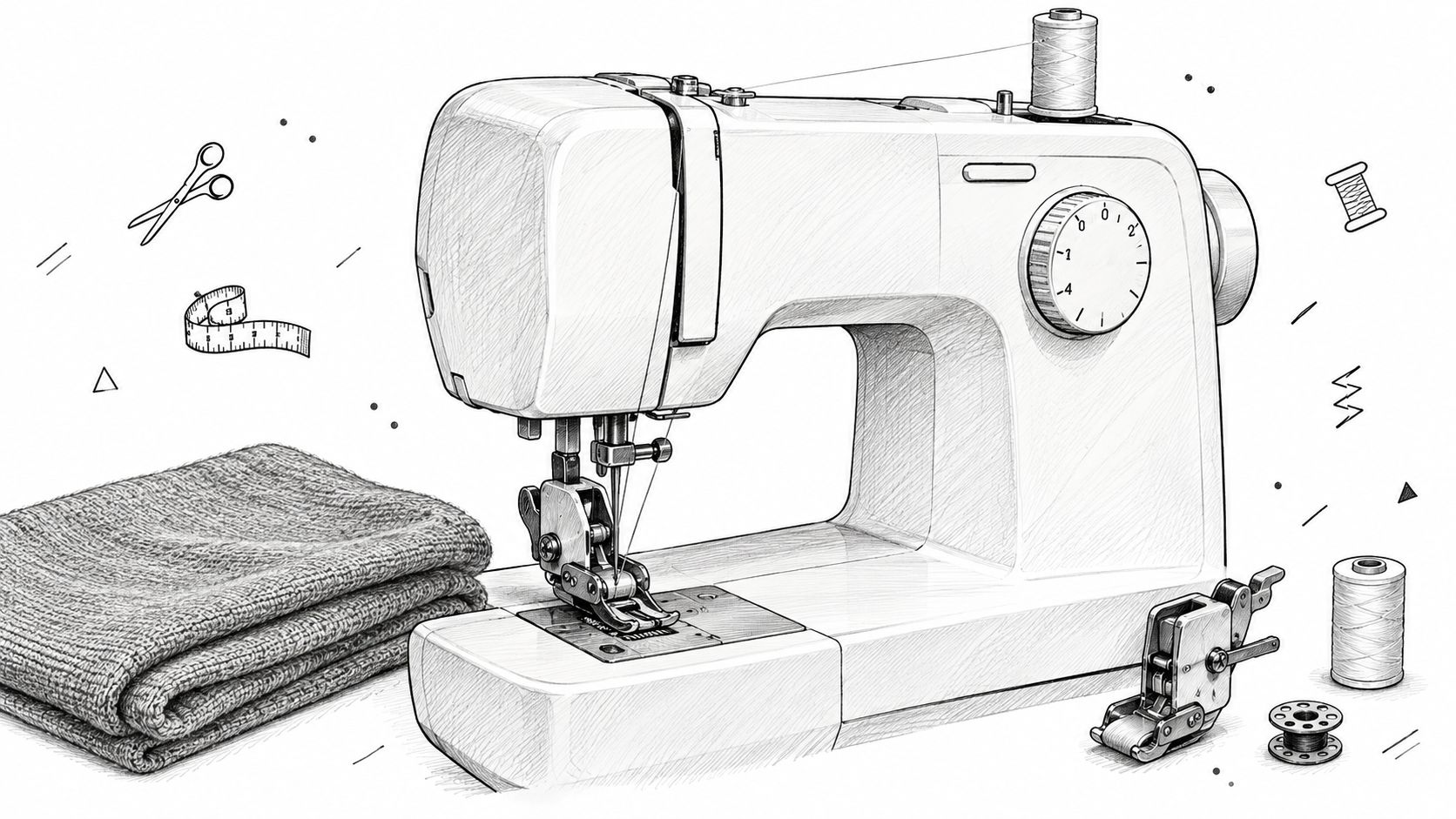
A well-chosen machine can still produce a stretched seam if the setup ignores the fabric. The first test should use a scrap cut from the same area of the fabric, not a different remnant with a different recovery. Lightweight jersey, mid-weight ponte, and highly elastic activewear each need a slightly different balance of needle, pressure, and feeding.
Start with the needle and presser-foot pressure
For a sturdy knit, a universal needle may work. Lighter knits generally benefit from a ballpoint or stretch needle because the rounded point moves between the loops instead of cutting directly through them. A fresh needle also matters. A slightly damaged point can create skipped stitches or holes even when the settings appear correct.
Presser-foot pressure controls how firmly the machine holds the fabric. Too much pressure can stretch a soft jersey as it passes under the foot, creating a wave that remains after the seam is released. If the machine allows pressure adjustment, lower it gradually for lightweight or elastic fabric, then test again. A stable ponte may need less adjustment than a fluid jersey.
The stitch should also match the seam's job. A narrow zigzag or stretch stitch works for a construction seam on a regular machine. A narrow hem stitch can reduce bulk, while a serger stitch provides both joining and edge finishing. A blind hem setting may suit some hems, but it should be tested carefully because the folded edge and stitch movement can behave differently from a simple zigzag.
Use differential feed as a fabric-control dial
On a serger, the normal differential-feed setting is typically 1.0. Raising the setting above 1.0 makes the front feed dogs move fabric faster than the back feed dogs, which helps reduce stretching and rippling in elastic seams, as explained in this differential-feed guide for knit fabric.
For a light jersey that waves only slightly, a small increase above the normal setting may be enough. Mid-weight ponte often needs less correction because it has more body. A highly elastic knit may need a more assertive adjustment, but the fabric should never be forced through the machine. At 2.0, the front feed dogs advance fabric twice as fast as the back feed dogs, which provides a useful test benchmark rather than a universal final setting.
The practical range for knit sewing is about 0.7 to 2.0, according to this even-feed and differential-feed explanation. Values below 1.0 can help manage fabric that bunches or gathers, while values above 1.0 commonly help fabric that stretches and forms waves. The correct setting is the one that produces a flat seam on the actual sample.
Before changing multiple controls, test one variable at a time. A short sample reveals whether the problem comes from feeding, pressure, needle selection, or thread tension. The B-Sew Inn tension adjustment guide can help when the seam remains unbalanced after the fabric is feeding correctly.
The video below shows the kind of setup and handling that helps a sewist evaluate a knit seam before committing to a garment.
Needles, Threads, and Stitch Choices That Matter
A knit seam can look fine on the worktable and fail the first time the garment stretches. The needle, thread, and machine category all affect whether the seam stays flexible, avoids holes, and recovers after wear. Match those choices to the fabric's weight and stretch before judging the stitch list on a machine.
A sharp universal needle can pierce knit loops instead of moving between them. That often produces skipped stitches, tiny holes, or a seam that appears acceptable until the fabric is pulled. For sturdier, lower-stretch knits, a universal needle may work. Lighter or more elastic fabrics usually need a rounded point.
Ballpoint and stretch needles both have rounded points, but they respond to different fabric behavior. Ballpoint needles suit heavier, looser sweater knits, where the needle needs to pass between larger loops. Stretch needles suit highly elastic fabrics such as Spandex or Lycra, where the scarf and eye design help maintain stitch formation as the fabric moves. See this overview of types of sewing machine needles for a closer comparison.
Match the needle to the fabric, not the pattern
The Sewing Industries of America recommends a universal needle for some sturdier knits, while lighter weights need a ballpoint or stretch needle for better stitch formation and less fabric damage. Its guidance also identifies narrow zigzag, stretch stitch, and serger stitch seams as suitable options in this sewing-with-knits guideline.
Threads Magazine makes the same practical distinction between fabric behaviors. Ballpoint needles suit heavier, looser sweater knits, while stretch needles are intended for very elastic fabrics. If a ballpoint needle skips stitches on elastic knit, change the needle before adjusting every tension control, as explained in this needle selection guide for sewing machines.
Inspect the test scrap under tension. A needle that leaves visible holes can mark delicate performance fabric permanently, with the damage becoming clearer after washing or wear. Needle size, plate clearance, and fabric movement under the foot all matter, so test the actual fabric before assembling the garment.
Choose thread for movement
All-purpose polyester thread is a practical default for most knit seams. It has some give, resists ordinary abrasion, and works in both standard machines and sergers. Cotton thread can suit selected projects, but brittle thread is a poor match for a seam that must expand repeatedly.
Elastic thread or woolly nylon can add recovery and softness in high-stress areas, including leg openings, shoulder seams, and close-fitting activewear. These threads need machine-specific handling. Confirm that the machine can tension and form the chosen thread correctly before using it in the finished garment.
Decide whether the seam needs construction or appearance
A narrow zigzag is an accessible choice on a standard machine for light to mid-weight knits with moderate stretch. A stretch stitch allows more movement, although some built-in versions sew slowly and are difficult to remove. For frequent knit construction, a serger combines seam formation with edge finishing and suits garments such as T-shirts and leggings.
A coverstitch is better suited to visible hems on stretchy garments. It provides a professional finish with room for movement, but it does not replace a serger for closing seams or finishing raw edges. Choose according to the fabric and the job: a standard machine can handle occasional stable jersey, a serger suits repeated construction, and a coverstitch earns its place when stretch hems are a regular requirement.
How to Choose the Right Machine at B-Sew Inn
Machine selection becomes clearer when the buyer starts with fabric behavior rather than brand reputation or stitch count. A casual sewist making soft jersey tops may need a reliable standard machine with a walking foot and a stretch-capable stitch. A sewist making fitted activewear regularly will usually appreciate the division of labor between a serger for construction and a coverstitch machine for hems.
The occasional T-shirt maker
For occasional T-shirts, pajamas, and loungewear, a standard machine from a carried line such as Brother, Janome, Bernette, Bernina, or Baby Lock can be a practical foundation when it offers controlled feeding, adjustable presser-foot pressure, and useful stretch stitches. A walking foot and the correct needle may solve the most common problems on stable jersey without requiring a second machine.
This path suits a buyer who also quilts, repairs woven garments, or sews home projects. It becomes less attractive when the sewing queue contains many fitted garments, rolled edges, or highly elastic hems.
The activewear and small-batch garment maker
Activewear brings more demanding fabric behavior. Highly elastic materials need reliable feeding, suitable needle selection, and seams that recover instead of popping. A serger with differential feed is the logical construction machine, while a coverstitch machine handles hems and visible stretch topstitching.
A combination machine can save space, but a separate serger and coverstitch machine may make workflow easier for someone who switches frequently between seam construction and hemming. Buyers should test how easily the machine changes settings, how the presser foot handles thin fabric, and whether the stitch remains even while the fabric is stretched.
The ponte and sweater-knit sewist
Mid-weight ponte and heavier sweater knits reward stability. A strong regular machine with an even-feed system may be enough for ponte trousers, jackets, and structured knit dresses. A serger adds a clean edge finish, especially where the garment's inside will be visible or receive repeated wear.
Loose sweater knits call for a suitable ballpoint needle and careful handling. The machine should not compress the fabric so aggressively that it stretches under the foot. Feed control matters more than decorative capability in this category.
Hands-on testing before a major purchase
A machine can look impressive in an online specification list and still feel wrong with a particular knit. At the dealer's retail stores in Tulsa, Oklahoma City, Springfield, Humble, and Fayetteville, buyers can see and test machines in person, compare feeding behavior, adjust presser-foot control, and inspect stitches on fabric samples before spending several thousand dollars.
The retailer is an authorized sewing, quilting, and embroidery machine dealer, not a manufacturer, and it carries machines from Baby Lock, Bernina, Bernette, Brother, and Janome alongside sergers, coverstitch machines, threads, needles, notions, cabinets, and cutting tables. In-person machine mastery sessions, service, repair, trade-ins, and classes at the retail locations give buyers a way to continue learning after the purchase. The sewing machine buying guide can help organize the decision before a store visit.
A useful test: Bring the fabric that causes trouble at home. A machine that handles the actual slippery jersey or elastic activewear is more informative than one that performs only on a stable sample.
Troubleshooting the Three Most Common Knit Sewing Problems
Skipped stitches, wavy seams, and needle holes have different causes, even though they can appear on the same garment. The fastest diagnosis starts with a new sample, a fresh needle, and fabric cut from the same knit.
Skipped stitches
Start with the needle. Replace a worn universal needle with a ballpoint needle for a heavier or moderately stable knit, or a stretch needle for very elastic fabric. Rethread the machine, check that the thread seats correctly, and test again before changing tension. If the machine skips with the correct needle and properly threaded machine across several samples, timing or servicing may be involved.
Wavy or rippled seams
A wavy seam usually means the fabric stretched while passing through the stitch area. Reduce presser-foot pressure if the machine allows it, add a walking foot on a standard machine, or adjust the serger's differential feed above the normal setting. The operator should guide the fabric without pulling it, because stretching the fabric toward the back only hides the problem until the seam is released.
- Flat seam: Keep the setting and repeat the test after washing.
- Wavy seam: Increase fabric control gradually and retest.
- Gathered seam: Reduce the differential-feed setting or check whether pressure is too high.
Visible needle holes
Large or permanent holes point to a mismatch between needle and fabric, excessive needle size, or poor clearance at the needle plate. A rounded ballpoint or stretch needle can reduce damage, but the plate and presser foot should also be checked for rough spots or an opening that doesn't support the chosen stitch.
Performance knits deserve special care because a hole can remain visible even when the seam itself holds. If a correctly selected needle and careful setup don't solve the damage, a service technician can inspect timing, plate condition, and stitch formation. That is preferable to sacrificing another garment while adjusting controls at random.
B-Sew Inn offers machines, sergers, coverstitch equipment, needles, threads, notions, in-person classes, machine mastery sessions, and service support for knit-fabric sewing. Readers can test machines at stores in Oklahoma, Missouri, Texas, and Arkansas or browse the selection at B-Sew Inn before choosing equipment for jersey, ponte, sweater knit, or activewear.

