

A popped seam on activewear often looks like a sewing mistake. The fabric stretches, the seam opens, and the thread appears to have failed without warning. In many cases, the machine did its job correctly. The problem is that a smooth, conventional thread can't elongate and recover in step with a highly elastic knit.
Wooly nylon thread addresses that mismatch with a textured structure designed for movement. It has a different job from ordinary all-purpose thread, and it also has different machine requirements. The right looper placement, tension, and test process matter just as much as the thread choice.
Table of Contents
- Why Wooly Nylon Is the Secret to Unbreakable Stretch Seams
- Understanding the Unique Properties of Wooly Nylon
- The Golden Rule Using Wooly Nylon in Your Sergers
- Comparing Applications Sergers, Coverstitch, and Regular Machines
- Troubleshooting Common Tension and Threading Issues
- Explore Wooly Nylon and Serger Machines at B-Sew Inn
Why Wooly Nylon Is the Secret to Unbreakable Stretch Seams
A leggings cuff can look perfect when it leaves the machine. After repeated wear and washing, the fabric stretches every time the garment is pulled on, bent, or adjusted. If the seam thread stays comparatively rigid, the fabric moves while the thread resists. Eventually, the thread becomes the weak point and the seam pops open.
That failure isn't always caused by a poor stitch. It often comes from confusing stretch with recovery. A thread may extend under pressure, but if it doesn't return smoothly afterward, it can leave a loose, distorted seam. Wooly nylon is valued because it can stretch with the fabric and recover as the seam relaxes.
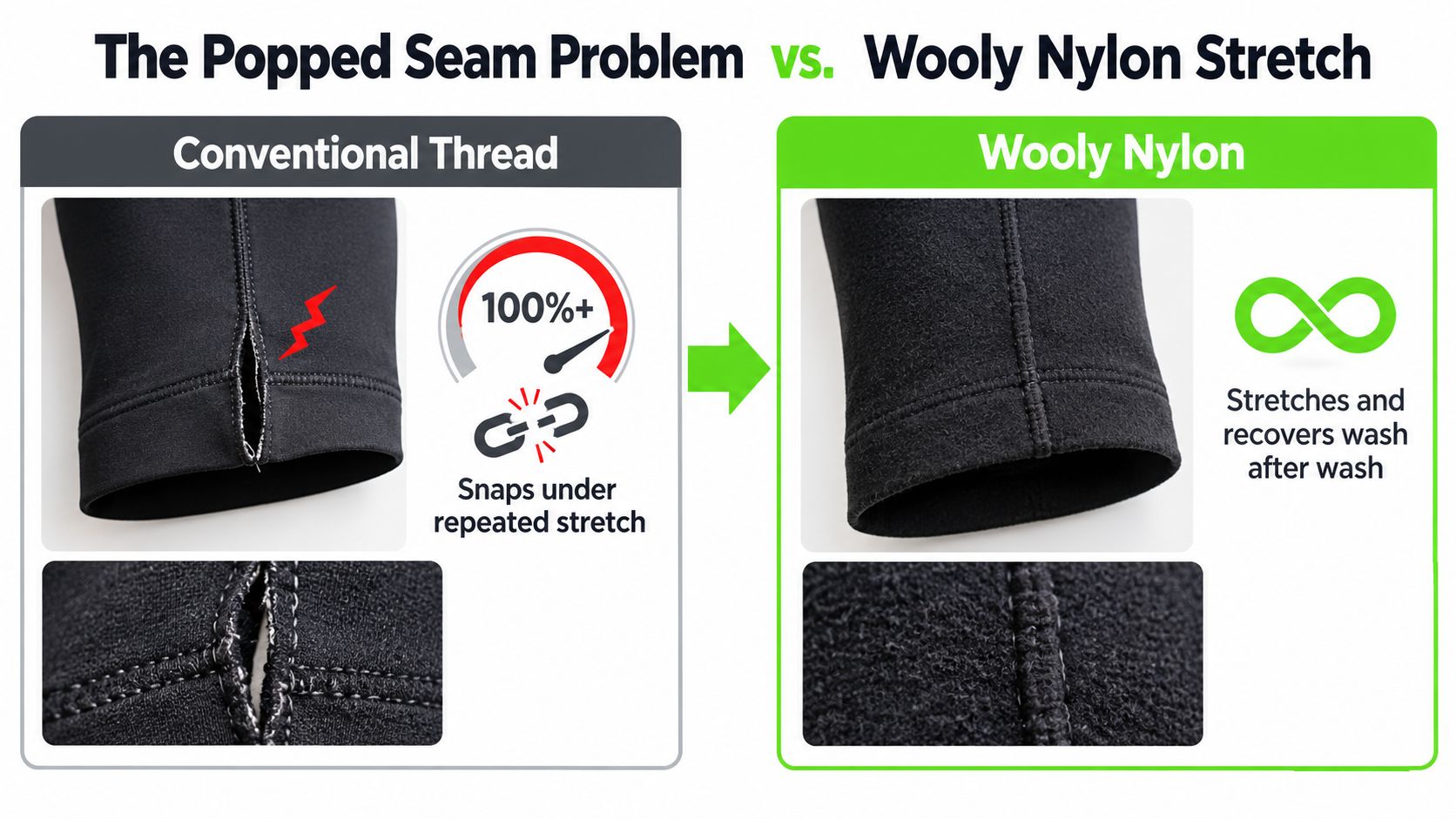
Why ordinary thread becomes the failure point
Wooly nylon is made from continuous nylon filaments that are mechanically crimped and heat-set. That process creates the thread's soft, fluffy appearance while retaining nylon's strength and elasticity, as described in this technical guide to wooly nylon construction.
The crimped filaments act differently from a smooth thread. They compress as the machine forms the stitch, then expand into a fuller, springier line once the stitch settles. That extra movement helps the seam accommodate fabrics such as spandex and other four-way knits.
Practical rule: If the garment needs to stretch repeatedly, the seam thread needs room to move repeatedly.
Sergers and overlock machines made this especially useful for activewear, swimwear, lingerie, and other garments where seam stretch and edge coverage matter. Texturized nylon was already associated with strong, stretchy seams and rolled edges before the current popularity of synthetic sportswear. The category's connection with serger loopers also explains why it can improve a seam without being treated like a standard needle thread.
For additional fabric-handling guidance, the pro minky sewing guide offers useful context on managing stretch materials. A separate stretch-fabric sewing guide can help a sewist evaluate the fabric, stitch, and machine combination before starting a finished garment.
Understanding the Unique Properties of Wooly Nylon
Wooly nylon isn't just a thicker version of ordinary thread. Standard spun thread is made from shorter fibers that are twisted together. Wooly nylon uses continuous filament nylon, then adds mechanical crimping and heat-setting to create a textured, expanded structure.
That construction produces three practical differences:
- Elasticity: The crimped filament can open and close as the seam moves.
- Coverage: The thread expands in the looper path and spreads over the fabric edge.
- Handle: The finished seam feels softer and fuller than one made with a smooth thread.
A smooth serger thread can leave visible gaps between looper stitches, especially on a rolled hem or a curved edge. Textured nylon fills more of that space, which makes it useful when the raw edge needs fuller coverage or when a seam sits against the body.
What the technical measurements mean
Independent technical testing reported about 48.7% elongation before failure and more than 94% recovery after 100 stretch-relax cycles at 30% extension. The same discussion lists a low modulus of elasticity of 185 MPa, compared with 2,800 MPa for standard polyester, and identifies a 30-weight thread as roughly 330 denier with breaking strength of about 1,120 cN. These figures are reported in this technical discussion of wooly nylon for stretch seams.
For the shop-floor decision, the modulus comparison matters more than memorizing the specifications. A lower modulus means the thread yields more readily under load. That helps it follow a knit instead of pulling against it, which is why wooly nylon works well in seams that repeatedly flex.
Weight still matters. A heavier Tex 70 version may suit thicker knits such as ponte, but its additional bulk can increase jamming risk in fine-needle setups. A sewist working with lightweight jersey shouldn't assume that the fullest thread will produce the strongest result. Excess bulk can create poor feeding, crowded thread paths, and an unattractive ridge.
The thread's texture also explains why it isn't a universal replacement for polyester. Smooth standard thread remains useful where a flat, controlled line is preferred. Wooly nylon earns its place when stretch, softness, or edge coverage matters more than a compact appearance.
The Golden Rule Using Wooly Nylon in Your Sergers
The most reliable starting point is simple: place wooly nylon in the serger loopers, not the needles. Keep regular polyester serger thread or another standard thread in the needle positions unless a machine-specific setup calls for something different. This balances the stitch, keeps the needle path less crowded, and lets the textured thread bloom where it provides the most coverage.
The serger threading guide is useful before changing an established setup, especially on a machine with concealed threading paths.
A dependable looper setup
- Raise the presser foot. This opens the tension discs so the replacement thread can seat correctly.
- Inspect the path. Wooly nylon can catch on a guide, cone edge, or partially closed cover. Remove lint and confirm that every looper guide is clear.
- Thread the looper completely. Don't rely on a knot pulled through a complicated path if the knot may snag. A smooth, secure join can work for some looper changes, but a full rethread is safer when the thread path is unfamiliar.
- Leave the needles threaded with standard thread. The needles form the structural part of the stitch, while the loopers provide stretch and coverage.
- Test on the actual fabric. A scrap of the same knit, folded in the same way as the garment, reveals more than a test on woven cotton.
The thread can go in one looper or both, depending on the desired coverage and stitch design. One looper may provide enough softness for a garment seam, while fuller coverage can suit an edge finish. More thread also means more bulk, so a decorative treatment shouldn't automatically be copied onto a flat garment seam.
A rolled hem shows the benefit immediately. The looper thread fluffs across the narrow edge, hiding gaps and creating a soft, rounded finish. A standard smooth thread may leave the fabric peeking through, particularly on a curved hem or a highly elastic knit.
Comparing Applications Sergers, Coverstitch, and Regular Machines
The machine determines where wooly nylon can do useful work. A serger forms the most natural environment because its loopers carry the thread around the edge, allowing the textured filaments to spread over the seam. A coverstitch machine can also benefit from specialty thread in the looper, while a regular sewing machine requires a more controlled bobbin experiment.
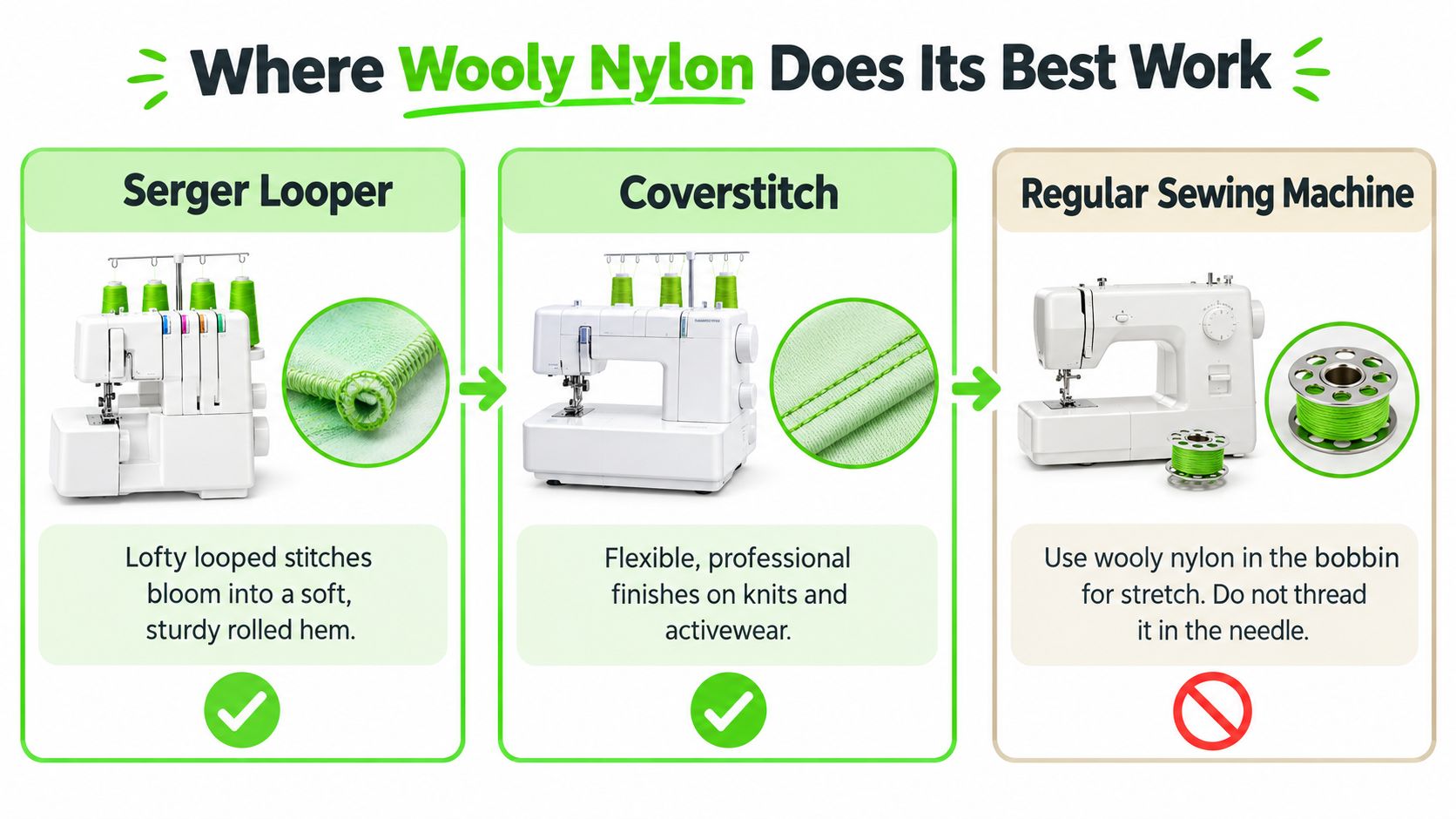
Choosing the machine for the finish
| Machine | Most useful placement | Typical result | Main caution |
|---|---|---|---|
| Serger | One or both loopers | Covered seams, rolled hems, soft edge finishes | Reduce tension as needed and test coverage |
| Coverstitch | Looper position | Flexible hem finishes on knits and activewear | Keep the needle thread path controlled |
| Regular sewing machine | Bobbin for selected stretch work | Added give on the underside of a seam | Don't treat wooly nylon as a routine needle thread |
A serger is the practical choice for an exposed edge that needs both trimming and finishing. Its looper structure lets wooly nylon fill the stitch, making it particularly effective on swimwear edges, activewear seams, lingerie, and rolled hems.
A coverstitch machine is better suited to a folded hem that needs parallel needle lines on the garment face and a flexible looper finish underneath. The result can look professional, but the thread still belongs in the looper rather than being forced through a needle eye designed for a smoother thread.
The regular sewing machine option is more specialized. Wooly nylon can be used in the bobbin when extra stretch is needed, but the machine must be tested carefully. The upper thread should remain a standard thread, and the bobbin case, tension, and stitch selection need to work together. A narrow zigzag or another stretch-compatible stitch may be more forgiving than a rigid straight stitch, depending on the fabric and seam.
The serger and coverstitch machine guide can help a sewist compare the type of finish required before choosing equipment. The best choice depends less on the thread alone than on whether the project needs edge trimming, a folded hem, or a single stitched seam.
Troubleshooting Common Tension and Threading Issues
Wooly nylon often fails during setup, not because the thread lacks capability, but because a machine threaded for smooth polyester is being asked to handle a bulkier, more elastic path. High tension can compress the thread too aggressively. A loose or incomplete path can create loops, nests, or uneven coverage.
Use the following chart as a starting diagnostic rather than a fixed set of machine numbers.
| Visible problem | Likely cause | First adjustment |
|---|---|---|
| Bird's nest under the fabric | Thread isn't seated in the tension path or the looper path is incomplete | Raise the presser foot, rethread, and confirm every guide |
| Tunneling along the seam | Excessive tension or too much thread bulk for the fabric | Lower the wooly nylon tension gradually and test a longer stitch |
| Sparse or inconsistent coverage | Thread isn't expanding evenly or is placed in the wrong path | Check looper threading and confirm the thread isn't snagging |
| Thread breaks during stretching | Tension is too tight or the thread path is obstructed | Reduce tension, inspect guides, and test on a scrap |
| Uneven stitch formation | Needles, thread, and fabric aren't balanced | Keep standard thread in the needles and retest the full combination |
A controlled adjustment protocol
Start with a fresh scrap. The machine should be threaded with the same needle thread, looper thread, fabric layers, and stitch selected for the project. Sew a short sample, stretch it in the direction the finished seam will move, and inspect both sides before changing more than one setting.
Lower tension first. Wooly nylon is highly elastic, so it commonly needs less tension than a standard thread. Large adjustments can hide the cause, so small changes make the result easier to read.
Check the thread path next. A knot that passes through a smooth polyester path may stop at a guide when used with a fluffy thread. A snag can create sudden tight spots, causing breakage in one section and loose loops in another.
Review the needle setup. Wooly nylon's best position is generally the looper. A suitable needle and standard needle thread help preserve stitch structure without forcing the bulky thread through the needle path.
Adjust stitch length only after rethreading. If the seam tunnels, the issue may be tension, excess bulk, or a stitch setting that compresses the fabric. A slightly longer stitch can give a stretchy material more room, but it won't correct an incorrectly threaded machine.
The serger tension adjustment guide can support machine-specific diagnosis. If the machine still nests or breaks thread after a complete rethread and controlled test, a service appointment is more sensible than repeatedly increasing or decreasing every dial.
Explore Wooly Nylon and Serger Machines at B-Sew Inn
A practical setup often includes more than wooly nylon. Standard serger thread for the needle positions, suitable needles, spare bobbins, and fabric scraps give the sewist enough control to isolate a tension problem. The Madeira Thread Chest can complement a broader thread collection, while the Mettler Tin Metrosene 50wt 64 Count is a closeout supply intended for shoppers who want to purchase it before it is gone. Closeout terms should be checked before ordering.
The retailer sells and services sewing, quilting, and embroidery machines from Baby Lock, Bernina, Bernette, Brother, and Janome, along with sergers, coverstitch machines, thread, stabilizer, notions, cabinets, and cutting tables. Sewists can bring a sample of activewear knit, swimwear fabric, or another stretch material to a store in Tulsa, Oklahoma City, Springfield, Humble, or Fayetteville and test machine behavior in person.
That hands-on step matters. A sewist can compare threading access, looper control, stitch visibility, and fabric handling before committing to a machine. In-person machine mastery sessions, classes, service, repair, and trade-ins also provide a route forward when a serger has been sitting unused or a tension problem persists.
The right next step depends on the problem. A new buyer may need to test serger and coverstitch options, while an experienced sewist may only need thread, a class, or service support for an existing machine.
Sewists can browse B-Sew Inn for sergers, coverstitch machines, specialty thread, and related notions, or visit a store to test a stretch-fabric setup in person. A class or service appointment can help resolve persistent threading and tension problems before the next activewear, swimwear, or knitwear project.

