

The quilt top is finished, the batting is smoothed out, and the first line of quilting looks fine until the machine skips a stitch at a seam. Then the thread starts to fuzz. It's tempting to turn the tension dial, but the needle deserves a closer look first.
The right quilting needle size starts with the numbers on the package and ends with a stitch test through the actual quilt layers. Hand needles and machine needles use different numbering systems, so keeping those systems separate prevents an easy purchasing mistake.
Table of Contents
- Machine and Hand Needle Size Chart
- Universal Quilting Sharps Stretch and Ballpoint
- Choosing a Size for Fabric Thread and Batting
- Fix Skipped Stitches Shredding and Holes
- Replace the Needle When the Stitch Changes
- Shop Needles Thread and Feet at B-Sew Inn
Machine and Hand Needle Size Chart
Higher machine numbers mean thicker needles. Higher hand-needle numbers generally mean finer, shorter needles. That distinction matters more than memorizing a favorite size.
On a machine-needle package, the number before the slash is the European metric designation. It describes shaft diameter in hundredths of a millimeter, so 80 means approximately 0.80 mm, while 90 means approximately 0.90 mm, as explained in the sewing machine needle reference. The number after the slash is the corresponding American size, not another measurement of the needle.
A package also identifies the needle type and system. Those details tell the shopper whether the needle suits the fabric and fits the machine. A familiar size alone doesn't establish compatibility.
Machine and hand quilting needle sizes
The chart gives starting jobs, not guaranteed settings. Its machine-size equivalents follow the manufacturer sewing-machine workbook, while the larger longarm package sizes are also listed in the longarm needle guide. The appropriate needle system must still match the machine.
| System | Size on the package | What the number means | Usual starting job |
|---|---|---|---|
| Machine | 70/10 | About 0.70 mm shaft, American 10 | Very fine piecing on lightweight cotton |
| Machine | 75/11 | About 0.75 mm shaft, American 11 | Fine piecing and light quilting with 50-weight thread |
| Machine | 80/12 | About 0.80 mm shaft, American 12 | Everyday piecing and light quilt sandwiches |
| Machine | 90/14 | About 0.90 mm shaft, American 14 | Ordinary quilting with batting and 40-weight thread |
| Machine | 100/16 | About 1.00 mm shaft, American 16 | Thicker batting, dense seams or heavier thread |
| Machine | 110/18 | About 1.10 mm shaft, American 18 | Dense or multiple layers and heavier longarm work |
| Machine | 120/20 | About 1.20 mm shaft, American 20 | Heaviest longarm quilting and resistant materials, where the machine permits |
| Hand between | 7 to 8 | Higher number is shorter and finer | Beginner hand quilting through several layers |
| Hand between | 9 to 10 | Finer than 7 or 8; size 10 may have a larger eye | Smaller stitches once threading is comfortable |
| Hand between | 12 | Shortest and finest common between in this range | Experienced quilters and dense, small stitches |
The hand sizes follow the American Sewing Guild's hand-quilting guidance, which describes betweens in sizes 5 through 12, recommends 7 or 8 for beginners, and notes a larger-eye option in size 10. The thread pairings in the machine rows are practical starting combinations, with eye clearance and fabric resistance determining the final choice.
Why hand needles need their own scale
A between is a short hand-quilting needle. Its compact length helps the quilter control the rocking motion through the quilt layers and form small, even stitches. A longer general-purpose hand needle may feel familiar, but it handles differently.
Hand sizing developed from wire-gauge conventions rather than a direct millimeter measurement. It also isn't fully standardized across needle classes and manufacturers. Matching numbers on different kinds of hand needles don't promise identical dimensions.
Package check: The system name, needle type, and complete size designation belong together. A hand between and a machine needle aren't interchangeable because part of their numbering looks alike.
Smaller isn't automatically better for hand quilting. A needle that's difficult to grip or thread can interrupt stitch rhythm, even if it makes a small hole. Comfort, thread clearance, and the ability to pass through the layers matter more than choosing the finest available needle.
Universal Quilting Sharps Stretch and Ballpoint
Needle size describes thickness; needle type describes the tool's working shape. A correct diameter with the wrong point can still produce disappointing stitches.
The comparison below separates needles that pierce woven fabrics from those designed to pass between knit loops. The distinction matters when a notions drawer contains packages left over from garment sewing.
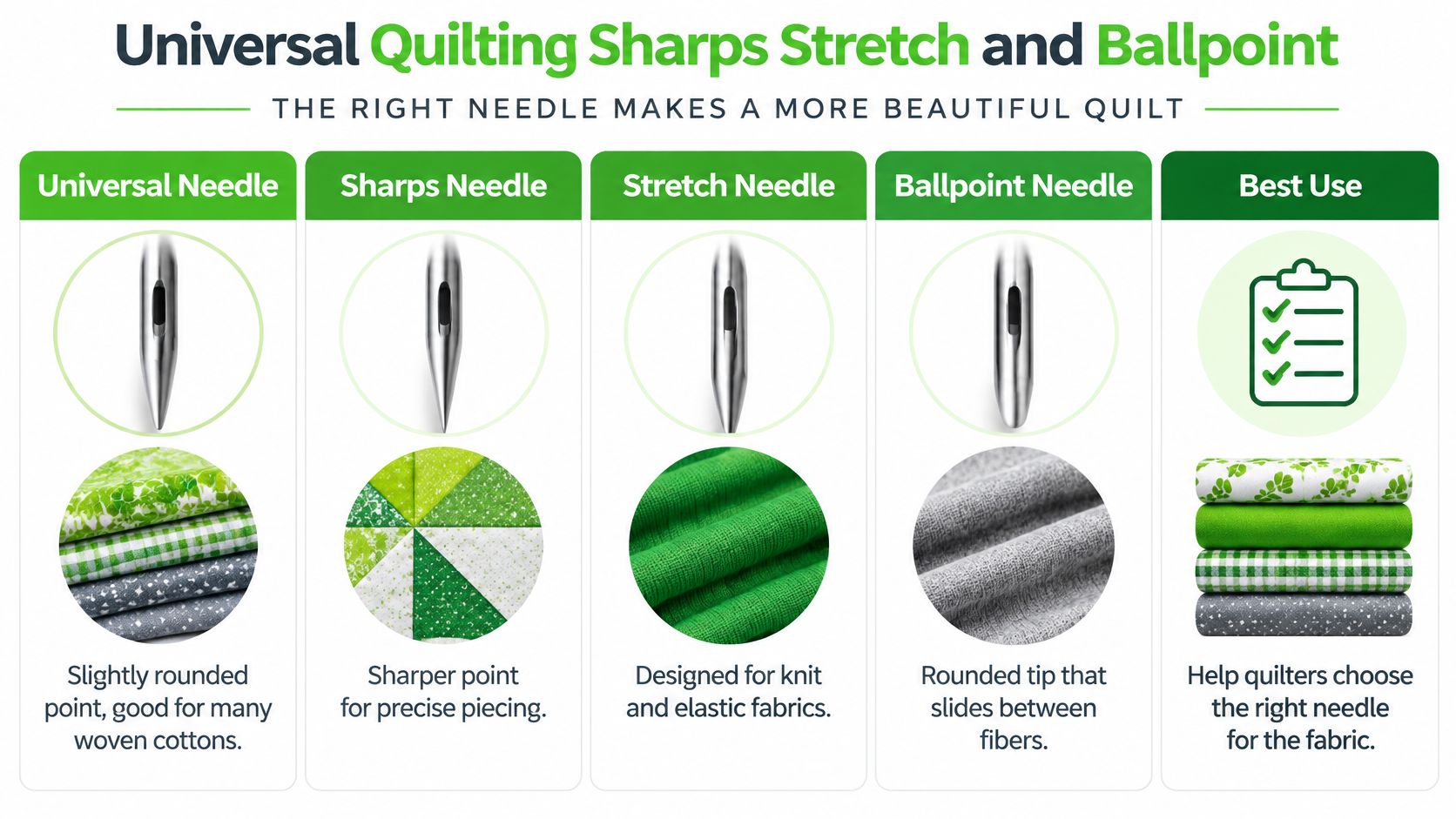
Needle points quilters actually use
| Needle type | Point | Use it for | Do not use it for |
|---|---|---|---|
| Universal | Slightly rounded | Woven cotton piecing and general sewing | Thick quilt sandwiches and knits as a first choice |
| Quilting, 130/705 H-Q | Slim, tapered, slightly rounded | Piecing plus stitching through batting and seams | Stretch knits |
| Sharps or microtex | Acute sharp point | Precise piecing, appliqué and smooth wovens | Knits, and very thick batting if it damages fibers |
| Hand between | Short needle, small eye | Hand quilting small, even stitches | Machine use |
| Stretch or ballpoint | Rounded ball | Jersey and other knits | Quilt cotton and batting as a first choice |
A universal needle is a reasonable starting tool for ordinary woven cotton piecing. A dedicated quilting needle is shaped for the additional resistance of batting and intersecting seams. The sewing-machine needle chart from Sewing.org identifies 75/11 and 90/14 as common quilting sizes and describes their tapered points for layered quilt work.
Sharps suit precise work on smooth wovens, where a clean entry matters. Hand sharps are different tools again: they're longer general-purpose hand needles, rather than the short betweens used for traditional hand quilting.
Match the point before the diameter
Stretch and ballpoint needles belong with knit fabrics. Their rounded tips help separate loops rather than pierce them; a sharp woven-fabric needle can damage those loops. Conversely, a knit-oriented point isn't the sensible first choice for a cotton quilt sandwich.
Walking-foot, free-motion, and longarm quilting describe different methods, not permission to ignore needle type. Each still needs a point and shaft suited to the materials and a system approved for the machine.
The guide to types of sewing machine needles provides another way to sort mixed packages before starting a project. Packages are best stored with their labels, rather than combined in an unmarked container.
Choosing a Size for Fabric Thread and Batting
For fine piecing or lightweight quilting, 75/11 with 50-weight thread is a useful starting combination. For heavier 40-weight thread or greater layer resistance, 90/14 is another practical start, following the technical quilting needle guide.
That isn't a universal thread-weight rule. The Illinois State Board of Education sewing reference gives 75/11 or 80/12 for 40-weight thread and suggests an eye approximately 40 percent larger than the thread diameter. Different recommendations make sense because thread construction, eye shape, fabric, and batting all affect performance.
Starting needle size by quilt job
These are sample-test choices rather than fixed prescriptions. The heavier-thread and longarm rows require particular attention to the machine manual's permitted needle sizes and systems.
| Job | Thread to try | Start size | Move up when |
|---|---|---|---|
| Fine piecing, no batting | 50-weight cotton | 75/11 | Seams stack or the needle bends |
| Everyday piecing | 50-weight cotton | 80/12 | The needle deflects at intersections |
| Light quilting, thin batting | 50-weight | 80/12 | Skips appear on the backing |
| Ordinary quilt sandwich | 40-weight | 90/14, after testing 80/12 | Wool, polyester or dense cotton batting adds resistance |
| Heavier thread or many seams | 30-weight or 28-weight | 100/16 | The eye still shreds thread |
| Longarm or very resistant layers | Heavier quilting thread | 110/18 to 120/20 | The stitch still skips after a new needle, within the machine's approved range |
A larger needle provides more stiffness, but it also makes a larger opening. An eye that's too small can abrade the thread; an unnecessarily thick shaft can leave conspicuous marks in fine cotton.
Batting thickness alone doesn't settle the choice. Lofty batting may compress readily, while a flatter, dense assembly can offer considerable resistance. Seams, backing fabric, quilting density, and machine speed belong in the decision too.
Confirm the choice on the real sandwich
- Build a representative sample. The sample needs the project's top fabric, batting, and backing, including an intersecting seam where possible.
- Use the intended setup. The same thread, presser foot, and quilting method make the test meaningful. Piecing has no batting; walking-foot quilting feeds a sandwich; free-motion work adds hand-guided movement.
- Change only the needle. Holding the other settings steady makes the result easier to interpret.
- Inspect both sides. The smallest suitable needle carries the thread cleanly without skips, fuzz, objectionable holes, or persistent popping.
A successful sample is more useful than a perfect-looking thread-and-needle pairing on paper.
The sewing thread size guide helps distinguish thread labels before testing. Once thread construction and size are settled, Dirt Cheap Headwear's thread matching guide offers useful context for color selection, a separate decision from needle clearance.
Domestic machines from Baby Lock, Bernina, Bernette, Brother, and Janome follow the same diameter logic. Their approved needle systems, however, still require confirmation in the individual machine manual.
Fix Skipped Stitches Shredding and Holes
A skip at a thick seam can look like a tension problem, but the needle may be deflecting as it meets the extra layers. Before adjusting tension, power off the machine and check that the needle faces the correct direction and is fully seated in the clamp.
For ordinary piecing, 75/11–80/12 is a common starting range; for ordinary quilting, 80/12–90/14 is common. Those ranges narrow the choice, but the stitch on your own quilt sandwich is the final check.
Quilt stitch symptoms and the needle change to try
| What you see | Check first | Single change to test |
|---|---|---|
| Skipped stitches | Deflection, dull point, or needle too fine | Try a fresh quilting needle one size larger |
| Thread shredding or fuzz | Eye too small or a burr on the needle | Try a larger eye, often 90/14 for 40-weight thread, and replace the needle |
| Visible holes | Needle thicker than the cloth needs | Try the next size smaller if the thread still passes freely |
| Puckering | Needle hole too large for light fabric | Try a smaller needle, then reassess tension |
| Popping at seams | Bent needle or shaft too fine for the layers | Try a fresh 90/14 or 100/16 |
| New skips after a batting change | Needle may be too fine for the denser sandwich | Retest with a 90/14 or 100/16 |
Treat each adjustment as a controlled trial. Replace a bent needle rather than continuing to sew with it, and stop if the needle strikes the foot or plate.
Read the location of the problem
Skips limited to stacked seams suggest resistance or deflection. If stitches skip across an easy, flat area too, check the needle's condition and installation, then confirm that the machine is threaded correctly and the needle system is compatible.
Fuzz concentrated near the needle eye points to rubbing or a rough surface. Loosening tension won't smooth a burr. If a fresh needle with enough eye clearance still damages the thread, inspect the thread path.
Large holes call for a smaller needle, provided it carries the thread freely. Puckering can also come from tension, fabric handling, or insufficient support, so change the needle first and reassess before making other adjustments.
Troubleshooting discipline: Stitch the same sample after each change. Changing the needle, tension, speed, and foot together makes it hard to tell what helped.
A walking foot must be installed and engaged correctly. With free-motion quilting, guide the sandwich without pulling it sideways against the needle. For other possible causes, see B-Sew Inn's guide to diagnosing skipped stitches. If skips continue after checking installation, needle condition, and threading, have the machine inspected by a qualified technician.
Replace the Needle When the Stitch Changes
An hour count isn't proof that a needle is still sound. The needle-replacement recommendations discussed by SewingTrip include claims of replacement every 6–8 hours or about 10,000 penetrations, but don't describe a controlled, independent test establishing those intervals for every quilting setup.
Light piecing and dense free-motion quilting don't expose a needle to identical conditions. Resistance, accidental impacts, thread abrasion, and the work itself matter. A replacement schedule can serve as a reminder, but it shouldn't overrule visible damage or deteriorating stitches.
Signs that justify a fresh needle
- Bent shaft or impact. A needle that struck a pin, foot, or plate deserves immediate replacement and a check for the cause.
- Roughness or burrs. A damaged eye or point can catch thread even when the machine is threaded correctly.
- Changed sound. New popping or thumping calls for stopping and examining the needle and material resistance.
- Changed stitches. New skips, sudden thread fuzz, enlarged holes, or repeated breakage justify a fresh needle before further adjustment.
A needle doesn't need to look dramatically bent to be unsuitable. Small damage can be difficult to see without magnification, so a known-fresh needle is a useful diagnostic tool.
Coatings aren't a replacement policy
A premium coating isn't a reason to ignore stitch changes. Claims about longer life need comparable conditions, including the machine, thread, fabric, and batting. Without that context, a percentage improvement doesn't tell a quilter how long the needle will perform on a particular project.
For high-volume work, planned replacement at the start of a substantial project can reduce the risk of carrying an already worn needle into a finished top. The schedule should reflect actual workload, with immediate replacement whenever damage appears.
A fresh needle should match the successful sample setup, not simply be the last unused needle in the drawer.
Keeping labeled spares prevents an unnecessary change of both condition and size during troubleshooting. The replacement needle guide can help organize that purchase around machine compatibility rather than appearance alone.
Shop Needles Thread and Feet at B-Sew Inn
A needle size that looks right on the package still needs to work with your machine, thread, and quilt sandwich. Bring your machine model, the needle package, thread label, and a stitched sample when asking for help. That gives you a practical starting point for choosing compatible supplies.
B-Sew Inn sells sewing, quilting, and embroidery machines, along with accessories and supplies. Its range includes sewing, embroidery, serger and coverstitch, and long arm quilting machines, as well as sewing and quilting thread, embroidery thread, serger thread, and presser feet for sewing, serger, and long arm machines.
Bring the setup, not just the size
A sample can show whether the needle and thread made clean stitches in your actual fabric and batting. If a section has skipped stitches or rough thread, bring that area too. The quilting supplies checklist can help you gather needles, thread, feet, and other project supplies.
For questions about machine use, B-Sew Inn offers instructional events and classes. If a fresh, compatible needle and a sound setup do not resolve a persistent machine problem, ask about service options.
Foot compatibility matters alongside needle compatibility. A foot designed for one machine configuration may not fit another, even if both machines can sew a straight line.
Test a larger quilting setup in person
If you are considering a larger quilting machine, hands-on assessment can help you judge visibility around the needle, room for the quilt sandwich, and how the controls feel. Try the quilting method you expect to use, and bring a sample sandwich if possible. These practical checks can make machine features easier to compare than specifications alone.
B-Sew Inn sells long arm quilting machines and systems, including sit-down, computerized, and high-speed models. Visit B-Sew Inn to shop needles, thread, and compatible presser feet, or explore its instructional offerings.

